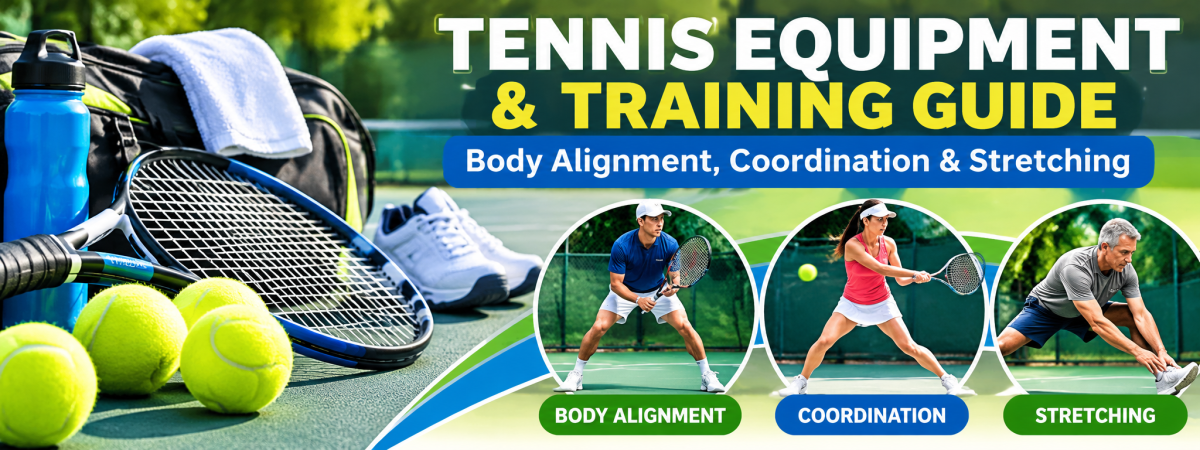
Tennis Equipment and Training Guide: Body Alignment, Coordination, Footwork, and Stretching
Tennis is a sport that combines physical fitness, coordination, balance, timing, concentration, and tactical decision-making. Whether you are learning your first forehand or preparing for competitive recreational matches, understanding the fundamentals can help you practice more effectively.
The right tennis equipment supports comfortable movement, while correct footwork and body coordination help you reach the ball and execute controlled shots. Stretching, mobility exercises, and progressive strength training can also support your ability to remain active and enjoy tennis over the long term.
This complete guide explains the essential equipment, training materials, body alignment principles, practical exercises, and practice routines that basic and intermediate players can use to improve their tennis skills.
1. Essential Tennis Equipment and Its Functions
You do not need expensive equipment to begin learning tennis. Start with items that support comfort, safety, and consistent practice.
1.1 Tennis Racket
The tennis racket is the primary tool used to hit the ball. Its weight, head size, grip size, balance, and string setup influence how it feels and performs.
Main functions:
-
Allows players to execute forehands, backhands, serves, volleys, and overheads.
-
Helps control ball direction, spin, and depth.
-
Provides a connection between the player's movement and the ball.
Beginner recommendation: Choose a comfortable racket that is easy to maneuver. Avoid selecting a racket based only on power or professional-player endorsements.
Intermediate recommendation: Evaluate racket weight, balance, string type, and string tension based on your playing style and comfort. Players experiencing persistent arm discomfort should consider their technique and equipment together.
1.2 Tennis Balls
Tennis balls are used for rallying, serving, groundstroke practice, and match play.
Main functions:
-
Develop timing and hand-eye coordination.
-
Improve ball control and shot consistency.
-
Allow players to practice different speeds, heights, and trajectories.
Beginners can benefit from low-compression balls, which generally travel more slowly and provide additional time to prepare. Use balls appropriate for the player's ability and the court surface.
1.3 Tennis Shoes
Tennis involves repeated acceleration, deceleration, lateral movement, and changes of direction. Ordinary running shoes may not provide the same lateral stability as court-specific tennis shoes.
Main functions:
-
Provide traction for court movement.
-
Support lateral stability and controlled stopping.
-
Offer cushioning and comfort during repeated movement.
Choose shoes suited to hard courts, clay courts, or other playing surfaces. Proper fit is important, particularly around the heel, forefoot, and toes.
1.4 Racket Grip and Overgrip
The grip is the section of the racket handle held by the player. An overgrip can improve comfort and help manage sweat.
Main functions:
-
Support a comfortable racket hold.
-
Help players maintain consistent grip pressure.
-
Improve traction when hands become sweaty.
Avoid squeezing the racket unnecessarily hard throughout a rally. Excessive gripping can increase forearm fatigue and interfere with smooth racket movement.
1.5 Tennis Clothing and Accessories
Breathable shirts, shorts, socks, caps, visors, wristbands, and towels help players manage sweat and remain comfortable.
Main functions:
-
Improve comfort during long sessions.
-
Help manage sweat.
-
Provide some protection from direct sunlight when appropriate clothing and accessories are used.
For outdoor tennis, combine suitable clothing with sunscreen, shade during breaks, and regular hydration.
1.6 Water Bottle
Hydration is particularly important during tennis in hot and humid conditions.
Main functions:
-
Makes fluids available during practice.
-
Helps players replace fluid lost through sweating.
-
Supports a consistent hydration routine.
Drink regularly rather than waiting until you feel extremely thirsty. Longer sessions and heavy sweating may require additional fluids and electrolytes.
1.7 Tennis Bag
A tennis bag organizes your equipment and makes it easier to prepare for training.
Consider carrying:
-
Racket and spare overgrip.
-
Tennis balls.
-
Water bottle.
-
Towel and spare socks.
-
Sunscreen and a cap.
-
Any personally needed first-aid supplies.
2. Tennis Training Materials and Their Functions
Training materials help players practice specific skills instead of relying entirely on ordinary rallies.
2.1 Training Cones and Flat Markers
Place cones or flat markers around the court to create movement routes and visual targets.
Training benefits:
-
Practice lateral movement and recovery.
-
Improve positioning and movement decisions.
-
Establish target areas for groundstrokes.
-
Develop controlled changes of direction.
Start with short distances and simple movement patterns. Increase speed only after you can maintain balance and control.
2.2 Agility Ladder
An agility ladder provides marked spaces for footwork exercises.
Training benefits:
-
Develop rhythm and foot placement.
-
Practice coordinated stepping patterns.
-
Improve awareness of lower-body movement.
An agility ladder is not essential for tennis improvement. On-court split-step practice and realistic movement drills are often more directly relevant to tennis situations.
2.3 Ball Basket or Hopper
A ball basket stores multiple balls for repeated practice.
Training benefits:
-
Makes serving practice more efficient.
-
Allows repeated forehand and backhand drills.
-
Helps coaches feed balls to specific locations.
-
Reduces interruptions between repetitions.
Focus on the quality of each repetition instead of simply hitting as many balls as possible.
2.4 Rebound Net or Practice Wall
A suitable practice wall or rebound net returns the ball to the player.
Training benefits:
-
Develops timing and consistency.
-
Encourages early racket preparation.
-
Improves control of groundstrokes and volleys.
-
Allows independent practice without a partner.
Begin at a manageable distance and use controlled shots. Move farther away or increase the pace as your consistency improves.
2.5 Resistance Bands
Resistance bands can be used for controlled exercises involving the shoulders, upper back, hips, and legs.
Training benefits:
-
Support progressive strength training.
-
Develop control during shoulder rotation exercises.
-
Provide resistance for hip and leg exercises.
-
Complement on-court training.
Use resistance that allows smooth movement without pain. Resistance bands are training tools, not a substitute for proper stroke technique or professional assessment when symptoms persist.
2.6 Exercise Mat and Foam Roller
An exercise mat provides a comfortable surface for mobility, balance, and core exercises. A foam roller may provide temporary relief from muscle soreness.
Training benefits:
-
Supports floor-based core exercises.
-
Provides a stable surface for mobility work.
-
Helps organize recovery routines.
Foam rolling does not correct structural alignment by itself. Use it as an optional comfort tool rather than a replacement for strength and mobility training.
2.7 Stopwatch, Sports Watch, and Phone Camera
These tools help players monitor practice and review their technique.
Training benefits:
-
Time warm-ups and drills.
-
Track work and rest intervals.
-
Record practice sessions.
-
Review racket preparation, footwork, and recovery movements.
Video recordings from the side and behind can help identify technique patterns that are difficult to notice while playing.
3. Body Coordination and Alignment in Tennis
Body coordination is the ability to combine movements smoothly. Body alignment describes how body segments and joints are positioned in relation to one another during a movement.
In tennis, good movement involves the feet, knees, hips, trunk, shoulders, arms, and racket working together. There is no single perfect alignment for every shot because the incoming ball, stance, and tactical situation change throughout a match.
The objective is to maintain useful balance, move efficiently, and avoid unnecessary strain.
3.1 Feet and Foot Placement
The feet create the foundation for tennis movement.
Important principles:
-
Begin in a balanced ready position.
-
Use a split step as your opponent prepares to hit.
-
Take adjustment steps to find a comfortable distance from the ball.
-
Avoid reaching excessively when you can move into position.
-
Recover after each shot.
A player who arrives at the ball with good spacing often has more options than a player who reaches awkwardly with the racket.
3.2 Knees and Hips
The knees and hips help players absorb movement, change direction, and generate force.
Important principles:
-
Use comfortable knee flexion.
-
Keep the knees controlled during stops and changes of direction.
-
Coordinate hip rotation with the swing.
-
Avoid forcing deep knee bends or extreme rotations.
The goal is not to keep the knees bent as deeply as possible. Instead, adjust your body position to the ball while maintaining balance and comfort.
3.3 Torso and Trunk Rotation
The trunk helps coordinate the lower body and upper body during strokes.
Important principles:
-
Prepare your shoulders early.
-
Coordinate torso rotation with your legs and arms.
-
Maintain control during the swing.
-
Avoid trying to generate every shot using only the arm.
The amount of rotation varies with the stroke. A serve, forehand, volley, and defensive slice do not require identical body movements.
3.4 Shoulders and Arms
The shoulders and arms guide racket preparation, the swing, and follow-through.
Important principles:
-
Prepare the racket early.
-
Use a comfortable and controlled swing.
-
Avoid excessive muscular tension.
-
Do not force painful shoulder positions.
Shoulder strength and mobility are particularly relevant for serving and overhead strokes. Players with persistent shoulder pain should seek an appropriate professional assessment.
3.5 Head Position and Ball Tracking
Tracking the ball allows the player to estimate its trajectory, speed, and bounce.
Important principles:
-
Watch the ball approach.
-
Recognize whether it is short, deep, high, or wide.
-
Maintain comfortable head and trunk control.
-
Adjust your feet before the contact point becomes difficult.
Do not make the body rigid in an attempt to keep the head perfectly still. Natural movement is part of an effective tennis stroke.
3.6 Contact Point and Racket Face
The contact point is where the racket meets the ball. The racket face and swing path influence direction, spin, and trajectory.
Important principles:
-
Reach a comfortable hitting distance.
-
Adjust to the height and direction of the incoming ball.
-
Prepare the racket before the ball arrives.
-
Control the racket face toward your intended target.
-
Avoid unnecessary reaching or forced wrist movements.
The contact point differs between forehands, backhands, serves, volleys, and defensive shots. Technique should be adapted to the situation rather than forced into one position.
3.7 Recovery and Court Position
Recovery is the movement that follows a shot and prepares you for your opponent's next reply.
Important principles:
-
Finish the shot under control.
-
Regain balance when necessary.
-
Recover toward a position that covers likely opponent responses.
-
Prepare your racket for the next shot.
Returning to the exact center of the court is not always the best decision. Your recovery position depends on your shot direction, your opponent's position, and the angles they can use.
4. Understanding the Tennis Kinetic Chain
The kinetic chain describes how different parts of the body coordinate to produce and transfer movement.
During a forehand, a typical sequence includes:
-
Read the ball: Recognize the incoming ball's direction, height, speed, and bounce.
-
Move into position: Use a split step and adjustment steps to establish suitable spacing.
-
Prepare the racket: Turn and position the body according to the shot.
-
Coordinate the swing: Combine lower-body movement, trunk rotation, and arm action as appropriate.
-
Make contact: Control the contact point and racket face.
-
Finish comfortably: Allow the swing to continue naturally.
-
Recover: Regain a useful court position and prepare for the next ball.
This sequence is a practical teaching framework rather than a rigid formula. Different shots require different movement patterns.
The central lesson is that efficient timing and coordination matter more than simply trying to hit harder. Players should develop technique gradually and avoid forcing movements that cause pain.
5. Tennis Stance and Alignment: Open, Closed, and Neutral
Understanding stance helps players adapt to different balls.
5.1 Neutral or Square Stance
In a neutral stance, the feet are positioned more across the direction of the intended shot, with the body generally turned sideways during preparation.
Useful situations:
-
Learning groundstroke fundamentals.
-
Hitting a comfortable ball with sufficient time.
-
Practicing weight transfer and controlled rotation.
5.2 Open Stance
In an open stance, the feet face more toward the net rather than being positioned fully sideways.
Useful situations:
-
Handling wide balls.
-
Recovering quickly after a groundstroke.
-
Hitting when there is limited time to move into a neutral stance.
An open stance still requires balance and appropriate body rotation. It does not mean standing upright and swinging only with the arm.
5.3 Closed Stance
In a closed stance, the player steps across the body more toward the intended direction of the shot.
Useful situations:
-
Certain approach shots.
-
Moving forward to attack a shorter ball.
-
Specific tactical or positional situations.
No stance is best for every ball. Good players learn to choose a stance that fits the incoming shot, available time, and court position.
6. Footwork Drills for Basic and Intermediate Players
Drill 1: Ready Position and Split Step
Purpose: Improve readiness and reaction to the opponent's shot.
How to practice:
-
Stand in a balanced ready position with the racket in front.
-
Keep your knees comfortably flexed.
-
Perform a small split step as your partner prepares to hit.
-
Move toward the anticipated direction of the ball.
-
Recover and repeat.
Suggested practice: Two sets of 8–10 controlled repetitions.
Drill 2: Lateral Movement and Recovery
Purpose: Improve movement to either side and preparation for the next ball.
How to practice:
-
Place two flat markers several steps apart.
-
Begin in the ready position between them.
-
Move laterally toward one marker.
-
Simulate a balanced shadow stroke.
-
Recover toward the starting area.
-
Repeat on the opposite side.
Suggested practice: Two sets of 6 repetitions per side.
Drill 3: Forehand and Backhand Shadow Swings
Purpose: Develop racket preparation and coordination without the pressure of hitting a moving ball.
How to practice:
-
Start in a comfortable ready position.
-
Turn the body to prepare the stroke.
-
Practice moving into the contact position.
-
Complete the swing comfortably.
-
Recover to the ready position.
Suggested practice: 8–10 repetitions per side.
Drill 4: Target Hitting
Purpose: Improve direction and control.
How to practice:
-
Place flat markers in safe target areas inside the court.
-
Rally at a manageable pace.
-
Aim toward the selected target.
-
Prioritize depth and consistency before increasing speed.
-
Track how often you reach the intended area.
Suggested practice: Two rounds of 10 balls.
Drill 5: Hit and Recover
Purpose: Connect stroke technique with tactical court positioning.
How to practice:
-
Begin in a balanced ready position.
-
Hit a controlled ball toward a target.
-
Recover according to the direction of your shot.
-
Prepare for the next feed.
-
Repeat with forehands and backhands.
Suggested practice: Two sets of 6–8 balls.
Start slowly and increase intensity only when you can perform the movements with good control. The suggested repetitions are starting points, not mandatory targets.
7. Stretching, Mobility, and Strength for Tennis
A warm-up prepares the body for activity. Mobility exercises help players move comfortably, while strength training supports the physical demands of tennis.
7.1 Dynamic Warm-Up
Before playing, begin with approximately 5–10 minutes of light activity, adjusted to your fitness level.
Possible exercises include:
-
Brisk walking or easy jogging.
-
Gentle arm circles.
-
Controlled torso rotations.
-
Comfortable leg swings.
-
Light lateral steps.
-
Gradual practice swings.
Start with easy movement and increase intensity progressively.
7.2 Calf and Ankle Mobility
The calves and ankles contribute to pushing off, stopping, and changing direction.
Try controlled ankle movements and gentle calf raises while holding a stable support if needed.
Purpose: Prepare the lower legs for court movement and develop basic strength and control.
7.3 Hip Mobility
Gentle leg swings and controlled hip movements help prepare the body for changing direction and reaching different balls.
Purpose: Support comfortable hip movement during footwork and groundstrokes.
Avoid forcing a stretch or bouncing aggressively at the end of your range.
7.4 Shoulder Preparation
Light resistance-band exercises and comfortable shoulder movements can be included in a warm-up or strength routine.
Purpose: Develop shoulder control and support the demands of racket movement.
Avoid heavy resistance immediately before playing or forcing the shoulder into painful positions.
7.5 Balance Training
Try standing on one leg near a stable support or practicing controlled weight shifts.
Purpose: Develop balance and awareness of body position.
Begin with short, comfortable intervals. Progress to more challenging exercises only when you can perform them safely.
7.6 Core Stability
Exercises such as bird dogs, dead bugs, and modified planks can develop trunk strength and control.
Purpose: Support coordinated movement during strokes and changes of direction.
Use appropriate exercise variations and stop if an exercise causes pain.
7.7 Static Stretching After Practice
When the body is warm, gentle static stretches may be useful for maintaining flexibility.
Possible areas include:
-
Calves.
-
Hamstrings.
-
Hip flexors.
-
Chest and shoulders.
Stretch comfortably without bouncing or forcing the joint. Static stretching is not a guarantee against injury, and it should complement rather than replace appropriate strength and movement training.
8. Basic vs. Intermediate Tennis Training
Basic players should prioritize:
-
Comfortable racket handling.
-
Consistent contact with the ball.
-
Forehand and backhand fundamentals.
-
Ready position and split-step timing.
-
Safe movement and recovery.
-
Learning the rules and scoring system.
Intermediate players should prioritize:
-
More consistent depth and direction.
-
Adaptable stance and contact point.
-
Better movement to wide and deep balls.
-
Serve and return consistency.
-
Tactical shot selection.
-
Recovery positioning and point construction.
Progression should be based on skill and comfort, not simply the number of months spent playing.
9. A Practical 30-Minute Tennis Training Routine
Minutes 1–5: Warm-Up
Walk briskly, perform gentle arm circles, rotate the torso comfortably, and practice controlled leg swings.
Minutes 6–10: Footwork
Practice the ready position, split step, short lateral movements, and recovery steps.
Minutes 11–20: Groundstrokes
Practice forehands and backhands with a partner, coach, or practice wall. Prioritize consistent contact, spacing, and balance.
Minutes 21–25: Target and Recovery Drills
Aim toward safe court targets and recover after each shot. Focus on making a good decision before increasing pace.
Minutes 26–30: Cool-Down
Walk slowly, breathe comfortably, and perform gentle stretches if appropriate.
For longer sessions, add rest and hydration breaks. Adjust the routine to your physical condition and experience.
10. A Weekly Tennis Training Plan
The following example combines tennis skills with movement and recovery. Adjust the schedule to your availability and fitness.
Day 1 — Groundstroke fundamentals
-
Forehand and backhand practice.
-
Contact-point drills.
-
Controlled target hitting.
Day 2 — Mobility and general strength
-
Gentle mobility exercises.
-
Balance practice.
-
Appropriate core and resistance-band exercises.
Day 3 — Footwork and court positioning
-
Split-step practice.
-
Lateral movement.
-
Hit-and-recover drills.
Day 4 — Rest or light activity
-
Walking or other comfortable activity.
-
Recovery and sleep.
Day 5 — Serve, return, and tactical practice
-
Controlled serve practice.
-
Return positioning.
-
Directional targets and point construction.
Day 6 — Recreational match play
-
Apply your technique during friendly singles or doubles.
-
Concentrate on consistency and tactical decisions.
Day 7 — Rest or gentle mobility
-
Review your progress.
-
Identify one skill to practice the following week.
This is an example, not a requirement to play six days per week. Reduce the schedule if you are new to exercise, returning after a break, or experiencing unusual fatigue.
11. Tennis Training Considerations for Adults Aged 40–75
Tennis can remain an enjoyable activity throughout adulthood. Training should reflect individual fitness, experience, mobility, balance, and recovery needs rather than age alone.
Useful principles include:
-
Warm up before intense play.
-
Increase training volume and speed gradually.
-
Wear suitable court shoes.
-
Use controlled footwork before attempting high-speed direction changes.
-
Include strength and balance exercises appropriate to your ability.
-
Take rest breaks in hot weather.
-
Maintain hydration.
-
Allow sufficient recovery between demanding sessions.
-
Seek professional guidance for persistent pain or significant movement limitations.
Players with existing health concerns or a history of injury may benefit from an individualized exercise plan from an appropriately qualified healthcare or fitness professional.
Stop exercising and seek urgent medical attention if you develop chest pain, fainting, or severe or unusual shortness of breath.
12. Tennis Equipment Checklist for Beginners
Before heading to the court, check that you have the following essentials:
-
Comfortable tennis racket.
-
Tennis balls suitable for your skill level.
-
Court-specific tennis shoes.
-
Comfortable clothing and socks.
-
Water bottle.
-
Towel and sun protection.
-
Optional training cones or flat markers.
-
Optional resistance bands for suitable exercises.
-
Optional exercise mat for off-court training.
You can build your training kit gradually. A good racket, appropriate shoes, balls, and consistent practice are more important than purchasing every training accessory at once.
13. Frequently Asked Questions About Tennis Training
What equipment does a beginner need to play tennis?
Start with a comfortable racket, tennis balls, suitable court shoes, comfortable clothing, and a water bottle. Cones and resistance bands can be added later for specific drills.
How can I improve my tennis body coordination?
Practice balanced ready positions, split steps, shadow swings, and controlled groundstrokes. Work on moving your feet into position before swinging, and recover after each shot.
Why is body alignment important in tennis?
Good body positioning helps players maintain balance, reach the ball effectively, and coordinate their movements. It can also reduce unnecessary strain, although no technique can eliminate all injury risk.
Is stretching necessary before tennis?
A gradual warm-up with light activity and dynamic movements is generally appropriate before playing. Gentle static stretching can be included after practice or in separate flexibility sessions.
How often should beginners practice tennis?
Two or three manageable sessions per week can be a useful starting point for many beginners. The appropriate frequency depends on fitness, recovery, existing activity, and session intensity.
Can adults aged 50, 60, or 70 still improve their tennis skills?
Yes. Adults can continue learning and improving tennis skills at different ages. Training should be adapted to individual ability, with attention to balance, strength, movement control, recovery, and comfort.
Does expensive tennis equipment automatically improve performance?
No. Equipment should fit your needs and playing level. Consistent practice, sound technique, appropriate footwear, and effective decision-making are essential parts of improvement.
Conclusion: Build Better Tennis Through Coordination and Consistency
Improving at tennis begins with understanding how equipment, movement, balance, and technique work together.
Beginners should concentrate on learning the basic strokes, controlling the ball, developing footwork, and building confidence. Intermediate players can progress toward more consistent shot placement, adaptable stances, effective recovery, and tactical awareness.
A thoughtful training routine does not need to be complicated or expensive. Begin with the essentials, practice regularly, progress gradually, and pay attention to how your body responds.
The goal is not simply to hit harder. It is to move efficiently, make better decisions, control the ball, and enjoy tennis for years to come.