Every powerful tennis serve begins with a healthy shoulder. But when pain develops every time you reach overhead, many players assume it's simply muscle soreness. In reality, it could be Shoulder Impingement Syndrome—one of the most common orthopedic injuries treated in the United States.
According to orthopedic organizations such as the American Academy of Orthopaedic Surgeons (AAOS), shoulder impingement is among the leading causes of shoulder pain and is particularly common in adults over 40 and athletes who perform repetitive overhead motions, including tennis players, swimmers, volleyball players, and baseball pitchers.
If left untreated, what begins as simple inflammation may progress to chronic tendon damage or even a rotator cuff tear.
A Real USA Sports Medicine Case
A 47-year-old recreational tennis player from Florida visited an orthopedic sports medicine clinic after six months of worsening right shoulder pain.
Initially, the discomfort appeared only after long matches.
Soon, every serve caused pain.
Eventually, even sleeping on his right side became impossible.
Simple daily activities like reaching into a kitchen cabinet or fastening a seatbelt produced sharp pain.
MRI imaging later revealed chronic subacromial impingement with inflammation of the bursa and early supraspinatus tendinopathy—but fortunately no complete tendon tear.
After a structured rehabilitation program, gradual strengthening, and corrections to his serving mechanics, he returned to recreational tennis without surgery.
Cases like this are common across the United States and illustrate why early treatment is so important.
What Is Shoulder Impingement Syndrome?
The shoulder is designed for extraordinary mobility.
Unlike the hip joint, it sacrifices stability to allow a tremendous range of motion.
This flexibility allows tennis players to serve, smash, and generate topspin.
However, it also creates vulnerability.
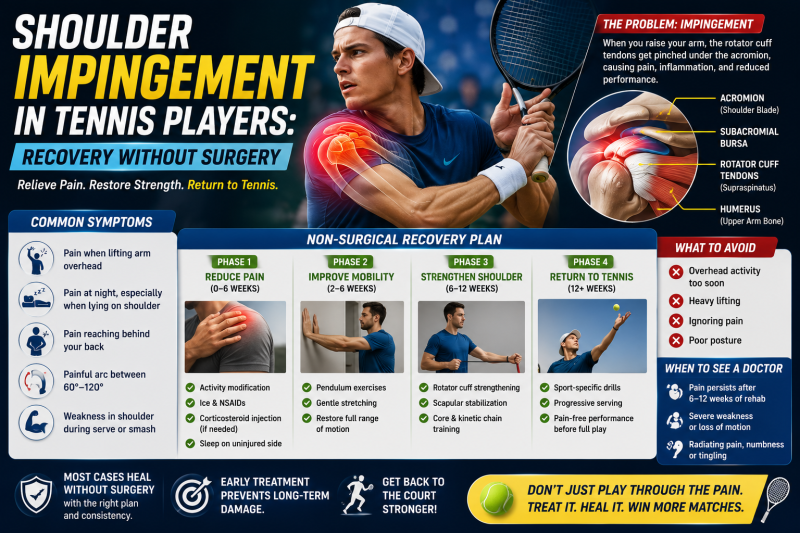
At the top of the shoulder lies a small space called the subacromial space.
Within this narrow area are:
- The subacromial bursa, a fluid-filled sac that reduces friction.
- The rotator cuff tendons, especially the supraspinatus tendon.
- The underside of the acromion, part of the shoulder blade.
When the arm repeatedly moves overhead, these tissues can become compressed.
Repeated pinching causes inflammation, pain, and gradual tendon damage.
This condition is known as Shoulder Impingement Syndrome.
Why Tennis Players Develop This Injury
Every serve places tremendous force through the shoulder.
Professional players may perform hundreds of overhead motions every week.
Without proper mechanics, strength, and recovery, these repeated movements gradually overload the shoulder.
Several factors increase risk:
- Repetitive serving.
- Frequent overhead smashes.
- Poor serving mechanics.
- Weak shoulder blade stabilizers.
- Tight chest muscles.
- Limited shoulder mobility.
- Age-related tendon degeneration.
Many injuries develop gradually over months rather than after a single event.
The Hidden Role of the Shoulder Blade
Modern sports medicine recognizes that shoulder impingement rarely occurs in isolation.
The shoulder blade acts as the platform for every overhead stroke.
If muscles such as the lower trapezius, rhomboids, and serratus anterior become weak, the shoulder blade loses its normal position.
This alters shoulder mechanics.
As a result, the rotator cuff must work harder to stabilize the joint.
Over time, this overload narrows the available space beneath the acromion, increasing friction on the tendons and bursa.
Treating only the painful tendon without addressing shoulder blade mechanics often leads to recurring symptoms.
Early Warning Signs
Most patients first notice subtle discomfort.
Common symptoms include:
- Dull aching pain on the front or outer shoulder.
- Pain when serving or smashing.
- Discomfort reaching overhead.
- Difficulty reaching behind the back.
- Pain lifting objects above shoulder height.
One classic finding is the painful arc, where lifting the arm sideways causes discomfort roughly between 60° and 120° of elevation.
Progressive Symptoms
Without treatment, inflammation continues.
Pain gradually becomes constant.
Many patients begin waking during the night because they cannot sleep on the affected shoulder.
As tendon irritation increases, weakness develops.
Simple tasks become difficult.
Serving speed decreases.
Overhead shots lose power.
In some cases, chronic impingement may contribute to rotator cuff tendon degeneration and tearing.
How Doctors Diagnose Shoulder Impingement
Orthopedic specialists combine history, physical examination, and imaging.
Common clinical tests include:
Neer Test
The physician raises the patient's arm overhead while internally rotating the shoulder.
Pain reproduced during this maneuver may indicate narrowing of the subacromial space.
Hawkins-Kennedy Test
The shoulder is flexed to approximately 90 degrees before internally rotating the arm.
Pain may suggest irritation of the rotator cuff or bursa.
These tests are helpful but are interpreted together with the patient's symptoms and other examination findings rather than used alone to make the diagnosis.
Is It the Shoulder or the Neck?
One diagnostic challenge is distinguishing shoulder impingement from cervical radiculopathy, where nerves in the neck cause pain radiating into the shoulder.
Neck-related problems may also produce:
- Tingling.
- Numbness.
- Burning pain.
- Weakness extending into the arm or hand.
Because symptoms can overlap, physicians may use imaging, neurological examination, and in selected cases a diagnostic local anesthetic injection into the subacromial space to help determine whether the pain originates primarily from the shoulder.
Imaging in the United States
Doctors may order:
X-rays
Useful for identifying:
- Bone spurs.
- Acromion shape.
- Arthritis.
- Joint narrowing.
Ultrasound
Allows real-time evaluation of:
- Bursa inflammation.
- Tendon movement.
- Partial tendon tears.
MRI
MRI provides the most detailed assessment of:
- Rotator cuff injuries.
- Bursa swelling.
- Tendon degeneration.
- Full-thickness tears.
Standard USA Treatment Pathway
Most patients improve without surgery.
Orthopedic guidelines generally recommend conservative treatment first.
Phase 1: Reducing Inflammation (Weeks 0–6)
Treatment focuses on calming irritated tissues.
Patients are encouraged to:
- Reduce painful overhead activities.
- Continue gentle daily movement rather than complete immobilization.
- Apply ice after activity.
- Use NSAIDs when appropriate and recommended by a healthcare professional.
For severe pain preventing rehabilitation, a physician may recommend a carefully targeted corticosteroid injection into the subacromial space. Because repeated injections may weaken tendon tissue, they are generally used selectively.
Improving Sleep
Night pain is extremely common.
Patients are often advised to:
- Sleep on their back.
- Sleep on the unaffected side.
- Place a pillow beneath the injured arm for support.
Proper positioning reduces strain on the shoulder while sleeping.
Phase 2: Physical Therapy
Physical therapy is the cornerstone of recovery.
Early exercises emphasize gentle mobility, including Codman's pendulum exercises, to maintain movement without overloading the injured tissues.
As pain improves, therapists typically progress to stretching tight chest muscles—such as with doorway pectoral stretches—and strengthening the rotator cuff and shoulder blade muscles.
Exercises like side-lying external rotations, rows, and scapular stabilization drills help restore normal shoulder mechanics and reduce pressure within the subacromial space.
Phase 3: Returning to Tennis
Before returning to competition, athletes should demonstrate:
- Full range of motion.
- Minimal or no pain.
- Normal shoulder strength.
- Good serving mechanics.
- Adequate endurance for match play.
Returning too early can increase the risk of recurrent symptoms or more significant tendon injury.
When Is Surgery Considered?
Surgery is not the first option for most patients.
An orthopedic consultation may be appropriate when:
- Pain remains severe despite 3–6 months of structured rehabilitation.
- Daily activities remain significantly limited.
- Weakness continues to interfere with function.
- Imaging reveals structural problems requiring repair, such as a large rotator cuff tear.
In selected cases, surgeons may perform arthroscopic procedures that can include removing inflamed bursal tissue (bursectomy) and, when appropriate, reshaping part of the acromion (acromioplasty) to improve space for tendon movement. Whether these procedures are beneficial depends on the individual's anatomy and associated shoulder pathology, so treatment decisions are made on a case-by-case basis.
Preventing Shoulder Impingement
Many tennis-related shoulder injuries can be reduced through proper conditioning.
Sports medicine specialists recommend:
- Warm up thoroughly before serving.
- Strengthen the rotator cuff and shoulder blade muscles.
- Improve core and hip stability.
- Stretch the chest and posterior shoulder regularly.
- Gradually increase training volume.
- Address shoulder pain early instead of playing through it.
- Work with a qualified coach to optimize serving mechanics.
Final Thoughts
Shoulder Impingement Syndrome is one of the most common causes of shoulder pain among tennis players in the United States. Although it often begins as mild inflammation from repetitive overhead activity, ignoring the symptoms can lead to persistent pain, reduced performance, and, in some cases, rotator cuff damage.
The encouraging news is that most patients improve with early diagnosis, activity modification, and a structured rehabilitation program. For those who do not respond to conservative care, modern orthopedic evaluation can help determine whether additional interventions—including surgery in selected cases—are appropriate.
Protecting the shoulder is not only about treating pain—it is about preserving the mobility, strength, and confidence needed to enjoy tennis for years to come.
Medical disclaimer: This article is for educational purposes only and is not a substitute for professional medical advice. If you experience persistent shoulder pain, significant weakness, numbness, or loss of function, consult an orthopedic specialist or sports medicine physician for an individualized evaluation.