
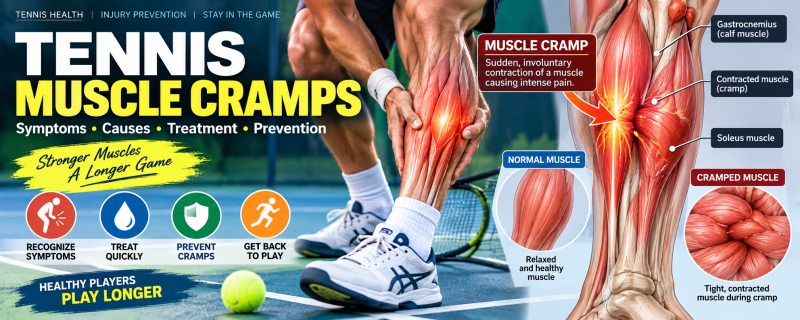
Exercise-Associated Muscle Cramps (EAMC)
A tennis doctor and tennis expert's guide to recognizing, treating, and preventing painful muscle cramps on the court.
Quick Overview
Muscle cramps are sudden, involuntary, and often painfully intense contractions of one or more muscles. In tennis, they can strike during a long rally, an intense third set, or a demanding training session.
As a tennis doctor and sports medicine expert, I want players to understand that a muscle cramp is more than an uncomfortable moment. It can temporarily stop your movement, affect your footwork, and increase the risk of falling or sustaining another injury.
Exercise-Associated Muscle Cramps (EAMC) are cramps that occur during or shortly after physical activity. They commonly affect the calves, hamstrings, and quadriceps.
Most cramps last from a few seconds to several minutes, although soreness may remain for hours or even days.
Tennis doctor's note: Muscle cramps are not always caused by dehydration or low potassium. Exercise intensity, neuromuscular fatigue, heat, sweating, and individual susceptibility can all contribute.
Symptoms of Tennis Muscle Cramps
Sudden, Sharp Muscle Pain
A cramp may feel like an abrupt, severe tightening or knot in your calf, thigh, or hamstring. The pain can become intense enough to stop your movement immediately.
Hard or Rigid Muscle
The affected muscle may feel firm, contracted, or visibly distorted beneath the skin. You may be unable to relax it normally.
Temporary Loss of Movement
A cramped leg can make it difficult to run, push off, change direction, or maintain balance during a tennis rally.
Residual Soreness
Even after the muscle relaxes, tenderness and mild discomfort can remain for hours or occasionally days.
Warning Signs That Need Medical Attention
Not every painful leg symptom is a simple cramp. Seek urgent medical assessment if you experience:
-
Severe swelling, bruising, or a popping sensation.
-
Chest pain, shortness of breath, or fainting.
-
Severe muscle pain with dark or cola-colored urine after intense exercise.
-
A hot, swollen, red calf with unexplained pain.
-
Repeated cramps accompanied by weakness, numbness, or loss of function.
Why Do Tennis Players Get Muscle Cramps?
Neuromuscular Fatigue
The leading explanation for many exercise-associated cramps is altered neuromuscular control during fatigue.
During a long, high-intensity tennis match, your muscles repeatedly contract and relax. As fatigue develops, the nervous system may become more likely to produce involuntary muscle contractions.
A grueling three-set match with repeated sprints, lunges, and explosive changes of direction can push the calves, hamstrings, and quadriceps beyond their current conditioning level.
Heavy Sweating and Electrolyte Loss
Tennis played in hot, humid weather can lead to substantial fluid and sodium loss through sweat.
This may contribute to cramping in some athletes, especially when combined with prolonged exercise and inadequate fluid replacement.
However, sweating and dehydration are not the only explanations. Not every player who cramps is dehydrated, and taking extra electrolytes does not guarantee prevention.
Inadequate Physical Conditioning
A player who suddenly increases training volume, match duration, or intensity may be more vulnerable to fatigue-related cramps.
Examples include:
-
Returning to tennis after several months away.
-
Playing a long tournament after limited conditioning.
-
Suddenly increasing sprint drills or plyometric exercises.
-
Playing in extreme heat without heat-acclimatization training.
Carbohydrate and Energy Depletion
Long matches increase energy demands. Inadequate carbohydrate intake can contribute to fatigue and reduced exercise performance.
For prolonged tennis sessions, appropriate fueling can help maintain energy availability and delay fatigue. However, low carbohydrate stores are not established as the sole or universal cause of muscle cramps.
Heat and Environmental Stress
Hot weather increases the physiological demands of tennis. Heat, prolonged exertion, and individual susceptibility may combine to make cramps more likely.
Diagnosis: How a Tennis Doctor Evaluates Muscle Cramps
Clinical Evaluation
Most uncomplicated exercise-associated muscle cramps can be assessed through a medical history and physical examination.
A sports medicine doctor may ask:
-
When did the cramp begin?
-
Which muscle was affected?
-
Were you playing tennis, exercising, or resting?
-
How long did the cramp last?
-
Was there heavy sweating, heat exposure, or a recent increase in training?
-
Have you experienced similar cramps before?
-
Are you taking any medications or supplements?
Physical Examination
The doctor may evaluate muscle tenderness, strength, flexibility, swelling, sensation, and the ability to walk normally.
When Are Blood Tests Needed?
Blood tests are not routinely necessary for every isolated tennis cramp.
If cramps are frequent, severe, generalized, occur at rest, or are accompanied by other symptoms, medical screening may be appropriate. Depending on the history, a clinician may consider:
-
Sodium, potassium, calcium, and magnesium.
-
Kidney function and other metabolic tests.
-
Thyroid testing when clinically indicated.
-
Additional neurological or vascular assessment when symptoms suggest another condition.
Important: Blood tests and imaging should be guided by the clinical findings. They are not automatically required for every athlete with a cramp.
Immediate Treatment: What to Do When You Cramp on Court
Step 1: Stop Playing
Do not try to run through a severe cramp. Stop the rally, notify your opponent or coach, and move to a safe position.
Step 2: Gently Stretch the Affected Muscle
Slow, gentle, sustained stretching can help relieve an acute cramp.
For a calf cramp:
-
Sit or stand with support.
-
Gently straighten the affected leg.
-
Pull the toes toward your shin if tolerated.
-
Hold the stretch until the cramp eases.
-
Avoid bouncing or forcing the muscle.
For a hamstring cramp:
-
Sit or lie down safely.
-
Slowly straighten the leg.
-
Gently move the foot and ankle toward a comfortable stretch.
-
Stop if pain becomes sharp or severe.
For a quadriceps cramp:
-
Hold onto a stable support.
-
Bend the knee gently if comfortable.
-
Bring the heel toward the buttock only as far as tolerated.
Step 3: Gentle Massage
Lightly massage or knead the cramped muscle if it feels comfortable. Avoid aggressive deep tissue massage, especially when there is swelling, bruising, or concern for a muscle tear.
Step 4: Replace Fluids and Sodium When Appropriate
Sip water or an electrolyte beverage, particularly after heavy sweating or prolonged play.
If you have been sweating heavily, sodium-containing fluids may be useful. Avoid forcing large amounts of water rapidly.
Tennis expert tip: Hydration is part of match preparation, not something to think about only after a cramp begins.
Step 5: Consider Rapid-Relief Sensory Triggers
Small amounts of strong-tasting substances, such as pickle juice or mustard, have been studied for their possible rapid effects on acute cramps.
These may work through sensory nerve pathways rather than by instantly replacing lost electrolytes.
However:
-
Evidence is not conclusive for every athlete.
-
They are not a substitute for medical care.
-
They do not immediately restore hydration or sodium balance.
-
Avoid products that trigger allergies or medical problems.
Prevention: How to Reduce Tennis Muscle Cramps
Hydration Before, During, and After Play
Start matches adequately hydrated. During prolonged sessions or hot weather, drink regularly according to thirst, sweat losses, and individual needs.
For heavy sweaters, sodium-containing fluids may be helpful.
Avoid both severe dehydration and excessive water intake.
Fuel Your Tennis Performance
Eat balanced meals and snacks that provide carbohydrates before prolonged tennis sessions.
For long matches or tournaments, appropriate carbohydrate-containing drinks or snacks may help maintain energy availability.
Examples include:
-
Bananas.
-
Rice or oatmeal before play.
-
Bread or sandwiches.
-
Sports drinks during prolonged activity.
-
Easily digested carbohydrate snacks.
Build Muscular Endurance
A tennis conditioning program should prepare the muscles for repeated acceleration, deceleration, and directional changes.
Include:
-
Calf raises.
-
Hamstring strengthening.
-
Quadriceps and glute exercises.
-
Lunges and split squats.
-
Core training.
-
Tennis-specific endurance drills.
Use Progressive Training
Avoid sudden increases in match duration or intensity.
If you are returning to tennis after a long break, gradually increase the number of sessions, total playing time, and intensity.
Train for Heat
When playing in hot, humid conditions, allow time to acclimatize to the heat. Schedule breaks and use appropriate clothing and sun protection.
Warm Up and Cool Down
Before tennis:
-
Perform light jogging or movement.
-
Use dynamic leg swings and walking lunges.
-
Gradually increase intensity.
After tennis:
-
Walk lightly.
-
Perform comfortable stretches.
-
Rehydrate and refuel.
Sports medicine perspective: Stretching alone cannot guarantee that cramps will not happen. Overall conditioning and fatigue management are essential.
Return to Tennis After a Muscle Cramp
Do Not Rush Back Onto the Court
A cramp may resolve quickly, but the muscle may remain fatigued or sore.
Before returning, confirm that:
-
The acute spasm has completely stopped.
-
You can walk normally.
-
The affected muscle has comfortable range of motion.
-
There is no significant swelling, bruising, or sharp pain.
-
You can perform light movements without symptoms.
Gradual Re-entry
Begin with:
-
Easy walking.
-
Gentle dynamic movements.
-
Comfortable practice swings.
-
Light hitting with reduced intensity.
-
Gradual return to normal tennis movement.
If twitching, cramping, pain, or weakness returns, stop playing.
When Should You Not Return?
Do not return to competition if you have persistent pain, significant weakness, swelling, suspected muscle strain, or difficulty walking.
A medical evaluation is appropriate when symptoms do not resolve normally.
Tennis Muscle Cramps vs. Other Injuries
| Condition | Typical Features |
|---|---|
| Muscle cramp | Sudden involuntary tightening, often resolves within minutes. |
| Muscle strain | Pain from muscle or tendon injury, sometimes with a pop, swelling, or bruising. |
| Heat illness | Cramps may occur with weakness, dizziness, nausea, or other heat-related symptoms. |
| Tendon injury | Pain often linked to loading a tendon, such as the Achilles or patellar tendon. |
| Possible blood clot | Unexplained one-sided swelling, warmth, redness, or calf pain needs medical evaluation. |
A tennis player should not assume that every painful calf or thigh symptom is a simple cramp.
Frequently Asked Questions
Can dehydration cause tennis cramps?
Dehydration and heavy sweating may contribute, but many cramps also involve neuromuscular fatigue and individual susceptibility.
Is low potassium the main cause?
Not usually. Low potassium can cause muscle symptoms, but ordinary exercise-associated cramps are not automatically caused by potassium deficiency. Do not take potassium supplements without an appropriate medical reason.
Does pickle juice stop cramps?
Some studies suggest strong sensory stimuli may help relieve cramps quickly. The evidence is not universal, and pickle juice does not replace proper hydration or medical treatment.
Should I take magnesium for tennis cramps?
Magnesium is not a guaranteed treatment for exercise-associated muscle cramps. Supplementation is most appropriate when a deficiency or another medical indication is identified.
Can I continue playing after a cramp?
Only after the cramp has fully resolved and you can move comfortably and safely. If pain or weakness persists, stop playing.
Why do cramps happen late in a tennis match?
Late-match fatigue, intense repeated movement, heat, and individual susceptibility may contribute. It is not necessarily caused by dehydration alone.
Final Advice From a Tennis Doctor
Muscle cramps are common in active athletes, but they should not be ignored when they are severe, recurrent, or accompanied by other symptoms.
The best approach combines smart conditioning, adequate fueling, appropriate hydration, heat management, and safe return-to-play decisions.
Your goal is not simply to finish the match. Your goal is to stay healthy enough to keep playing tennis for years.
Medical Disclaimer
This article is for general educational purposes and does not replace an examination or diagnosis by a qualified physician, sports medicine doctor, or other licensed healthcare professional.
Muscle cramps can have different causes. If symptoms are severe, recurrent, unexplained, or accompanied by weakness, swelling, dark urine, chest pain, or other concerning signs, seek appropriate medical care.