
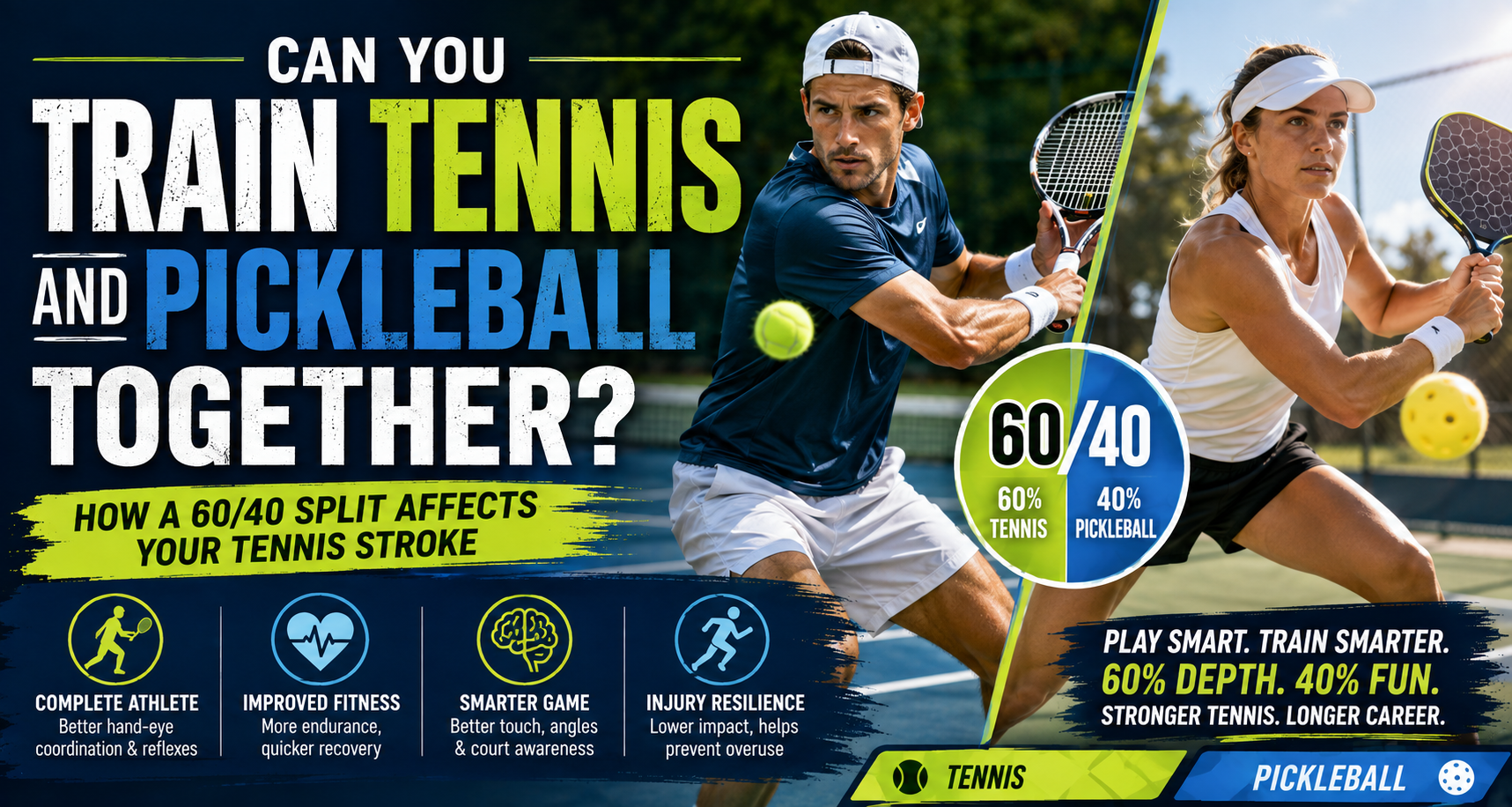
Yes. A 60% tennis / 40% pickleball split can work very well, especially if tennis remains your primary sport. The key is understanding that pickleball will change some movement and timing habits—but it does not automatically damage your tennis strokes.
My recommendation as a tennis-performance coach
If your priority is improving tennis, I would structure your training closer to:
60–70% tennis → 30–40% pickleball
That gives you enough pickleball exposure to develop touch, reaction speed, hand-eye coordination, and compact exchanges without allowing pickleball mechanics to dominate your tennis muscle memory.
Where pickleball can affect your tennis
1. Compact swings
Pickleball encourages short, efficient swings because of the smaller court and faster exchanges. If you bring that habit into tennis, your groundstrokes can become too short, reducing racquet-head speed, spin, and depth.
2. Wrist and hand action
Pickleball involves considerably more hand manipulation, especially around the kitchen. In tennis, particularly on topspin groundstrokes, you generally want the racquet controlled through the kinetic chain rather than consciously "flicking" the wrist.
3. Court positioning
Pickleball teaches you to spend a lot of time near the non-volley line. Tennis requires much larger court movements and significantly different recovery patterns. Make sure your tennis sessions continue to emphasize baseline movement, open-stance loading, crossover steps, and recovery.
4. Timing
The pickleball's slower flight and different bounce can alter your perception of timing. After a long pickleball session, a tennis ball can initially feel faster and heavier.
But there is a BIG benefit
Pickleball can actually complement tennis.
It can improve:
- Reaction time
- Hand-eye coordination
- Volleys
- Reflex exchanges
- Soft hands
- Paddle/racquet awareness
- Anticipation
- Quick preparation
- Short-ball decision making
For an experienced tennis player, those skills can transfer back into tennis if you deliberately maintain your tennis mechanics.
The most important rule
Don't try to make your tennis stroke look like your pickleball stroke.
Think of them as two different movement systems.
When you pick up the tennis racquet:
Longer preparation → stronger leg drive → rotational kinetic chain → racquet-head speed → full follow-through.
When you pick up the pickleball paddle:
Compact preparation → quick reaction → controlled paddle face → shorter movement.
Your brain can learn to switch between the two.
A good weekly structure
If tennis is your priority:
Training
Percentage
Tennis
60–70%
Pickleball
30–40%
Tennis stroke work
High priority
Tennis serve
High priority
Tennis movement
High priority
Pickleball
Supplemental
I would also avoid playing a long pickleball session immediately before an important tennis match. Give your nervous system some tennis-specific hitting beforehand so your timing and swing patterns are calibrated to the tennis ball.
Bottom line
60% tennis / 40% pickleball is a reasonable combination. You are unlikely to lose your tennis stroke simply because you play pickleball 40% of the time.
The bigger risk is allowing pickleball habits to replace tennis-specific practice. If you continue regular tennis groundstroke, serve, return, footwork, and point-pattern training, you can actually become a more versatile racket-sport athlete.
For a competitive tennis player, I'd personally favor 70/30 during periods when tennis performance is the main goal, and 60/40 during recreational or off-season periods.