
Quick Overview
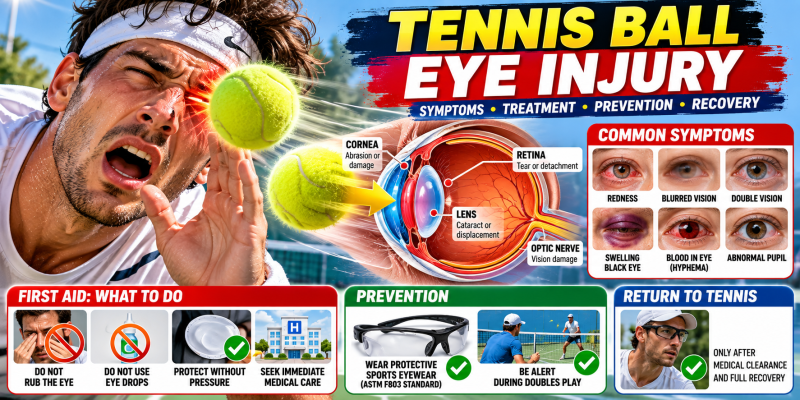
An eye injury caused by a direct impact from a high-velocity tennis ball is an urgent medical scenario. Because the tennis ball matches the approximate diameter of the human eye socket, it can bypass the protective orbital bones and deliver a direct, blunt-force trauma (ocular contusion) to the eyeball itself. This can cause rapid tissue compression, structural damage to internal eye components, bleeding, and potentially permanent vision loss if not evaluated and treated promptly.
Key Symptoms
Following a direct tennis ball strike, watch closely for both immediate and delayed warning signs:
-
Visual Changes: Blurry vision, double vision (diplopia), sudden loss of vision, or persistent blind spots/shadows in the field of view.
-
Pain & Discomfort: Severe sharp pain, deep aching around the eye socket, or a feeling of intense pressure.
-
Physical & Structural Signs:
-
Swelling and rapid bruising ("black eye").
-
Redness of the sclera (white of the eye) or pooling of blood inside the anterior chamber (hyphema).
-
Asymmetry or abnormal shape of the pupil, or failure of the pupil to react to light.
-
Eyelid lacerations or bleeding.
-
-
Associated Symptoms: Nausea, dizziness, or headache resulting from trauma.
Causes & Risk Factors
-
Primary Cause: High-speed impact from a tennis ball during aggressive play (e.g., getting hit by an opponent's high-speed smash, a heavy baseline groundstroke, or a deflection off the frame of a racket during close-range net play/doubles).
-
Risk Factors:
-
Playing close to the net in doubles without adequate reaction time.
-
High-powered baseline striking combined with lack of protective eyewear.
-
Fatigue, which can slow reaction times and impair defensive positioning.
-
Diagnosis
Any significant impact to the eye from a tennis ball requires a professional ophthalmologic examination:
-
Initial Triaging: Assessing visual acuity immediately following the injury (checking if the player can read numbers, fingers, or objects).
-
Comprehensive Ocular Exam: Performed by an optometrist or ophthalmologist using specialized tools:
-
Slit-Lamp Examination: To inspect the cornea, iris, lens, and anterior chamber for micro-tears, inflammation, or internal bleeding (hyphema).
-
Funduscopic Exam: Examining the retina and optic nerve at the back of the eye to rule out retinal detachment or tearing.
-
Intraocular Pressure (IOP) Check: Measuring eye pressure to detect spikes (common with internal bleeding or trauma).
-
Orbital Imaging: CT scans or X-rays if there is suspicion of a "blowout fracture" (fracture of the bones surrounding the eye socket).
-
Immediate Treatment & First Aid
-
Do Not Rub: Never rub, apply pressure to, or bandage the injured eye, as this can worsen internal bleeding or structural damage.
-
Avoid Self-Medicating: Do not apply eye drops or ointments unless explicitly prescribed by a medical professional.
-
Protect and Rest: Keep the player calm, head elevated slightly (to help reduce intraocular pressure), and cover the eye loosely with a rigid shield (like the bottom of a clean paper cup) if available, ensuring no pressure rests on the globe.
-
Seek Immediate Care: Transport the player to an emergency room or an eye care specialist immediately for professional evaluation, even if symptoms appear mild at first.
Prevention Strategies
-
Protective Eyewear: Wear sports-specific protective glasses or goggles featuring polycarbonate lenses (meeting ASTM F803 standards) designed for racquet sports, especially for juniors, doubles players who spend time at the net, or players with monocular vision.
-
Court Awareness: Maintain high alertness during doubles play when opponents are executing overhead smashes or close-range volleys.
Return to Tennis Protocol
Returning to the tennis court depends entirely on the severity of the diagnosis and medical clearance:
-
Strict Medical Clearance: Absolute clearance from an ophthalmologist is mandatory before resuming any physical activity.
-
Rest Period: Complete rest avoiding any heavy lifting, bending over, or elevated heart rate during the initial healing phase (to prevent secondary bleeding inside the eye).
-
Gradual Reintroduction:
-
Phase 1: Light, non-strenuous activity once cleared, avoiding any risk of a secondary ball strike or abrupt head movements.
-
Phase 2: Controlled rallying without pressure or competitive match play.
-
Phase 3: Full return to match play, with a mandatory transition to wearing certified protective sports eyewear to prevent re-injury.
-