
For tennis players in their 50s, 60s, and 70s, staying active can be one of the most rewarding parts of aging. But years of serving, sprinting, stopping, and changing direction can also place considerable stress on the knees, calves, ankles, Achilles tendons, and feet.
When your legs begin to hurt after tennis, it can be tempting to search for a simple home remedy.
One increasingly popular option is turmeric, especially turmeric or curcumin products promoted for joint pain and inflammation.
The important question is:
Can turmeric actually help an older tennis player with painful knees and legs?
The answer is more nuanced than many social-media posts suggest.
Why Leg Pain Becomes More Common With Age
Aging does not automatically mean you have to stop playing tennis. However, your body may recover differently than it did when you were younger.
Common problems in recreational tennis players over 50 can include:
- Knee osteoarthritis
- Patellar tendon irritation
- Achilles tendinopathy
- Calf muscle strains
- Hamstring problems
- Ankle stiffness
- Plantar fasciitis
- Hip and thigh weakness
- Reduced balance and mobility
- Overuse injuries
Knee osteoarthritis is particularly important because it becomes more common with age and can cause pain, stiffness, swelling, and difficulty moving the joint.
For a tennis player, these symptoms can become noticeable during lunging, pushing off for a wide shot, stopping suddenly, or walking downstairs after a match.
What About Turmeric Paste?
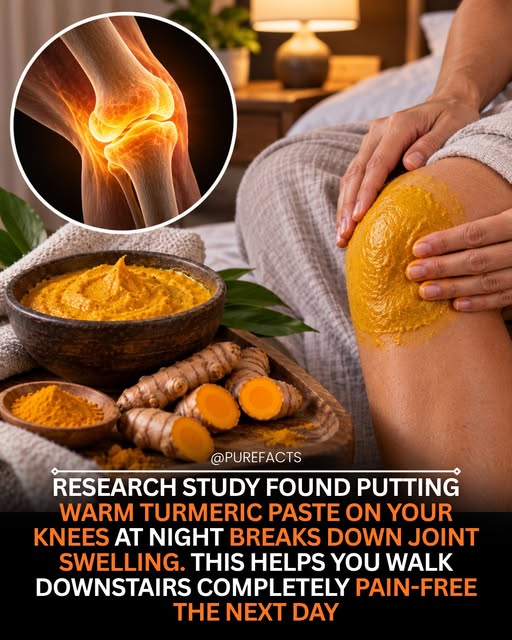
The image accompanying this article suggests that applying a warm turmeric paste to the knee at night can dramatically reduce swelling and make someone completely pain-free the following day.
That claim should be treated cautiously.
Research has investigated turmeric and its active compounds, particularly curcumin, for osteoarthritis. Some studies of oral turmeric or curcumin products have reported improvements in knee pain and function, but the evidence is not strong enough to conclude that turmeric reliably treats osteoarthritis.
More importantly, evidence that topical curcumin applied directly to the skin reduces knee osteoarthritis pain remains limited.
Therefore, a tennis player should not assume that putting turmeric paste on the knee will eliminate inflammation or guarantee pain-free tennis the next morning.
Turmeric Is Not a Replacement for Treatment
A turmeric paste may be a traditional home practice, but it should not replace professional evaluation when persistent knee or leg pain is interfering with tennis.
The goal isn't simply to temporarily hide the pain.
The goal is to understand why the leg hurts and safely restore the player's ability to move.
Build Stronger Tennis Legs
For an older tennis player, managing leg pain should involve more than searching for a single anti-inflammatory food or home remedy.
Exercise and strength training are important components of managing knee osteoarthritis.
A tennis-specific recovery program can include:
Strengthen the thighs
Appropriately modified exercises such as sit-to-stands, squats, and step-ups can help develop lower-body strength.
Strengthen the hips and glutes
The hips contribute significantly to lateral movement around the court. Better strength and control can help support tennis movement.
Train the calves
The calves contribute to split steps, acceleration, deceleration, and push-offs.
Calf exercises should be introduced gradually if you already have Achilles or calf pain.
Improve balance
Balance becomes increasingly important with age. Controlled single-leg exercises can help develop stability needed for tennis.
Maintain mobility
Focus on maintaining comfortable movement through the ankles, knees, hips, hamstrings, and calves.
The 50–70 Tennis Player Needs a Different Recovery Strategy
One common mistake older recreational players make is trying to train exactly as they did decades earlier.
You don't necessarily need to stop playing.
Instead, consider managing your training load more intelligently.
For example:
Hard tennis day → recovery or light activity → moderate tennis → recovery
rather than:
Hard tennis → hard tennis → hard tennis → significant pain → several days away from tennis
Consistency is generally more useful than repeatedly pushing through significant pain.
Don't Play Through Every Kind of Pain
There is an important difference between normal post-exercise soreness and pain that deserves medical attention.
Seek professional evaluation if you develop:
- Significant swelling
- A knee that becomes hot or red
- Severe or rapidly worsening pain
- Inability to bear weight
- A knee that locks
- A feeling that the knee repeatedly gives way
- A significant injury during tennis
- Calf swelling accompanied by unusual warmth or pain
- Fever together with a painful, swollen joint
These symptoms can indicate conditions that require medical assessment rather than home treatment.
Can an Older Tennis Player Still Play With Knee Osteoarthritis?
Often, the answer isn't simply "stop playing."
Management can involve exercise, strength training, activity modification, weight management when appropriate, and other treatments based on the individual's condition.
The correct approach depends on the actual cause of the pain.
A player with mild osteoarthritis may require a very different program from someone with an Achilles tendon injury, meniscus problem, or significant joint inflammation.
That's why diagnosis matters.
What About Turmeric in Your Tennis Recovery Routine?
Turmeric can be part of a normal diet.
But it shouldn't be viewed as a miracle treatment for aging tennis knees.
Some oral turmeric or curcumin preparations may have potential for improving symptoms associated with knee osteoarthritis, but more research is needed to establish which formulations, doses, and long-term approaches are most appropriate.
Topical turmeric or curcumin is even less certain.
Concentrated curcumin products can also cause side effects and have been associated with liver injury in some cases. People taking medications or considering concentrated supplements should discuss them with a healthcare professional.
The Real Goal: Keep Playing for Years
For a tennis player in their 50s, 60s, or 70s, the objective shouldn't be to eliminate every sensation of discomfort overnight.
The bigger goal is to:
Maintain strong legs.
Protect your joints.
Improve mobility.
Recover properly.
Control training load.
Keep yourself on the tennis court.
Turmeric may be an interesting complementary option, but a jar of turmeric cannot replace strength training, appropriate recovery, medical evaluation, or a properly designed tennis program.
Your best tennis years don't necessarily have to end because you're getting older.
They may simply require smarter training and smarter recovery.
Tennis Takeaway
Don't chase a miracle cure for your knees. Build a body that can continue playing.
For tennis players over 50, strong muscles, appropriate conditioning, mobility, recovery, and sensible training progression can form the foundation for staying active on the court.