Quick Overview
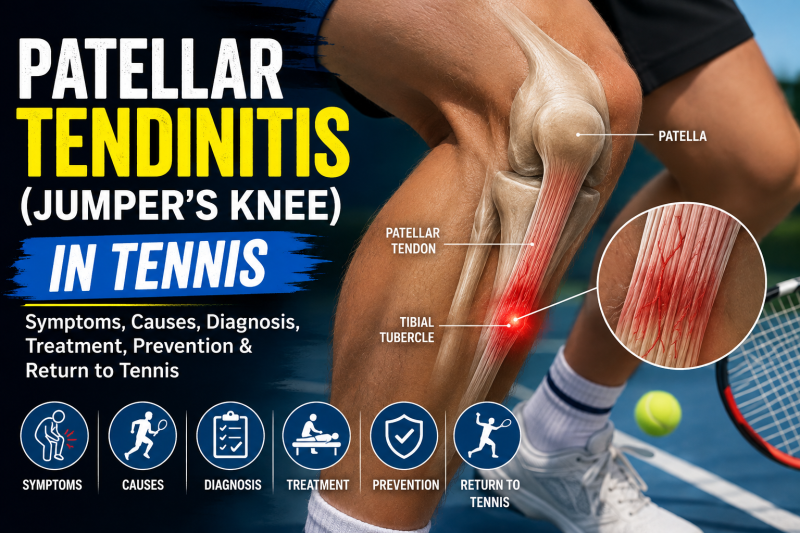
Patellar tendinitis, more accurately called patellar tendinopathy, is an overuse injury affecting the patellar tendon—the strong tissue connecting the kneecap (patella) to the tibial tubercle.
Despite the common name “jumper’s knee,” tennis players can develop this condition from repeated jumping, explosive push-offs, sudden stops, lunges, and rapid changes of direction.
Chronic patellar tendinopathy is generally associated with tendon degeneration and impaired collagen organization rather than classic inflammation. Repetitive loading can exceed the tendon’s ability to recover, gradually reducing its capacity to tolerate high-intensity activity.
Why It Matters in Tennis
Tennis repeatedly loads the extensor mechanism during:
- Explosive first-step acceleration
- Split steps and jump landings
- Deep knee flexion
- Hard-court deceleration
- Wide lateral lunges
- Repeated directional changes
- Serve and overhead movement
- High-volume training and competition
Symptoms
The most characteristic symptom is localized pain at the bottom of the kneecap, where the patellar tendon begins.
Common symptoms include:
- Pain directly below the kneecap
- Tenderness at the inferior pole of the patella
- Pain during jumping or landing
- Pain with squatting
- Discomfort during lunges
- Pain during acceleration or deceleration
- Stiffness after prolonged sitting
- Pain after tennis rather than during everyday walking
- Reduced explosive power
- Symptoms that initially improve during warm-up but return afterward
Typical Progression
Patellar tendinopathy can progress gradually:
Early stage:
Pain occurs mainly after intense tennis sessions.
Intermediate stage:
Pain appears during the beginning of activity, may improve temporarily with warming up, then returns after exercise.
Advanced stage:
Pain occurs throughout training and may interfere with normal daily activities, jumping, stairs, and squatting.
Persistent or worsening knee pain should be evaluated by a qualified sports-medicine professional.
Causes
Patellar tendinopathy usually develops when repetitive tendon loading exceeds the body's ability to recover and adapt.
Common Tennis-Related Causes
1. Sudden training increase
Rapidly increasing:
- Match frequency
- Practice duration
- Sprint volume
- Plyometric drills
- Jump training
- Strength-training intensity
can overload the tendon.
2. Repeated hard-court loading
Rigid surfaces can increase repetitive impact and loading demands, particularly when combined with high training volume.
3. Poor load management
Insufficient recovery between demanding tennis sessions can prevent the tendon from adapting.
4. Quadriceps weakness or poor capacity
The quadriceps and patellar tendon work together to absorb and generate force. Insufficient strength can increase the relative demand placed on the tendon.
5. Reduced flexibility and mobility
Limited quadriceps, hamstring, calf, or ankle mobility may alter lower-extremity mechanics.
6. Reduced ankle dorsiflexion
Restricted ankle movement can change squat, landing, and deceleration mechanics.
7. Repetitive jumping and landing
Split steps, jump serves, aggressive court movement, and repeated explosive movements increase tendon loading.
Diagnosis
Patellar tendinopathy is primarily a clinical diagnosis based on the athlete's history and physical examination.
Physical Examination
A sports-medicine clinician may assess:
- Point tenderness at the inferior pole of the patella
- Pain during resisted knee extension
- Pain during squatting
- Single-leg squat performance
- Jump and landing mechanics
- Quadriceps strength
- Hamstring and calf flexibility
- Ankle dorsiflexion
- Hip and lower-extremity mechanics
A single-leg decline squat may reproduce symptoms and can be useful during clinical assessment.
VISA-P
The Victorian Institute of Sport Assessment–Patella (VISA-P) questionnaire can help measure symptoms and functional limitations and track rehabilitation progress.
Higher scores generally indicate better function and fewer symptoms.
Imaging
Imaging is not always necessary.
Ultrasound may demonstrate:
- Tendon thickening
- Altered tendon structure
- Hypoechoic regions
- Loss of the normal fibrillar appearance
- Increased Doppler vascularity
MRI may be considered when the diagnosis is uncertain or another injury needs to be excluded.
Potential differential diagnoses include:
- Patellofemoral pain
- Hoffa's fat-pad irritation
- Meniscal pathology
- Patellar fracture or stress injury
- Osgood-Schlatter-related problems in younger athletes
- Other causes of anterior knee pain
Treatment
The modern approach is generally progressive tendon loading rather than prolonged complete rest.
Treatment should be individualized according to symptom severity, tendon capacity, training demands, and the athlete's goals.
Phase 1: Pain Control & Isometric Loading
Approximate timeframe: Weeks 1–2
Goals
- Reduce excessive tendon irritation
- Maintain strength
- Establish tolerable tendon loading
- Temporarily reduce high-energy activities
Possible exercises include:
- Isometric knee-extension holds
- Leg-press isometric holds
- Controlled wall-sit variations
A clinician or physical therapist can determine the appropriate resistance and duration.
Tennis Modification
Temporarily reduce:
- Repeated jumping
- High-intensity plyometrics
- Sprinting
- Deep explosive lunges
- Long high-volume sessions
Complete inactivity is not automatically required.
Phase 2: Heavy Slow Resistance
Approximate timeframe: Weeks 3–8
The goal is to progressively increase the capacity of the quadriceps-patellar tendon unit.
Exercises may include:
- Leg press
- Squats
- Split squats
- Hack squats
- Controlled decline squats
- Knee extensions
The emphasis is on slow, controlled resistance with progressive increases in load.
A physical therapist should determine the appropriate resistance, repetitions, range of motion, and progression rather than relying on a fixed program.
Phase 3: Energy-Storage & Plyometric Training
Approximately Week 9 onward
Once strength and symptoms have improved, tennis players gradually reintroduce the high-speed loading that the tendon must tolerate during competition.
Progression may include:
- Low-intensity pogo hops
- Bilateral jumping
- Single-leg jumping
- Forward and lateral hops
- Controlled landing drills
- Multidirectional plyometrics
- Reactive movement
- Tennis-specific acceleration and deceleration
- Full-intensity court movement
The 24-Hour Response
A useful rehabilitation principle is to monitor how the knee responds during the session and over the following 24 hours.
If symptoms substantially worsen and do not return toward the athlete's normal baseline, the training load may need to be reduced.
Medical & Interventional Options
Most athletes should first receive an appropriately structured rehabilitation program.
For persistent symptoms despite well-managed conservative treatment, a sports-medicine specialist may discuss additional options.
Depending on the individual case, these can include:
- Extracorporeal shockwave therapy (ESWT)
- Injection-based treatments such as PRP
- Other specialist-guided interventions
- Surgical treatment for carefully selected chronic cases
Surgery is generally considered only after substantial conservative management has failed.
Importantly, treatments marketed as “regenerative” are not interchangeable, and evidence varies by intervention. A specialist should discuss expected benefits, limitations, risks, and alternatives.
Prevention
The best prevention strategy is progressive load management combined with adequate strength and recovery.
Tennis Players Should:
1. Increase training gradually
Avoid sudden increases in:
- Court time
- Match volume
- Sprinting
- Jumping
- Plyometrics
2. Build quadriceps strength
Progressively strengthen the muscles responsible for knee extension.
3. Train the entire kinetic chain
Include:
- Glutes
- Quadriceps
- Hamstrings
- Calves
- Hip stabilizers
- Core
4. Maintain mobility
Address meaningful restrictions in:
- Quadriceps
- Hamstrings
- Calves
- Ankle dorsiflexion
5. Manage recovery
Allow sufficient recovery between high-load sessions.
6. Monitor court workload
Avoid combining excessive match play with large increases in strength and plyometric training at the same time.
7. Don't ignore persistent pain
Repeatedly playing through progressively worsening anterior knee pain can make load management more difficult.
Return to Tennis
Return to tennis should be criteria-based rather than based solely on a specific number of weeks.
Stage 1 — Daily Activity
The player should be able to:
- Walk normally
- Climb stairs comfortably
- Perform controlled squats
- Complete normal daily activities without significant symptoms
Stage 2 — Strength
Progress toward near-symmetrical lower-limb strength and good control during:
- Squats
- Split squats
- Single-leg exercises
- Knee-extension movements
Stage 3 — Running
Gradually introduce:
- Jogging
- Accelerations
- Decelerations
- Lateral running
- Change-of-direction drills
Stage 4 — Tennis Movement
Progress from:
Mini-tennis → controlled groundstrokes → baseline movement → lateral drills → point construction → full-court practice → competitive play
Stage 5 — Full Return
Before unrestricted competition, the athlete should demonstrate:
- Good single-leg control
- Adequate strength
- Tolerance of jumping and landing
- Tolerance of repeated acceleration/deceleration
- Ability to complete tennis-specific training without a significant next-day flare-up
Key Takeaway
Patellar tendinopathy is a load-management problem as much as it is a knee problem.
For tennis players, successful recovery usually involves reducing excessive tendon load temporarily, maintaining appropriate activity, progressively rebuilding strength, restoring energy-storage capacity, and gradually returning to explosive tennis movements.
Persistent, severe, or worsening knee pain should be assessed by a qualified sports-medicine clinician or physical therapist, particularly when pain begins affecting daily activities.