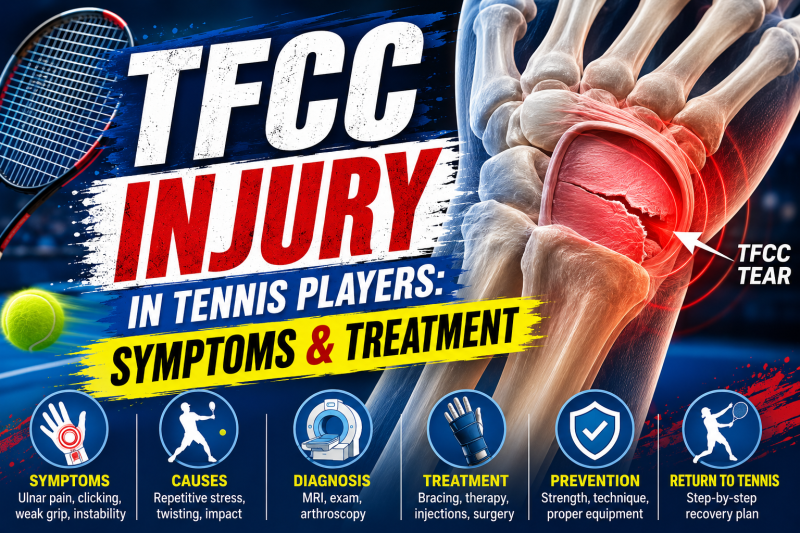
A Triangular Fibrocartilage Complex (TFCC) injury is a wrist injury affecting the cartilage and ligament structures on the ulnar side of the wrist—the side nearest the pinky finger.
For tennis players, the TFCC is particularly important because it helps stabilize the wrist and the distal radioulnar joint (DRUJ) while the player grips the racket, rotates the forearm, hits groundstrokes, serves, volleys, and absorbs impact.
A TFCC injury can range from a small degenerative tear to a significant traumatic tear associated with wrist instability. Symptoms can sometimes resemble a simple wrist sprain, which can make diagnosis challenging.
Importantly, not every TFCC tear seen on imaging requires surgery. Some tears may be asymptomatic, while symptomatic injuries are often initially treated without surgery. Evidence from recent reviews suggests that appropriately selected patients can achieve good outcomes with conservative treatment.
Symptoms
The most characteristic symptom is pain on the pinky side of the wrist.
A tennis player may notice:
- Ulnar-sided wrist pain
- Pain when gripping the racket
- Pain during a two-handed backhand
- Pain when hitting a serve or overhead
- Pain when turning the palm upward or downward
- Clicking, popping, or catching in the wrist
- Reduced grip strength
- Pain when lifting objects
- Difficulty opening jars or turning door handles
- Wrist discomfort when pushing up from a chair
- A sensation that the wrist is unstable
Some players describe a sharp pain during racket impact followed by an aching sensation after play.
The location of the pain can be an important clue, but symptoms alone cannot confirm a TFCC tear.
Why TFCC Injuries Matter in Tennis
Tennis places repeated rotational and loading demands on the wrist and forearm.
During a typical match, the wrist and forearm repeatedly move through:
Grip → forearm rotation → wrist stabilization → racket impact → recovery
The TFCC contributes to stability between the radius and ulna and helps transmit and absorb forces through the wrist.
Players may be particularly vulnerable when they suddenly increase:
- Training volume
- Match frequency
- Serve practice
- Heavy topspin practice
- Racket weight
- String tension
- Strength-training loads
- Repetitive wrist exercises
A sudden fall onto the hand can also cause an acute traumatic TFCC injury.
Causes
TFCC injuries generally fall into two broad categories: traumatic and degenerative.
1. Traumatic TFCC Injury
A traumatic tear can occur after:
- Falling onto an outstretched hand
- A sudden twisting injury
- Forced forearm rotation
- A heavy impact through the racket
- An awkward defensive shot
- A sudden change of direction while the hand is fixed
- Sports-related trauma
A player may remember a specific moment when the wrist suddenly hurt.
2. Degenerative TFCC Injury
The TFCC can also gradually deteriorate with age and repetitive loading.
A player may develop symptoms without a single dramatic injury.
Repeated wrist loading, cumulative wear, and anatomical factors can contribute to this type of problem.
Importantly, an abnormal TFCC finding on an MRI does not automatically mean that the finding is the source of pain. Some TFCC abnormalities can occur without symptoms.
Diagnosis
Diagnosing a TFCC injury usually starts with a detailed history and physical examination.
A clinician may ask:
- When did the pain begin?
- Was there a specific injury?
- Does forearm rotation reproduce the pain?
- Does gripping the racket make symptoms worse?
- Is there clicking or instability?
- Have symptoms persisted despite rest?
The wrist may then be examined for tenderness, range of motion, grip strength, and stability of the distal radioulnar joint.
X-Ray
X-rays do not directly show the TFCC.
However, they can help identify:
- Fractures
- Arthritis
- Bone alignment
- Ulnar variance
- Other possible causes of wrist pain
MRI
MRI can provide information about the TFCC and surrounding soft tissues and may help identify a tear.
However, imaging findings must be interpreted together with the patient's symptoms and physical examination.
Wrist Arthroscopy
In selected cases, wrist arthroscopy can be used to directly evaluate the TFCC and treat certain tears.
Treatment
Treatment depends on the type of tear, location, instability, symptoms, age, activity level, and response to conservative care.
1. Conservative Treatment
For many symptomatic injuries, treatment initially focuses on reducing irritation and allowing the wrist to recover.
Possible measures include:
- Activity modification
- Temporary rest from tennis
- Wrist immobilization or bracing
- Anti-inflammatory medication when medically appropriate
- Hand or wrist therapy
- Progressive strengthening
- Gradual restoration of forearm rotation
- Modification of tennis technique and equipment
A systematic review of traumatic TFCC injuries found that nonoperative treatment can produce comparable functional outcomes to surgery in appropriately selected cases.
Another systematic review found that conservative management was generally used as the initial treatment before surgery was considered when symptoms persisted.
2. Physical Therapy and Hand Therapy
Rehabilitation may focus on restoring:
- Wrist range of motion
- Forearm rotation
- Grip strength
- Wrist and forearm endurance
- Proximal upper-limb strength
- Functional control during racket movements
The goal is not simply to make the wrist stronger. The player needs to regain the ability to stabilize the wrist during rapid tennis-specific movements.
3. Corticosteroid Injection
A clinician may consider an injection in selected cases to reduce pain and inflammation.
An injection does not automatically repair a torn TFCC. It should be considered as part of an individualized treatment plan rather than a substitute for rehabilitation.
4. Arthroscopic Debridement
Some tears, particularly certain central tears, may be treated with arthroscopic debridement.
This procedure removes or smooths damaged tissue rather than repairing tissue that has adequate healing potential.
5. TFCC Repair
Peripheral TFCC tears may sometimes be repaired because portions of the peripheral TFCC have better blood supply and healing potential.
Surgical repair is generally followed by a period of protection and structured rehabilitation.
6. Ulnar Shortening Osteotomy
In selected patients, the ulna may contribute to excessive loading of the TFCC.
When clinically significant positive ulnar variance is present, an ulnar shortening osteotomy may be considered.
This is a more substantial procedure and is not necessary for every TFCC injury.
Patient Experiences: Why Recovery Can Be Frustrating
TFCC injuries can be frustrating for athletes because symptoms may persist even when the initial X-ray appears normal.
A player may initially be told that the problem is a wrist sprain.
If pain continues—particularly ulnar-sided pain associated with rotation, gripping, or instability—further evaluation may be necessary.
Another important issue is that recovery is highly variable.
A small symptomatic tear in a stable wrist is very different from a peripheral tear associated with distal radioulnar joint instability.
Therefore, comparing one player's recovery timeline with another player's experience can be misleading.
Prevention for Tennis Players
There is no guaranteed method of preventing every TFCC injury, but tennis players can reduce unnecessary wrist stress.
Build Training Load Gradually
Avoid suddenly doubling practice volume or adding long serving sessions after a period of inactivity.
Strengthen the Forearm
A progressive program can include:
- Wrist flexion and extension
- Forearm pronation and supination
- Grip strengthening
- Controlled eccentric exercises
- Shoulder and upper-arm strengthening
Exercises should be introduced progressively rather than performed aggressively when the wrist is already painful.
Check Your Equipment
Equipment can influence the forces transmitted to the wrist.
Consider having a qualified tennis professional evaluate:
- Racket weight
- Balance
- Grip size
- String setup
- String tension
- Technique
Equipment changes should be made gradually rather than changing several variables simultaneously.
Do Not Ignore Persistent Ulnar-Sided Pain
A common mistake is continuing to play through wrist pain because the symptoms initially seem minor.
If pain repeatedly appears during gripping or forearm rotation, reducing the provoking activity and seeking an appropriate evaluation may prevent a relatively manageable problem from becoming persistent.
Return to Tennis
Returning to tennis should be based on function rather than simply the number of weeks since injury.
Before returning to full competition, the player should ideally demonstrate:
- Minimal or no wrist pain
- Near-normal wrist range of motion
- Restored grip strength
- Good forearm rotation
- Ability to stabilize the wrist
- Ability to perform tennis-specific movements without symptoms
A gradual progression is usually safer than immediately returning to full match intensity.
Suggested Return-to-Tennis Progression
Stage 1 — Daily Activities
The wrist tolerates normal daily activities without significant pain.
Stage 2 — Tennis-Specific Movement
Begin controlled shadow swings and light forearm movements.
Stage 3 — Mini-Tennis
Start with short-court hitting at reduced intensity.
Stage 4 — Groundstrokes
Progress to controlled baseline hitting.
Stage 5 — Serves and Overheads
Introduce serves gradually because they can place substantial demands on the wrist and forearm.
Stage 6 — Competitive Play
Return to practice sets before full competitive matches.
If pain, clicking, weakness, or instability returns during progression, reduce the workload and reassess rather than simply pushing through.
How Long Does It Take to Return?
There is no single recovery timeline for every TFCC injury.
Conservative treatment may require several weeks to several months depending on the injury and response to treatment. A systematic review of sports-related TFCC injuries reported conservative treatment periods ranging from approximately 6 weeks to 6 months before surgery was considered for persistent symptoms.
After arthroscopic repair, recovery can take considerably longer.
A 2023 systematic review of 15 studies involving 478 patients found that approximately 84% returned fully to their previous work or sport activities after arthroscopically assisted TFCC repair. The review also reported that range of motion and grip strength commonly recovered to more than 90% of the opposite side, although the literature did not establish a consistent timetable for full functional recovery.
That distinction is important for tennis players: returning to hitting a ball is not necessarily the same as returning to pre-injury competitive performance.
When Should a Tennis Player See a Specialist?
Consider evaluation by a sports-medicine physician, orthopedic surgeon, or hand/wrist specialist when:
- Ulnar-sided wrist pain persists
- Pain repeatedly returns after tennis
- Grip strength is declining
- The wrist clicks or catches
- The wrist feels unstable
- Forearm rotation is painful
- Symptoms follow a significant fall or twisting injury
- You cannot return to normal tennis activity despite rest
Urgent medical assessment is appropriate after significant trauma when there is severe pain, deformity, major swelling, numbness, or loss of function.
TFCC Injury vs. Ordinary Wrist Sprain
These conditions can look similar initially.
Feature
Wrist Sprain
Possible TFCC Injury
Pain
Variable wrist location
Often pinky-side wrist
Rotation
May hurt
Frequently provocative
Grip
Can be painful
Often painful or weak
Clicking
Possible
Can occur
Instability
Less typical
May occur
Tennis impact
May aggravate
Often aggravates
Diagnosis
Clinical examination
Examination ± imaging/arthroscopy
This table is a guide, not a diagnostic test.
Key Takeaway for Tennis Players
A TFCC injury can turn ordinary tennis movements—gripping, rotating the forearm, serving, and absorbing racket impact—into painful activities.
The good news is that a TFCC tear does not automatically mean surgery. Many patients are initially managed with activity modification, immobilization, and rehabilitation, while surgery is reserved for selected injuries or persistent symptoms.
For competitive players, the most important goal is not simply getting back onto the court quickly. It is restoring enough pain-free motion, grip strength, wrist stability, and tennis-specific control to handle the repetitive forces of a full match.
If ulnar-sided wrist pain continues, especially when gripping or rotating the forearm, getting the wrist properly evaluated is more useful than repeatedly playing through the pain.
Medical disclaimer: This article is for educational purposes and does not diagnose or treat an individual injury. A qualified healthcare professional should evaluate persistent or significant wrist pain, particularly after trauma.
Sources
- PubMed — Return to sport following surgical management of triangular fibrocartilage tears: a systematic review.
- PubMed — Return to Activity After Arthroscopically Assisted Triangular Fibrocartilage Complex Repair: A Systematic Review.
- PubMed — The Natural History of Non-operatively Treated Traumatic Triangular Fibrocartilage Complex Tears: A Systematic Review.
- PubMed — A Systematic Review and Analysis of Palmer Type I Triangular Fibrocartilage Complex Injuries.