
Listen up. That study is eye-opening for the general public, but for a tennis player? It’s a direct warning about your first step.
Here’s the deal: Tennis isn’t a linear sport. It’s 3-5 seconds of explosive sprinting, a sudden plant, a loaded open-stance forehand, and immediate recovery. That 10-second one-leg test is the single best diagnostic for your ankle proprioception and hip stability—the two things that break down when you get tight in the 3rd set.
If you're 40+ and can’t hold that 10-second stance? Your recovery step off the wide ball is compromised. Your split-step is leaking energy. You're compensating with your lower back, and that’s a recipe for a pulled oblique or a rolled ankle on the hard courts.
Here is how we tweak that study into a non-negotiable tennis daily regimen, straight from the USPTA playbook:
1. The "Service Toss" Test (Not just standing still)
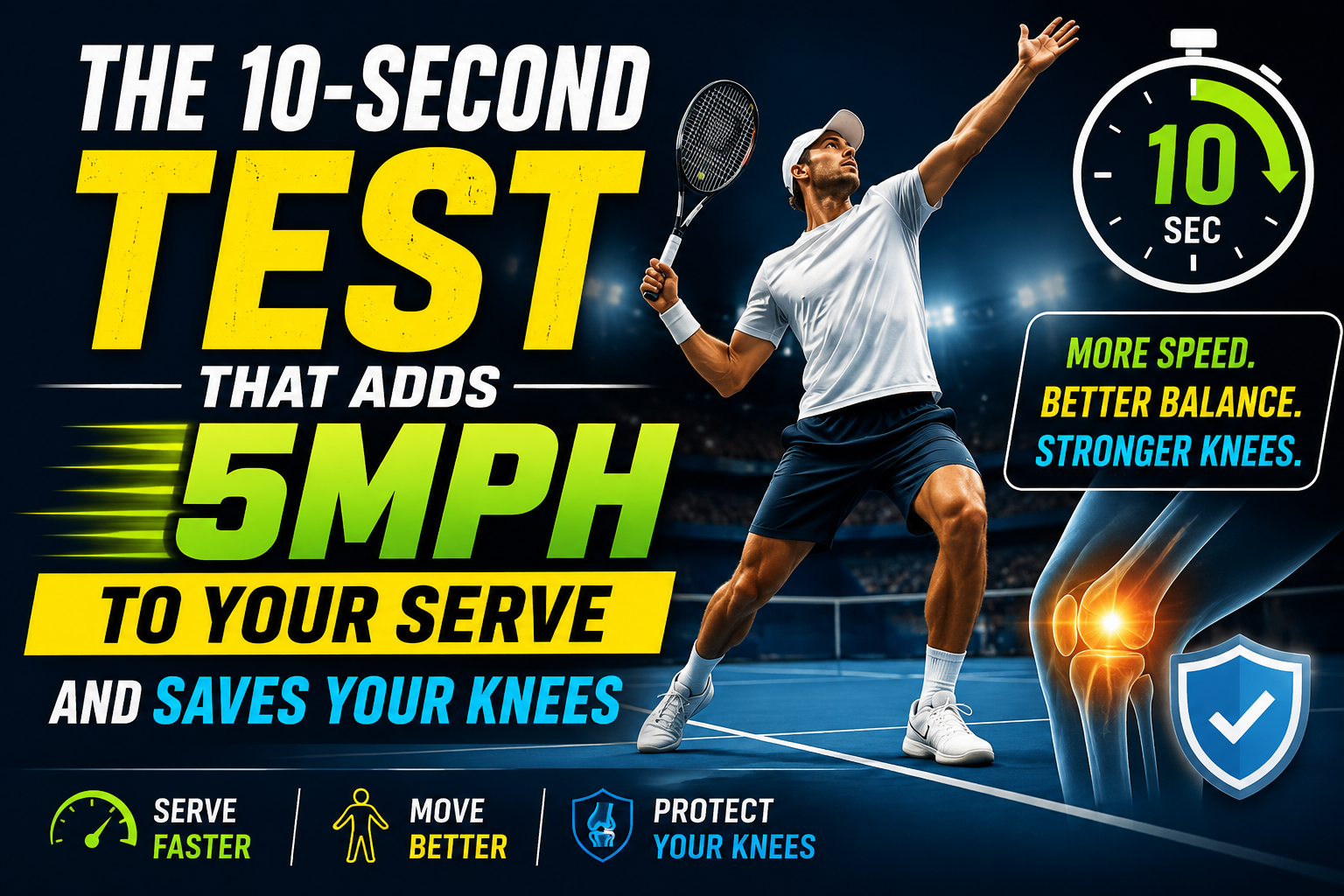
Forget just looking straight ahead. Do the 10-second test, but hold an imaginary racquet at the trophy position (serve toss). If you wobble on that standing leg, your kinetic chain is broken. You’re losing MPH on your flat serve. Fix that base, and you add 5mph without swinging harder.
2. The "Change-of-Direction" Warm-Up (Pre-Practice)
Do not just do this while brushing your teeth. That’s for amateurs.
In your daily warm-up, before you hit a single ball, do "The Pendulum":
- Balance on your right leg for 10 seconds.
- While balanced, slowly trace the "I, T, and L" pattern with your left toe on the ground (simulating a split-step recovery).
- Switch legs. Do this for 3 rounds.
- Why? Because tennis balance is dynamic, not static. This wakes up the glute medius, which keeps your knee tracking correctly when you push off wide.
3. The "Between-Points" Reset (On-Court Execution)
This is my favorite. After a long rally, instead of bouncing the ball with your racquet, do a 5-second one-leg balance check while waiting for the returner to get set.
If you can't hold a steady base for 5 seconds while fatigued, your brain is fried and your form is breaking. That is your cue to take a deep breath and engage your core before the next point. Use it as a neural reset.
4. The "Eyes-Closed" Finisher (Night Match Simulation)
In your cool-down (after stretching), do the 10-second test with your eyes closed. I guarantee you'll fail the first time. Tennis relies heavily on visual input, but when you're diving for a drop shot, your inner ear and nerves take over. Doing 3 sets of 10 seconds (eyes closed) on each leg post-practice trains the vestibular system to save you from those nasty ankle rolls on uneven courts.
The Expert Verdict:
Most recreational players train groundstrokes until their arms fall off but ignore the single-leg pillar. The good news? This is the cheapest, fastest way to extend your tennis longevity. If you are over 50 and can pass this test fresh, you can hang with the 30-year-olds in a 4.0 league.
Make it your bread and butter. Do it while waiting for your coffee, do it before you serve, and do it after a long rally. Your lateral movement will thank me when you're taking that ball on the rise instead of backing up. Now go hit the wall—safely.