
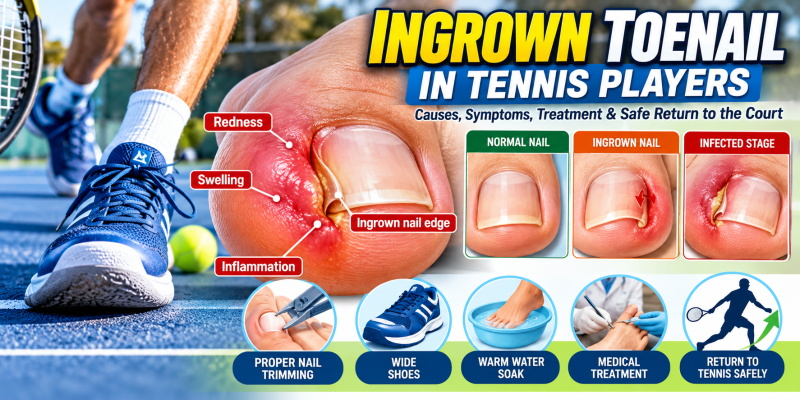
An ingrown toenail (onychocryptosis) can seem like a minor foot problem, but for tennis players it can become surprisingly painful. Every sprint, split step, lateral movement, and hard stop places pressure on the toes inside the tennis shoe.
When the edge of the toenail grows into the surrounding skin, it can cause pain, swelling, redness, inflammation, and sometimes infection. For competitive players, ignoring the problem can make ordinary court movement increasingly uncomfortable.
What Is an Ingrown Toenail?
An ingrown toenail occurs when the edge or corner of the toenail grows into the surrounding skin rather than forward over the toe.
It most commonly affects the big toe, although other toes can also be affected.
For tennis players, the combination of:
- Repeated sprinting
- Sudden braking
- Lateral court movement
- Tight or narrow tennis shoes
- Repetitive toe pressure
- Sweaty feet
- Repeated impact against the front of the shoe
can aggravate an already irritated nail.
Why Tennis Players Should Pay Attention
Tennis requires thousands of small foot movements during training and competition. During a hard change of direction, your toes help stabilize the foot inside the shoe.
If an ingrown toenail is present, this repeated pressure can irritate the skin around the nail and potentially make symptoms worse.
Ingrown Toenail Symptoms
Symptoms can develop gradually.
Early Symptoms
You may notice:
- Tenderness along one side of the toenail
- Mild redness
- Slight swelling
- Pain when wearing tennis shoes
- Discomfort when pressing on the toe
Moderate Symptoms
As irritation increases, you may experience:
- Increasing pain
- More noticeable swelling
- Redness around the nail
- Fluid or drainage
- Pain during walking or tennis
- Increased sensitivity inside the shoe
More Severe Symptoms
More advanced cases may develop:
- Pus
- Significant swelling
- Severe or throbbing pain
- Warmth around the toe
- Excess tissue or granulation tissue
- Redness spreading beyond the immediate nail area
Fever, chills, rapidly spreading redness, or worsening swelling should receive prompt medical attention.
What Causes Ingrown Toenails in Tennis Players?
1. Cutting the Toenail Too Short
One of the most common mistakes is cutting toenails extremely short or cutting deeply into the corners.
A better approach is generally to trim the nail relatively straight across and avoid aggressively digging into the sides.
2. Narrow Tennis Shoes
A tennis shoe that squeezes the toes can increase pressure against the nail.
Look for adequate:
- Toe-box width
- Toe-box height
- Overall foot stability
- Correct shoe length
Your toes should not repeatedly slam into the front of the shoe during hard stops.
3. Repetitive Tennis Trauma
Tennis involves constant acceleration and deceleration.
During aggressive movement, the toes can repeatedly experience pressure against the front or sides of the shoe.
This repeated micro-trauma may contribute to nail irritation.
4. Naturally Curved Toenails
Some people naturally have more curved or involuted toenails. This can increase their susceptibility to ingrown toenails.
5. Excessive Foot Moisture
Sweaty feet can soften the surrounding skin and contribute to friction inside the shoe.
Moisture management therefore matters for athletes who train frequently.
How Is an Ingrown Toenail Diagnosed?
Most ingrown toenails can be diagnosed through a physical examination.
A healthcare professional may examine:
- The nail edge
- Redness and swelling
- Drainage
- Granulation tissue
- Signs of infection
- Whether the problem is recurring
For people with diabetes, reduced circulation, neuropathy, or other conditions affecting wound healing, professional assessment is particularly important.
Ingrown Toenail Treatment
Treatment depends on how severe the problem is.
Mild Cases
For a mild ingrown toenail without significant infection, conservative care may include:
- Keeping the toe clean
- Wearing roomy footwear
- Reducing pressure on the toe
- Soaking the foot in warm water
- Keeping the area dry afterward
- Avoiding further aggressive nail trimming
Do not repeatedly dig into the nail corner or attempt to cut away a deeply embedded portion yourself.
What About Cotton or Dental Floss?
Some healthcare guidance uses a tiny amount of clean material under the nail edge in selected mild cases.
However, this should not be forced underneath a painful or deeply embedded nail. If the toe is significantly inflamed, draining pus, or infected, professional evaluation is more appropriate.
When Should a Tennis Player See a Doctor?
Seek medical evaluation if:
- Pain is getting worse
- Pus develops
- Redness is spreading
- The toe becomes increasingly warm or swollen
- Symptoms don't improve with conservative care
- The ingrown toenail repeatedly returns
- Walking becomes difficult
- You develop fever or feel generally unwell
A clinician may recommend treatment appropriate to the severity of the condition.
Partial Nail Removal
For a persistent or severe ingrown toenail, a healthcare professional may perform a partial nail avulsion.
The problematic section of nail is removed, usually under local anesthesia.
This can relieve the mechanical pressure caused by the nail edge.
For recurrent cases, a procedure targeting part of the nail matrix may be considered to reduce the likelihood that the problematic portion grows back.
How Tennis Shoes Can Contribute
A tennis shoe should provide stability without excessively compressing the toes.
When choosing footwear after an ingrown toenail, pay particular attention to the toe box.
Tennis Shoe Checklist
Look for:
- Adequate toe-box width
- Enough room for natural toe movement
- Correct shoe length
- Minimal toe pressure during lateral movement
- Good heel security
- Appropriate cushioning and stability
A wider shoe is not automatically better if your foot slides excessively inside it. The goal is secure heel and midfoot fit with adequate space for the toes.
Can You Play Tennis With an Ingrown Toenail?
This depends on the severity.
If the toe is only mildly irritated, you may be able to perform modified tennis activity if footwear does not increase the pain.
However, pain should not be used as something you simply push through.
Consider temporarily reducing:
- Match play
- Aggressive sliding
- Sprinting
- Hard braking
- High-intensity footwork drills
If the toe becomes more painful during or after tennis, that's a sign to reduce the load and reassess.
Returning to Tennis After Treatment
After Conservative Treatment
A gradual return may be reasonable once:
- Pain has substantially improved
- Swelling has settled
- Normal walking is comfortable
- Tennis shoes don't aggravate the toe
Start with:
Easy hitting → light footwork → controlled movement → normal practice → competitive play
Don't jump directly from a painful toe to a high-intensity match.
After Nail Surgery
Return depends on the procedure and how the wound heals.
The important milestones are:
- The wound is healing appropriately.
- Walking is comfortable.
- Tennis shoes don't create significant pressure.
- Lateral movement doesn't cause increasing pain.
- The treating clinician has no concerns about returning to sport.
A specific return-to-tennis timeline should therefore be individualized rather than based on a fixed number of days.
Tennis Expert Tip: Don't Ignore the Toe
From a tennis-performance perspective, an ingrown toenail can affect more than just the toe.
Pain may cause you to unconsciously change:
- Your split-step mechanics
- Push-off
- Lateral movement
- Deceleration
- Recovery position
- Weight distribution
That can make your movement less natural and potentially place additional stress on other parts of the foot and leg.
Treat the problem early rather than trying to compensate for it during competition.
How to Prevent Ingrown Toenails
Trim Toenails Correctly
Trim toenails relatively straight across and avoid cutting deeply into the corners.
Don't Cut Them Extremely Short
Leave enough nail to protect the end of the toe.
Choose Tennis Shoes Carefully
Make sure your toes aren't being compressed during:
- Split steps
- Sprints
- Lateral movement
- Hard stops
Keep Feet Dry
Change sweaty socks after training and allow tennis shoes to dry properly between sessions.
Protect Your Feet
If repeated toe trauma is occurring, examine your shoe fit and movement mechanics rather than simply covering the symptoms.
Final Tennis Doctor's Perspective
An ingrown toenail is usually manageable, but tennis players should not underestimate it.
Early tenderness can become significant inflammation or infection when repeated court pressure continues.
The goal isn't simply to get rid of the pain temporarily. The goal is to identify why the nail became irritated, correct the contributing factors, allow the tissue to heal, and then gradually return to tennis.
For recreational and competitive players alike, properly fitting tennis shoes, sensible nail trimming, foot hygiene, and early attention to symptoms can help keep a small toe problem from becoming a bigger interruption to your tennis season.
Medical note: This article provides general educational information and does not replace an examination by a doctor, podiatrist, or other qualified healthcare professional. Seek prompt medical care for spreading redness, significant infection, severe pain, fever, or other concerning symptoms.