
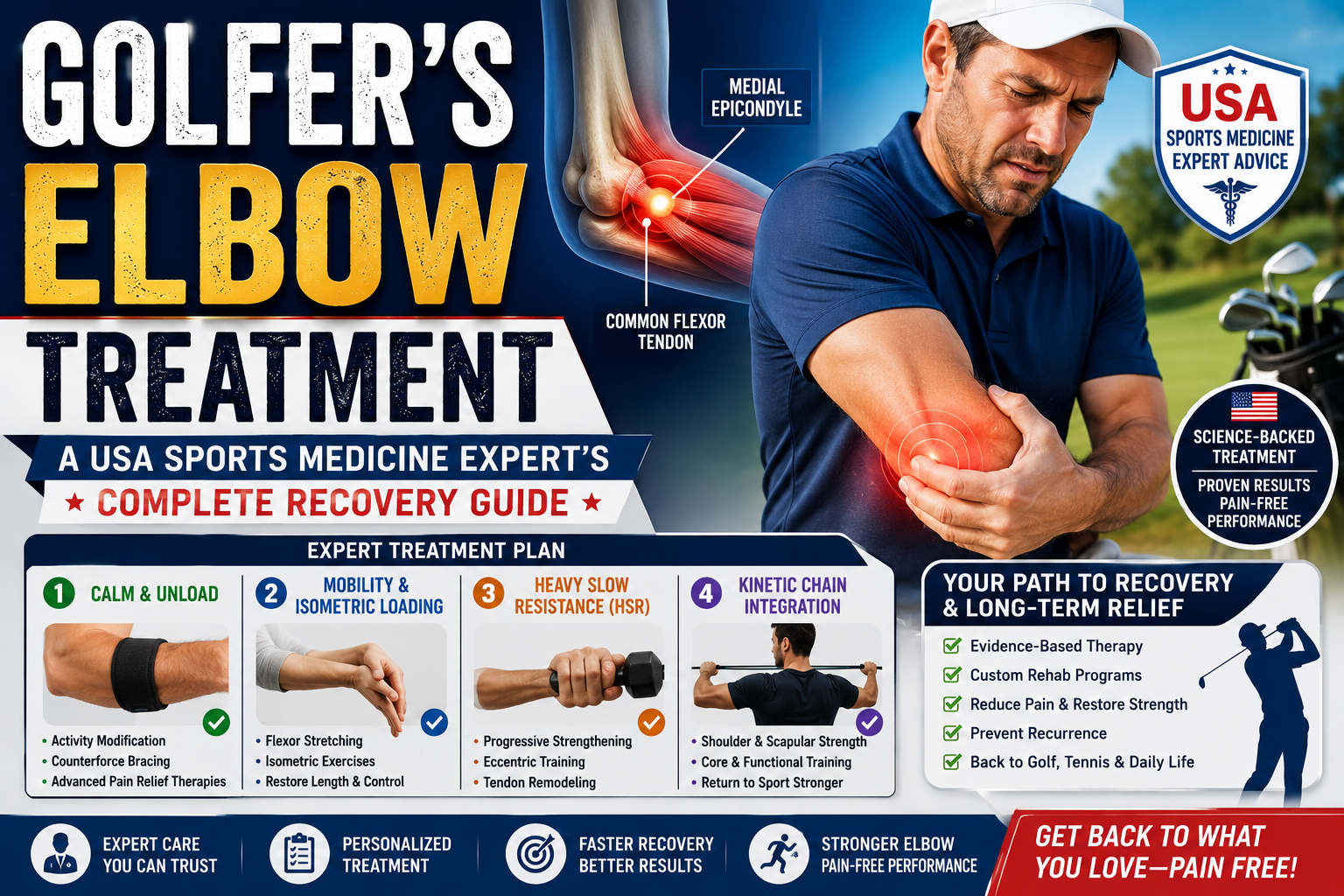
Golfer's Elbow (Medial Epicondylitis): A USA Sports Medicine Expert Explains the Latest Physical Therapy, Progressive Tendon Rehabilitation, and Proven Recovery Protocols Used by America's Leading Medical Centers
Golfer's elbow, medically known as medial epicondylitis, is one of the most misunderstood overuse injuries affecting athletes, recreational sports enthusiasts, manual laborers, and fitness enthusiasts throughout the United States. Despite its name, only a small percentage of patients actually develop the condition from playing golf. Tennis players, baseball pitchers, weightlifters, rock climbers, CrossFit athletes, construction workers, mechanics, plumbers, carpenters, and individuals performing repetitive gripping tasks are equally susceptible.
For decades, the injury was commonly described as a simple tendon inflammation. However, modern sports medicine research has dramatically changed that understanding.
Today, leading American institutions—including the Mayo Clinic, Cleveland Clinic, Mass General Brigham Sports Medicine, and orthopedic specialists affiliated with the American Academy of Orthopaedic Surgeons (AAOS)—recognize that chronic golfer's elbow is primarily a degenerative tendon disorder (tendinosis) rather than an inflammatory condition. This distinction is critically important because it completely changes how rehabilitation should be approached.
Instead of relying on prolonged rest, repeated cortisone injections, or passive treatments alone, contemporary American rehabilitation programs emphasize progressive tendon loading, mechanical remodeling, kinetic chain correction, and graduated return-to-sport protocols.
The goal is no longer simply reducing pain.
The goal is rebuilding a healthier, stronger tendon that can tolerate normal daily activities and high-level athletic performance.
Understanding Golfer's Elbow
Golfer's elbow develops where the common flexor tendon attaches to the medial epicondyle, the bony prominence on the inside of the elbow.
The muscles originating here are responsible for:
- Wrist flexion
- Finger flexion
- Forearm pronation
- Grip strength
- Stabilizing the wrist during lifting, throwing, and racquet sports
Unlike muscles, tendons receive relatively poor blood circulation. This limited vascular supply explains why tendon injuries heal much more slowly than muscle strains and why simply resting often fails to restore normal tendon structure.
Over time, repetitive stress produces:
- Collagen fiber disorganization
- Micro-tearing
- Reduced tendon strength
- Poor mechanical capacity
- Chronic pain during gripping and lifting
This process is known as tendinosis.
Why Modern USA Sports Medicine Avoids Prolonged Rest
One of the biggest changes in American rehabilitation philosophy is the understanding that complete inactivity weakens tendons.
When tendons are unloaded for extended periods:
- Collagen fibers become weaker
- Tendon stiffness decreases
- Muscle strength declines
- Joint stability deteriorates
- Recovery becomes longer
Instead, physical therapists prescribe carefully controlled loading.
Mechanical stress applied correctly stimulates:
- New collagen formation
- Improved tendon organization
- Increased tensile strength
- Better pain tolerance
- Enhanced functional performance
This concept forms the foundation of nearly every evidence-based rehabilitation program in sports medicine today.
Phase One: Calming the Painful System
The first rehabilitation phase focuses on reducing excessive mechanical stress while maintaining gentle movement.
Pain is often amplified not only by the injured tendon but also by surrounding nerve irritation.
The ulnar nerve, which travels behind the inside of the elbow, may become hypersensitive in some patients.
Reducing nerve irritation is one of the earliest priorities.
Activity Modification
Rather than stopping all movement, American physical therapists recommend temporarily reducing activities that overload the flexor tendon.
Common aggravating activities include:
- Heavy lifting
- Tight gripping
- Carrying heavy grocery bags
- Pull-ups
- Heavy deadlifts
- Repetitive hammering
- Golf swings
- Tennis serves
- Baseball throwing
Relative rest allows the irritated tendon to settle without causing deconditioning.
Counterforce Bracing
Many sports medicine physicians recommend a medial epicondylitis strap.
The brace is positioned approximately:
1–2 inches below the medial epicondyle.
Its function is mechanical.
Instead of allowing all force to concentrate at the tendon attachment, the strap redistributes tension into the forearm muscles.
Many patients experience immediate symptom reduction during daily activities.
However, braces are considered temporary aids—not permanent solutions.
Physical Therapy Modalities Used in the USA
Sports medicine centers frequently combine exercise with specialized therapeutic technologies.
These may include:
Extracorporeal Shockwave Therapy (ESWT)
Shockwave therapy delivers controlled acoustic energy into the tendon.
Potential benefits include:
- Increased local circulation
- Stimulation of tissue remodeling
- Reduction of chronic pain sensitivity
- Breakdown of abnormal scar tissue
Although not appropriate for every patient, ESWT has shown encouraging results for chronic tendinopathy that has not responded to conventional care.
Interferential Current Therapy (IFC)
Interferential Current Therapy uses intersecting electrical currents to reduce pain.
Potential effects include:
- Improved circulation
- Muscle relaxation
- Temporary pain relief
- Enhanced tolerance for exercise
IFC is typically used alongside an active rehabilitation program rather than as a stand-alone treatment.
Phase Two: Restoring Mobility
Once severe resting pain improves, therapists begin restoring flexibility.
A shortened flexor muscle group increases tendon stress with every gripping movement.
Wrist Flexor Stretch
One commonly prescribed stretch involves:
- Straighten the elbow completely.
- Turn the palm upward.
- Extend the wrist.
- Gently pull the fingers downward using the opposite hand.
Patients should feel a gentle stretch along the inner forearm—not sharp pain.
Typical recommendation:
- Hold 15–30 seconds
- Repeat 3–5 times
- Perform several sessions daily
Isometric Loading
Before introducing repetitive movement, therapists often prescribe isometric contractions.
An isometric exercise contracts the muscle without joint motion.
Example:
Hold a light dumbbell with the wrist in a neutral position.
Maintain the position for:
10–15 seconds.
Benefits include:
- Reduced tendon pain
- Improved muscle activation
- Increased tendon tolerance
- Minimal mechanical irritation
Many patients notice pain reduction immediately after properly performed isometric exercises.
Phase Three: Heavy Slow Resistance (HSR)
Heavy Slow Resistance training has become one of the most important evidence-based approaches for chronic tendinopathy.
Instead of quick repetitions, patients perform slow, controlled movements under gradually increasing resistance.
The slow eccentric phase appears especially beneficial for collagen remodeling.
Why Eccentric Training Works
During the lowering phase of an exercise, the tendon experiences controlled tension.
Research suggests this mechanical loading stimulates:
- Collagen synthesis
- Fiber alignment
- Increased tendon stiffness
- Improved force transmission
The tendon essentially learns to tolerate stress again.
Stage One: Supported 90 Degrees
Patients begin with:
- Elbow bent to 90°
- Forearm resting on a table
- Wrist extending beyond the edge
This minimizes unwanted shoulder involvement while focusing directly on the flexor tendon.
Stage Two: Partial Elbow Extension
As symptoms improve:
The elbow gradually straightens.
This increases the mechanical challenge while maintaining arm support.
Stage Three: Fully Extended Arm
The final progression removes external support.
The elbow remains straight.
The shoulder stabilizes the arm.
The entire kinetic chain contributes.
This stage better simulates sporting activities.
Resisted Wrist Flexion
The cornerstone exercise involves:
- Palm facing upward
- Curl weight upward over one second
- Pause briefly
- Lower slowly over three seconds
The slow lowering phase is the therapeutic component.
Patients should avoid dropping the weight quickly.
Forearm Rotation Training
The forearm naturally rotates throughout daily life.
Weakness during rotation increases tendon strain.
Using:
- Hammer
- Weighted rod
- Small dumbbell
Patients perform slow:
- Pronation
- Supination
These exercises strengthen muscles frequently overlooked during rehabilitation.
Progressive Overload
One of the biggest mistakes patients make is increasing weight too quickly.
American rehabilitation protocols typically recommend progressing only after:
- 30 pain-free repetitions
- Two consecutive successful sessions
- No symptom flare-up the following day
Weight increases should be gradual.
Usually:
1-pound increments.
Small improvements produce long-term tendon adaptation.
Phase Four: Restoring the Entire Kinetic Chain
Modern rehabilitation recognizes that elbow injuries rarely originate solely at the elbow.
Weakness elsewhere forces the forearm to compensate.
The shoulder, trunk, hips, and legs all contribute to upper limb force production.
Scapular Stability
The shoulder blade serves as the foundation of arm movement.
Weak scapular stabilizers cause excessive strain downstream.
Important muscles include:
- Lower trapezius
- Middle trapezius
- Rhomboids
- Serratus anterior
Common exercises include:
- Wall slides
- Resistance rows
- Serratus punches
- Prone Y raises
Improved scapular control allows the shoulder to transfer force efficiently.
Rotator Cuff Strength
The rotator cuff keeps the shoulder centered during movement.
Weak cuff muscles increase compensatory forearm activation.
Therapists often prescribe:
- External rotations
- Internal rotations
- Side-lying raises
- Band exercises
These improve shoulder endurance and reduce elbow overload.
Core Strength Matters
Power should travel:
Legs
Hips
Core
Shoulder
Arm
Hand
Sport implement
Weak core muscles interrupt this sequence.
The forearm becomes the body's emergency power source.
Eventually the tendon fails.
Returning to Golf, Tennis, or Work
Pain alone should never determine readiness.
Instead, therapists evaluate:
- Grip strength
- Wrist strength
- Endurance
- Functional testing
- Sport-specific movement
Most sports medicine specialists recommend achieving at least:
90% strength compared with the opposite arm
before unrestricted return to sport.
Technique Correction
Many patients experience recurring symptoms because the original mechanical problem remains.
Examples include:
Golf:
- Excessive wrist flexion
- Poor swing sequencing
- Gripping the club too tightly
Tennis:
- Late ball contact
- Wrist snapping
- Incorrect grip size
Weightlifting:
- Excessive wrist bending
- Poor pulling mechanics
Correct technique reduces future tendon overload.
Nutrition for Tendon Recovery
Healthy tendons require appropriate nutrition.
Sports dietitians often recommend:
- High-quality protein
- Vitamin C-rich foods
- Omega-3 fatty acids
- Adequate hydration
- Collagen-rich foods
Proper nutrition supports collagen synthesis during rehabilitation.
Sleep and Tissue Remodeling
Most tendon repair occurs during recovery—not during exercise.
Seven to nine hours of quality sleep promotes:
- Growth hormone release
- Protein synthesis
- Reduced fatigue
- Improved healing capacity
Poor sleep is consistently associated with slower recovery.
When Surgery Is Considered
Fortunately, surgery is rarely necessary.
Most patients improve significantly with structured rehabilitation over several months.
Surgical consultation may be appropriate when:
- Symptoms persist beyond 6–12 months
- Significant tendon degeneration exists
- Conservative care fails
- Functional limitations remain severe
Even after surgery, progressive rehabilitation remains essential.
Preventing Recurrence
Successful long-term prevention includes:
- Proper warm-up
- Gradual workload increases
- Regular forearm strengthening
- Shoulder stability exercises
- Correct sporting technique
- Appropriate equipment
- Adequate recovery days
- Avoiding sudden spikes in activity
Consistency matters far more than occasional intense exercise sessions.
Final Thoughts
The modern American approach to treating Golfer's Elbow (Medial Epicondylitis) has shifted from passive rest to active tendon rehabilitation based on the science of tissue remodeling. Leading sports medicine centers recognize that this condition is typically a chronic degenerative tendinopathy rather than a simple inflammatory problem, meaning recovery depends on rebuilding tendon capacity—not merely reducing pain.
Evidence-based rehabilitation follows a progressive pathway: calming irritated tissues through activity modification and selective bracing, restoring flexibility and pain-free movement with stretching and isometric loading, rebuilding tendon strength through Heavy Slow Resistance and eccentric exercises, and finally integrating the shoulder, core, and entire kinetic chain to eliminate the mechanical overload that caused the injury.
For athletes, recreational golfers, tennis players, manual workers, and anyone who depends on strong grip strength, patience and consistency are essential. Recovery rarely happens overnight, but with structured rehabilitation, gradual progression, proper technique, and attention to whole-body mechanics, the vast majority of individuals can return safely to their sport or occupation with restored strength, improved tendon resilience, and a substantially lower risk of recurrence.