Quick Overview
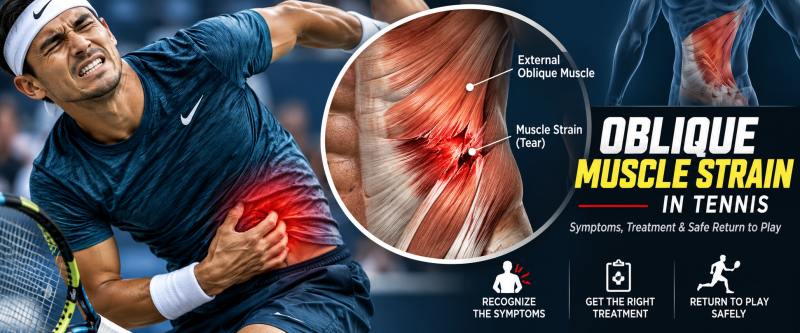
An oblique muscle strain occurs when one of the muscles along the side of the abdomen—the internal or external oblique—is overstretched or torn.
For tennis players, this is a classic rotational injury. The obliques help generate and control trunk rotation during powerful serves, forehands, backhands, and overheads.
The injury often happens when the abdominal muscles have to produce or control a large amount of force very quickly.
Tennis doctor’s advice: If you feel a sudden sharp pain along your side during a serve or overhead, stop playing. Continuing to hit through the pain can turn a manageable muscle injury into a longer-lasting problem.
What Does an Oblique Strain Feel Like?
An oblique strain typically causes localized pain along the side of the abdomen or lower rib area.
Common symptoms include:
-
Sudden sharp or stabbing pain
-
Pain along the side of the abdomen or waist
-
Tenderness when pressing the affected area
-
Pain during trunk rotation
-
Pain when bending sideways
-
Pain when coughing or sneezing
-
Pain with a deep breath in some cases
-
Muscle tightness or spasm
-
Bruising or swelling with a more significant tear
-
Reduced ability to generate rotational power
A tennis player may notice the injury immediately during one particular serve or stroke.
Other players develop gradually increasing soreness after repeated high-intensity serving.
Why Do Tennis Players Strain Their Obliques?
The obliques are heavily involved in rotating, stabilizing, and transferring force through the trunk.
1. The Serve
The tennis serve creates a rapid sequence of loading and unloading through the trunk.
The player coils the body and then explosively uncoils toward the ball.
The obliques help control this powerful rotation.
If the load becomes excessive, a muscle strain can occur.
2. Overhead Smashes
Overheads can place similar rotational and extension demands on the abdominal wall.
Repeated overheads, especially late in a session, can fatigue the trunk muscles.
3. Repetitive Rotation
Tennis isn't just about producing rotation.
The player also has to stop and control rotation.
The obliques therefore experience both concentric and eccentric loading during aggressive strokes.
4. Sudden Deceleration
A player may rotate aggressively to hit the ball and then need to rapidly stop that movement to recover.
This sudden eccentric demand can stress the oblique muscles.
5. Training Errors
A common pattern is:
Several days with little tennis → intense serving session → sudden side pain.
The muscles may simply not be prepared for the sudden increase in workload.
Oblique Strain vs. Other Causes of Side Pain
Not every pain near the ribs or abdomen is an oblique strain.
Possible causes can include:
-
Rib or intercostal muscle injury
-
Abdominal muscle strain
-
Hernia
-
Hip-related pain
-
Lumbar spine problems
-
Rib injury
-
Other medical causes of abdominal or chest discomfort
The location and movement that triggers pain can provide clues, but a diagnosis requires proper clinical assessment when symptoms are significant or persistent.
How Is an Oblique Strain Diagnosed?
Diagnosis usually starts with a sports-medicine history and physical examination.
A clinician may assess:
-
Exact location of tenderness
-
Pain during trunk rotation
-
Side-bending strength
-
Abdominal contraction
-
Rib and thoracic movement
-
Bruising or swelling
-
Functional movement
-
The specific tennis stroke that caused the injury
Ultrasound
Musculoskeletal ultrasound can sometimes identify a muscle tear and assess the abdominal wall dynamically.
MRI
MRI provides detailed images of muscle and soft tissue and may be considered when the diagnosis is uncertain or a significant tear is suspected.
Imaging isn't necessary for every mild muscle strain.
What Should You Do Immediately?
Stop Serving and Overheads
If a serve or overhead causes sharp side pain, stop the activity.
Don't repeatedly test the same stroke.
Relative Rest
Temporarily avoid movements that clearly reproduce pain, including:
-
Serving
-
Overheads
-
Powerful rotational strokes
-
Heavy lifting
-
Aggressive side bending
-
High-intensity abdominal exercises
Cold Therapy
A cold pack may help with short-term pain during the early stage.
Apply it for approximately 15–20 minutes at a time, protecting the skin with a cloth.
Maintain Comfortable Movement
Complete inactivity is not always necessary.
Pain-free walking and other comfortable activities may be maintained as tolerated.
Treatment for Tennis Players
Treatment depends on the severity of the muscle injury.
Early Protection
The first goal is to stop repeatedly stressing the injured muscle.
Don't attempt maximum-effort serving while the muscle is still painful.
Pain Medication
NSAIDs such as ibuprofen can help some people with short-term pain, but they aren't appropriate for everyone.
Consider your medical history, allergies, kidney function, stomach health, cardiovascular risks, and other medications.
When uncertain, ask a healthcare professional or pharmacist.
Progressive Rehabilitation
Rehabilitation should gradually expose the obliques to increasing levels of force.
Stage 1 — Isometric Control
Start with exercises that activate the trunk without significant movement, when tolerated.
Examples may include:
-
Gentle abdominal bracing
-
Modified side plank
-
Pain-free stabilization exercises
Stage 2 — Strength & Stability
Progress toward:
-
Side planks
-
Dead bugs
-
Bird-dogs
-
Pallof presses
-
Controlled trunk stabilization
Stage 3 — Rotation
Once strength and symptoms allow, introduce controlled rotational exercises.
Examples may include:
-
Cable rotations
-
Medicine-ball movements
-
Controlled trunk rotation
Stage 4 — Explosive Loading
Eventually progress toward tennis-specific explosive movements.
The athlete should be able to tolerate increasing rotational speed before returning to maximum-power serving.
How Long Does an Oblique Strain Take to Heal?
Recovery depends heavily on the severity of the injury.
A mild strain may settle relatively quickly.
A larger partial tear can require considerably longer rehabilitation.
Factors affecting recovery include:
-
Size of the tear
-
Location of the injury
-
Previous injury history
-
Conditioning level
-
Training volume
-
Rehabilitation
-
How quickly high-intensity rotation is reintroduced
Don't use a fixed recovery period as the only criterion for returning to tennis.
Function matters more than the calendar.
How Can Tennis Players Prevent Oblique Strains?
Improve Serve Mechanics
A well-coordinated serve uses the entire kinetic chain:
Leg drive → hips → trunk → shoulder → arm → racket
The goal isn't to eliminate trunk rotation.
The goal is to distribute the workload efficiently rather than placing excessive stress on one part of the body.
Improve Thoracic Mobility
The thoracic spine is designed to contribute to rotation.
Maintaining appropriate thoracic mobility can help the player rotate without forcing all of the movement through the lumbar spine and abdominal wall.
Train Rotation and Anti-Rotation
Tennis players need both:
The ability to rotate
and
the ability to resist unwanted rotation.
Useful training may include:
-
Side planks
-
Pallof presses
-
Cable rotations
-
Medicine-ball throws
-
Controlled trunk exercises
Warm Up Progressively
Before maximum-power serving:
-
Warm up the whole body
-
Activate the core
-
Perform dynamic trunk movements
-
Shadow the serve
-
Hit easy serves
-
Gradually increase speed
Don't make your first serve of the session a maximum-effort serve.
Manage Serving Volume
Avoid sudden increases in serving practice.
If you've taken several weeks away from tennis, rebuild gradually rather than immediately returning to your previous workload.
Return to Tennis After an Oblique Strain
The biggest mistake is returning to the serve before the abdominal wall is ready for explosive rotation.
Phase 1 — Tissue Healing
Initially avoid:
-
Serving
-
Overheads
-
Powerful rotation
-
Heavy abdominal training
Normal activities such as walking should progressively become comfortable.
You should not have significant pain simply from coughing, sneezing, or ordinary trunk movement before progressing.
Phase 2 — Core Activation
Begin appropriate rehabilitation with:
-
Gentle abdominal activation
-
Modified side planks
-
Bird-dogs
-
Dead bugs
-
Controlled stabilization exercises
The objective is to restore trunk control without provoking sharp pain.
Phase 3 — Controlled Tennis
Begin with:
-
Shadow swings
-
Easy groundstrokes
-
Compact strokes
-
Short cooperative rallies
Keep intensity and rotational demands relatively low.
Avoid maximum-power serving initially.
Phase 4 — Progressive Rotation
Gradually increase:
-
Stroke speed
-
Trunk rotation
-
Court movement
-
Rally intensity
-
Overhead activity
If pain returns or progressively increases, reduce the load and reassess.
Phase 5 — Return to Serving
Serving should be reintroduced gradually.
A practical progression is:
Easy serves → moderate serves → faster serves → normal practice
You can also increase volume gradually rather than attempting a full serving session immediately.
Phase 6 — Full Competition
Match play comes last.
Before returning to unrestricted competition, you should be able to:
-
Serve
-
Hit overheads
-
Rotate explosively
-
Sprint
-
Change direction
-
Recover between points
without significant pain or loss of strength.
When Should a Tennis Player See a Doctor?
Get evaluated if:
-
Pain is severe
-
You felt a sudden pop
-
Significant bruising develops
-
You notice a visible lump or bulge
-
Pain persists despite reducing activity
-
Symptoms repeatedly return when serving
-
Pain interferes with normal daily activities
-
You are unsure whether the pain is muscular
Seek urgent medical attention for severe or unexplained abdominal or chest-area pain, particularly when accompanied by symptoms such as difficulty breathing, fainting, fever, vomiting, or rapidly worsening pain.
Tennis Doctor's Bottom Line
The obliques are part of your tennis power system.
They help transfer force from your legs and hips through your trunk and into the racket.
That means a powerful serve can place tremendous demands on these muscles.
If you feel a sudden sharp pain on the side of your abdomen during a serve or overhead, don't try to hit through it.
The smarter progression is:
Protect → activate → strengthen → rotate → hit → serve → compete.
And remember:
Being able to walk pain-free does not necessarily mean your obliques are ready for a maximum-effort tennis serve.
Build the tissue's capacity gradually, restore rotational strength, and return to competition only when your body can handle the demands of tennis again.