
Protect Your Back, Improve Your Mobility, and Keep Playing Tennis for Years to Come
Tennis is a sport of speed, coordination, balance, strategy, and endurance. For players between the ages of 40 and 75, staying competitive is not only about hitting powerful forehands or serving with accuracy. It is also about maintaining proper body alignment, joint mobility, muscle flexibility, and balance.
As we grow older, our bodies naturally change. Muscles may become less flexible, joint mobility can decrease, and recovery after intense matches may take longer. Repeated twisting, sudden stops, reaching for wide balls, and bending to retrieve low shots can place additional stress on the lower back, hips, knees, shoulders, and ankles.
The good news is that regular, gentle stretching and strength exercises can help older tennis players maintain mobility, improve movement control, and continue enjoying the game.
The goal is not to move like a 20-year-old. The goal is to move efficiently, play intelligently, and remain healthy enough to enjoy tennis for decades.
1. Why Body Alignment Matters in Tennis
Body alignment refers to how the head, spine, pelvis, hips, knees, and feet work together during movement. Good alignment helps distribute forces more efficiently instead of repeatedly placing excessive stress on one area.
For example, when a player reaches for a wide forehand, poor foot positioning combined with excessive trunk twisting may place unnecessary strain on the lower back. A controlled split step, appropriate footwork, and coordinated hip and trunk rotation can help the player reach the ball more safely.
Important alignment principles include:
-
Neutral spine: Maintain a comfortable, natural spinal position instead of forcing the back into an extreme arch or rounded posture.
-
Stable hips and pelvis: Develop control during lunges, recovery steps, and changes of direction.
-
Knee and foot coordination: Keep the knees generally tracking in the same direction as the toes during squats and lunges.
-
Balanced rotation: Generate racket speed through coordinated leg drive, hip rotation, trunk movement, and shoulder action rather than forcing the lower back to do all the work.
-
Good recovery footwork: Return to a balanced position after each shot instead of remaining stretched out or off balance.
Alignment is not about keeping the body perfectly straight at all times. Tennis requires dynamic movement. The objective is to control that movement while adapting to the ball.
2. Eight Exercises for Back Mobility and Tennis Readiness
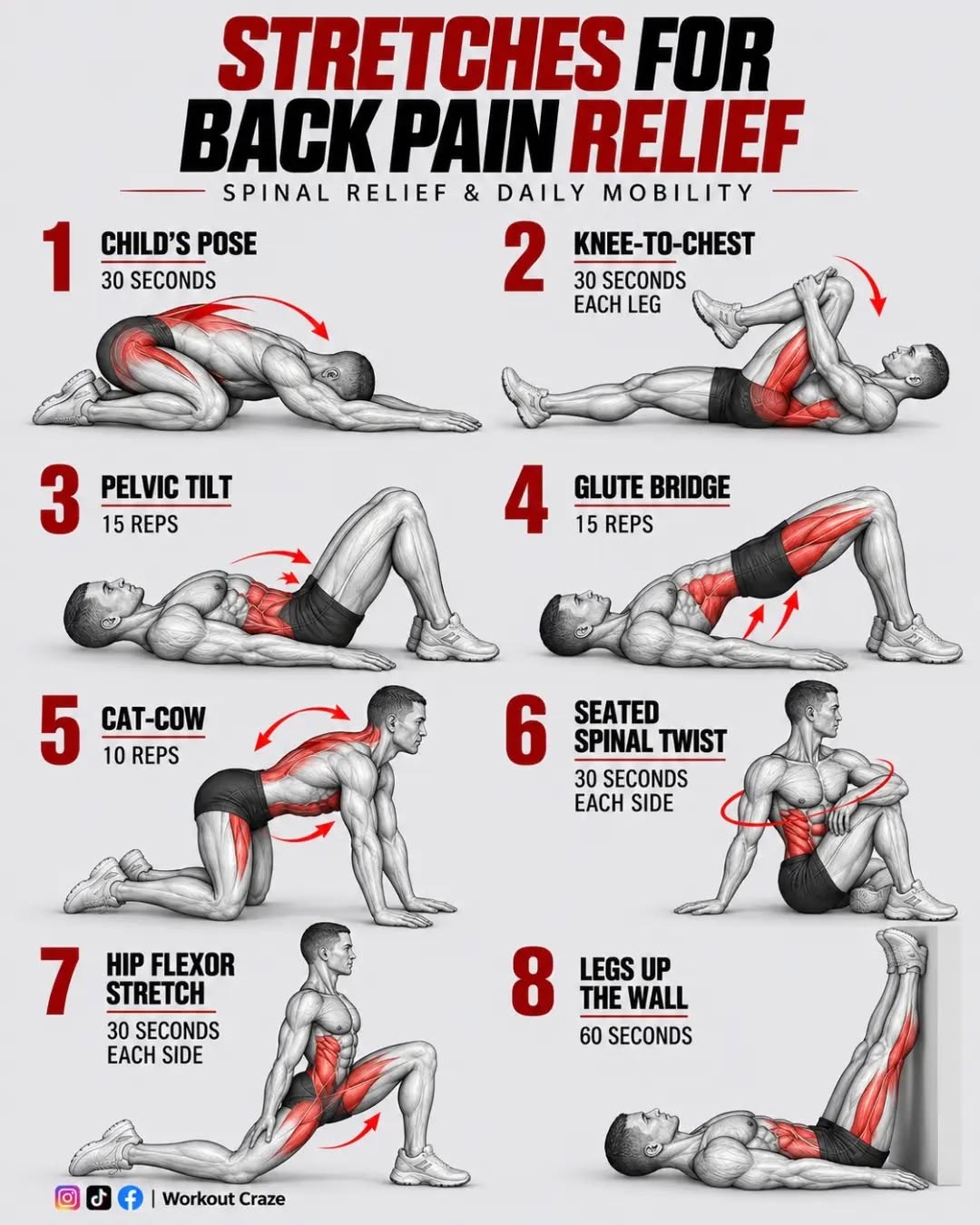
The accompanying stretching illustration presents eight exercises that can form part of a gentle mobility routine. These movements are particularly relevant for recreational tennis players who experience stiffness after sitting, working, or playing matches.
Exercise 1: Child's Pose
Suggested duration: 20–30 seconds, if comfortable.
Kneel on a mat, move your hips toward your heels, and extend your arms forward. Breathe slowly while relaxing into a comfortable position.
Potential benefits:
-
Gently stretches the back and hips.
-
Encourages relaxation after prolonged activity.
-
Helps some players feel less stiff after sitting.
Modify the position with a cushion under your hips or chest if needed. Avoid forcing the knees or lower back into a painful position.
Exercise 2: Knee-to-Chest Stretch
Suggested duration: 15–30 seconds per leg.
Lie on your back with your knees bent. Bring one knee gently toward your chest while keeping the other leg in a comfortable position.
Potential benefits:
-
Gently moves the hips and lower back.
-
May reduce the sensation of stiffness in some people.
-
Encourages controlled movement without standing balance demands.
Do not pull forcefully on your knee. If the position causes radiating pain, tingling, or numbness, stop.
Exercise 3: Pelvic Tilts
Suggested repetitions: 8–15 controlled repetitions.
Lie on your back with your knees bent and feet flat on the floor. Gently tighten your abdominal muscles to move your pelvis and flatten your lower back toward the floor, then relax.
Potential benefits:
-
Develops awareness of pelvic positioning.
-
Encourages controlled trunk movement.
-
Provides a gentle introduction to core muscle activation.
Move slowly and breathe normally. Avoid pushing hard through the feet or holding your breath.
Exercise 4: Glute Bridges
Suggested repetitions: 8–15 repetitions.
Lie on your back with your knees bent and feet about hip-width apart. Tighten your gluteal muscles and lift your hips until your shoulders, hips, and knees form an approximately straight line. Lower slowly.
Potential benefits:
-
Strengthens the gluteal muscles.
-
Supports hip extension used during tennis movement.
-
Helps develop strength around the hips and trunk.
Do not overarch your lower back at the top. Start with a small lift if your back is sensitive.
Exercise 5: Cat-Cow
Suggested repetitions: 8–10 slow cycles.
Start on your hands and knees. Slowly round your back, then move toward a gentle arch while keeping the movement comfortable.
Potential benefits:
-
Encourages spinal mobility.
-
Helps players practice controlled trunk movement.
-
Provides a gentle warm-up before more demanding exercises.
Avoid forcing either position. Players with wrist discomfort can try a modified version with their hands supported on a stable elevated surface.
Exercise 6: Seated Spinal Rotation
Suggested duration: 15–20 seconds per side.
Sit upright on a stable chair or on the floor with your legs comfortably positioned. Rotate your upper body gently to one side, keeping the movement within a pain-free range.
Potential benefits:
-
Encourages comfortable trunk rotation.
-
Helps maintain rotational mobility for everyday movement.
-
Supports body awareness during tennis preparation.
Do not use your arms to force a deeper twist. Players with osteoporosis, known spinal fractures, or significant back problems should ask a healthcare professional which rotational movements are appropriate.
Exercise 7: Hip Flexor Stretch
Suggested duration: 20–30 seconds per side.
Begin in a supported half-kneeling position, with one foot forward and the opposite knee on a padded surface. Gently shift your pelvis forward while keeping your torso upright.
Potential benefits:
-
Stretches the front of the hip.
-
May help reduce the feeling of tightness after prolonged sitting.
-
Supports comfortable hip extension when walking and running.
Keep the stretch mild. Avoid arching your lower back to create a deeper stretch. Use a chair or wall for balance if needed.
Exercise 8: Legs Up the Wall
Suggested duration: 1–3 minutes, if comfortable.
Lie on your back with your legs resting against a wall. Move closer to or farther from the wall to find a comfortable position.
Potential benefits:
-
Offers a gentle resting position after activity.
-
Allows the legs to relax without standing.
-
May feel soothing after a long day on the court.
This exercise is optional. Come out of the position slowly, and stop if you experience dizziness, discomfort, or unusual symptoms. It is not a proven treatment for back injuries.
3. A Practical Daily Routine for Tennis Players Aged 40–75
You do not need to perform every exercise for a long time. Consistency and comfort are more important than pushing for maximum flexibility.
| Activity | Suggested duration | Main purpose |
|---|---|---|
| Easy walking or marching | 5 minutes | Warm up the body |
| Cat-Cow | 8–10 repetitions | Gentle spinal mobility |
| Pelvic tilts | 8–15 repetitions | Pelvic control |
| Glute bridges | 8–12 repetitions | Hip and glute strength |
| Knee-to-chest stretch | 15–30 seconds per leg | Comfortable hip and back mobility |
| Hip flexor stretch | 20–30 seconds per side | Front-of-hip flexibility |
| Child's Pose or Legs Up the Wall | 1–3 minutes | Relaxation and gentle mobility |
This routine may take approximately 10–15 minutes, depending on rest periods and modifications.
You can begin with fewer exercises and gradually add more as your body adapts. Stretching should create a gentle pulling sensation, not sharp pain.
4. How Your Routine Should Change With Age
Chronological age alone does not determine what a tennis player can do. Your fitness, previous injuries, balance, medical history, and training experience are also important.
Ages 40–49: Build Efficient Movement
Focus on maintaining strength, hip mobility, trunk control, and good movement mechanics. Avoid assuming that a strong competitive level means your body can tolerate unlimited training.
-
Warm up before intense rallies.
-
Include strength training at least twice weekly if appropriate.
-
Avoid suddenly increasing match frequency or training intensity.
-
Practise controlled footwork and recovery positioning.
Ages 50–59: Protect Mobility and Recovery
Pay closer attention to recovery between matches and the way your back, shoulders, knees, and Achilles tendons respond to training.
-
Include regular balance and leg-strength exercises.
-
Build hip and ankle mobility gradually.
-
Reduce unnecessary reaching by improving court positioning.
-
Allow adequate recovery after demanding matches.
Ages 60–69: Prioritize Balance, Strength, and Control
Players in this age group can continue developing skill and fitness, but the training plan should reflect individual ability.
-
Use a longer, gradual warm-up.
-
Practise controlled lateral steps and changes of direction.
-
Use a stable support when learning new balance exercises.
-
Consider doubles, shorter sessions, or modified court drills when appropriate.
Ages 70–75: Keep Movement Safe and Enjoyable
The objective is to preserve independence, confidence, coordination, and enjoyment while managing individual physical limitations.
-
Start with comfortable walking and gentle mobility.
-
Use a chair or wall for support when needed.
-
Choose appropriate court surfaces and footwear.
-
Increase training gradually and avoid rushing for difficult balls when off balance.
-
Consult a healthcare professional or qualified physiotherapist if you have persistent pain, falls, or significant mobility limitations.
Older age does not automatically mean you must stop playing tennis. The appropriate level of activity depends on your health and physical capacity.
5. Why Strength Is Just as Important as Stretching
Stretching can improve flexibility and comfortable range of motion, but it does not replace strength training. Tennis requires the body to absorb force, accelerate, decelerate, and maintain balance.
A well-rounded routine can include:
-
Glute bridges or supported sit-to-stands: Develop hip and leg strength.
-
Calf raises: Build calf strength for walking and court movement.
-
Supported single-leg balance: Practise stability and body control.
-
Resistance-band rows: Strengthen upper-back muscles.
-
Gentle core exercises: Improve trunk control during movement.
Start with a manageable number of repetitions and maintain good technique. Increase resistance or volume gradually. If you have osteoporosis, heart disease, joint replacements, or other significant health conditions, seek individualized guidance before beginning a new strength program.
6. How Better Movement Can Help Your Tennis Game
Alignment and mobility are not just about comfort. They can also support better tennis performance.
More efficient movement: Comfortable hips, ankles, and trunk movement may help you get into position without unnecessary compensations.
Better balance: Controlled lunges and recovery steps can help you stay stable when changing direction.
Improved shot preparation: Appropriate trunk and hip rotation can contribute to coordinated groundstrokes and serves.
More confidence: A consistent warm-up and strengthening routine can help you understand your body's capabilities and limitations.
Long-term participation: Combining appropriate exercise, recovery, and sensible training loads can help you continue participating in tennis as you age.
However, no single stretch guarantees injury prevention or eliminates back pain. Technique, workload, sleep, recovery, strength, and existing health conditions all influence outcomes.
7. Common Mistakes Older Tennis Players Should Avoid
-
Stretching cold muscles aggressively. Begin with easy movement before attempting deeper stretches.
-
Forcing the lower back to rotate. Use comfortable, controlled trunk movement rather than pulling yourself into an extreme twist.
-
Ignoring persistent pain. Repeatedly stretching through pain may aggravate an underlying problem.
-
Skipping strength training. Flexibility alone does not provide all the strength and stability needed for tennis.
-
Returning to competition too quickly. Increase court time and intensity gradually after an injury or prolonged break.
-
Comparing yourself with younger players. Adapt your movement and tactics to your current abilities rather than forcing your body to match someone else's pace.
8. When Back Pain Needs Medical Attention
Mild muscular stiffness after activity may improve with gentle movement and appropriate rest. However, not every episode of back pain is caused by tight muscles or poor alignment.
Seek urgent medical attention if back pain is accompanied by new loss of bladder or bowel control, difficulty passing urine, numbness around the groin or saddle area, or rapidly worsening leg weakness. These can indicate a serious spinal problem.
Prompt medical assessment is also important for severe pain after a fall, pain with fever, unexplained weight loss, or persistent pain that worsens or does not improve.
If stretching repeatedly causes pain that travels down your leg, tingling, or numbness, stop the exercise and consult a healthcare professional.
Conclusion: Move Better Today to Keep Playing Tomorrow
For tennis players aged 40–75, body alignment, flexibility, strength, and balance are valuable parts of a long-term fitness strategy. Gentle mobility exercises can help maintain comfortable movement, while strength training supports the physical demands of tennis.
You do not need an extreme stretching routine to make progress. Start with a few comfortable exercises, warm up before playing, strengthen your hips and legs, and give yourself enough time to recover.
Remember: smart tennis is not only about how hard you hit the ball. It is also about how efficiently you move, how wisely you manage your energy, and how consistently you care for your body.
With an individualized approach, regular practice, and sensible recovery, tennis can remain a rewarding part of life well beyond age 40.
Medical Disclaimer
This article is for general educational purposes and is not a substitute for individualized medical advice, diagnosis, or treatment. Exercise suitability varies according to age, fitness, injury history, and health conditions. Stop any movement that causes pain or unusual symptoms, and consult a qualified healthcare professional when appropriate.