Quick Overview
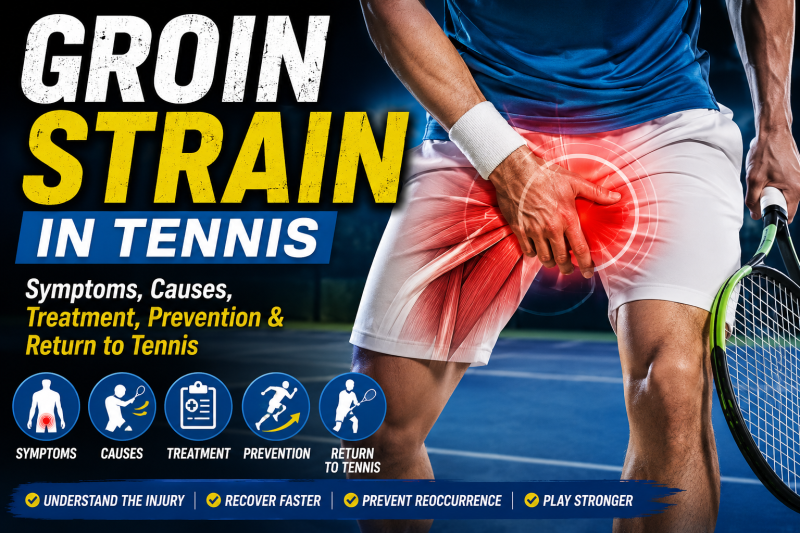
A groin strain is an injury involving one or more muscles of the inner thigh, most commonly the adductor longus. In tennis, these muscles are heavily loaded during explosive lateral movement, wide lunges, sudden changes of direction, sliding, and recovery steps.
The injury can range from a mild overstretch to a partial muscle or tendon tear. A more significant injury may cause sudden pain during an explosive movement and make walking, changing direction, or pushing off difficult.
A typical sports-medicine presentation might involve a recreational or competitive tennis player who feels a sudden pulling or tearing sensation in the upper inner thigh or groin while reaching for a wide ball.
Symptoms
Common symptoms of a tennis-related groin strain include:
- Sudden pain in the groin or inner thigh
- Pain when pushing off or changing direction
- Tenderness along the adductor muscles
- Pain with hip adduction—the movement of bringing the leg toward the body's midline
- Weakness during resisted hip adduction
- Pain during wide lateral lunges
- Difficulty running, accelerating, or decelerating
- Pain when getting up from a chair or bed
- Discomfort when crossing the legs
- Possible bruising or swelling in moderate-to-severe injuries
A severe tear may produce a distinct popping or tearing sensation, substantial weakness, and difficulty bearing weight.
Causes
Tennis places substantial demands on the groin because the athlete repeatedly moves through rapid acceleration, deceleration, and lateral displacement.
Common causes include:
1. Sudden lateral lunging
Reaching aggressively for a wide shot can place the adductors under high eccentric load while the leg is extended.
2. Rapid change of direction
Planting the foot and abruptly cutting in another direction can overload the adductor muscle complex.
3. Explosive acceleration
Starting a sprint toward a short ball can produce high forces through the hip and inner thigh.
4. Sliding and recovery
On clay courts especially, sliding and rapidly transitioning back to a balanced position can challenge the adductors.
5. Insufficient conditioning
Poor adductor strength or inadequate preparation for high-intensity tennis can increase injury risk.
6. Previous groin injury
A previous groin strain can increase the likelihood of recurrence if strength and sport-specific capacity have not been fully restored.
Diagnosis
Diagnosis begins with a detailed history and physical examination.
1. Medical history
The clinician asks:
- What movement caused the injury?
- Was there a pop or tearing sensation?
- Where exactly is the pain?
- Could the athlete continue playing?
- Is walking painful?
- Has the athlete experienced previous groin injuries?
2. Palpation
The clinician evaluates the adductor muscles and their attachment near the pubic region for localized tenderness.
3. Resisted adduction
The athlete attempts to bring the injured leg toward the midline against resistance.
Pain or weakness can indicate adductor involvement.
4. Adductor squeeze testing
A ball or dynamometer may be used between the knees while the athlete performs an isometric squeeze.
The clinician can assess:
- Pain
- Strength
- Side-to-side differences
- Progress during rehabilitation
5. Differential diagnosis
Groin pain does not always come from an adductor strain. The clinician may also consider:
- Athletic pubalgia
- Hip flexor injury
- Osteitis pubis
- Hip joint pathology
- Labral injury
- Stress injury
- Lumbar spine–referred pain
- Tendon injury
6. Imaging
Imaging isn't necessary for every uncomplicated strain.
Ultrasound or MRI may be considered when the diagnosis is uncertain, the injury is severe, symptoms persist, or a significant tendon injury, avulsion, or other pathology needs to be evaluated.
Treatment
Treatment depends on injury severity and the athlete's symptoms.
Phase 1 — Protection & Pain Control
Approximate period: early injury
Goals:
- Reduce pain
- Protect the injured tissue
- Maintain comfortable mobility
- Avoid aggravating movements
The athlete should temporarily reduce activities such as:
- Sprinting
- Wide lunges
- Hard lateral cutting
- Explosive serves
- Aggressive court recovery
Gentle, pain-limited movement and isometric adductor exercises may be introduced when appropriate.
Ice can be used for short-term comfort, although rehabilitation should focus on restoring function rather than relying on passive treatments alone.
Phase 2 — Strength Restoration
Once symptoms settle, rehabilitation progresses toward strengthening.
Exercises may include:
- Isometric adduction
- Side-lying hip adduction
- Resistance-band adduction
- Squats
- Split squats
- Lunges
- Controlled lateral movements
- Progressive Copenhagen adduction exercises
The emphasis should be on gradually increasing load, rather than rushing into maximal exercises.
Core and lumbopelvic strengthening should also be incorporated.
Phase 3 — Running & Agility
The player gradually progresses from controlled movement to tennis-specific demands.
A typical progression might be:
Walking → jogging → running → acceleration → deceleration → lateral shuffle → controlled cutting → tennis footwork
Plyometric activities can then be introduced:
- Skipping
- Hopping
- Bounding
- Low-level jumping
- Lateral jumps
- Controlled change-of-direction drills
The athlete should be monitored for increased pain during exercise or a significant symptom flare afterward.
Prevention
Reducing the risk of recurrent groin injury requires more than simply stretching.
Key prevention strategies:
Adductor strengthening
Regular progressive strengthening helps prepare the groin for the high forces experienced during tennis.
Copenhagen adduction training
Progressive Copenhagen exercises are commonly incorporated into athletic groin-strength programs.
Dynamic warm-up
Before tennis, use movements such as:
- Light jogging
- Dynamic hip movements
- Lateral shuffles
- Progressive lunges
- Controlled accelerations
Gradual workload progression
Avoid suddenly increasing:
- Match duration
- Sprint volume
- Court intensity
- Tournament frequency
- High-intensity lateral drills
Improve movement control
Develop strength and coordination through the:
Hip → pelvis → trunk → lower extremity
This helps the athlete control high-force changes of direction.
Return to Tennis
Returning to tennis should be criteria-based rather than based solely on a number of weeks.
Before full competition, the athlete should generally demonstrate:
1. Pain-free daily activity
Walking, stairs, getting out of a chair, and normal movements should be comfortable.
2. Restored adductor strength
Strength should be assessed and compared with the uninjured side where appropriate.
3. Pain-free running
The athlete should tolerate progressive running, acceleration, and deceleration.
4. Lateral movement
The player should comfortably perform:
- Side shuffles
- Lateral lunges
- Cutting
- Crossover steps
- Recovery movements
5. Tennis-specific drills
Progress from:
Shadow footwork → controlled feeding → live-ball drills → point play → practice match → competition
6. Reactive movement
The final stage should reproduce the unpredictability of tennis:
- Wide-ball recovery
- Sudden direction changes
- Explosive first steps
- Emergency lunges
- Open-stance hitting
- Defensive recovery
Return-to-Play Progression
Stage
Tennis Activity
1
Footwork and shadow swings
2
Light hitting with limited court movement
3
Controlled baseline and movement drills
4
Progressive lateral and directional drills
5
Full-court practice
6
Competitive practice/match simulation
7
Return to competition
If pain, weakness, or altered movement returns, the athlete should step back to the previous stage and be reassessed.
Clinical Takeaways
A groin strain in tennis is not simply a "pulled muscle." It can involve the adductor muscle-tendon complex and may require progressive rehabilitation before the athlete can safely tolerate tennis-specific loads.
The most important principles are:
- Don't rush back after pain disappears.
- Restore adductor strength.
- Train the core and lumbopelvic system.
- Progress from linear running to lateral and rotational movement.
- Reintroduce explosive tennis movements gradually.
- Test the athlete under unpredictable, game-like conditions before competition.
- A previous groin injury should be taken seriously because recurrence can occur when rehabilitation is incomplete.
Important: This is educational information, not an individual diagnosis or treatment plan. Severe pain, inability to bear weight, significant bruising, a palpable defect, or persistent symptoms warrant evaluation by a qualified sports-medicine professional.