
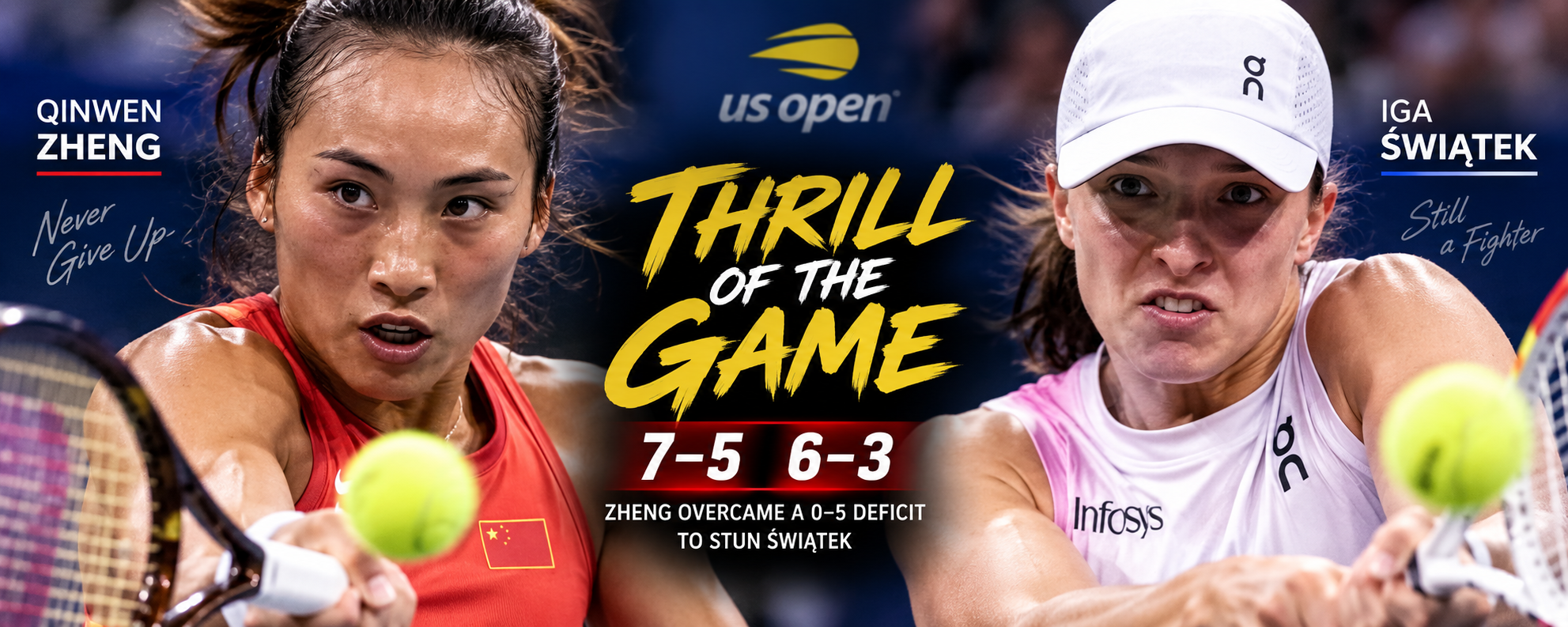
Qinwen Zheng d. [8] Iga Świątek 7–5, 6–3
There are comebacks, and then there are performances that completely change the emotional temperature of a tennis match.
Qinwen Zheng produced one of those performances at the 2026 US Open.
Down 0–5 in the opening set against Iga Świątek, Zheng appeared to be heading toward a straightforward defeat. Instead, she changed the rhythm of the match, tightened her decision-making and refused to panic.
Seven consecutive games later, Zheng had stolen the first set 7–5.
She then carried that momentum into the second set, winning 6–3 to eliminate the No. 8 seed and reach the quarterfinals.
What made the victory remarkable was not simply the scoreline.
Zheng found a way to make Świątek uncomfortable.
The Match Changed at 0–5
Świątek started brilliantly.
She was dictating the rallies, moving Zheng around the court and finding aggressive angles. After only 23 minutes, the Polish star had established a commanding 5–0 lead.
For most players, that scoreboard creates an enormous psychological problem.
Zheng had another option:
Forget the scoreboard. Win the next point.
That became the foundation of the comeback.
Instead of trying to immediately hit her way out of trouble, Zheng gradually found her rhythm and began making better decisions.
Her mindset became less about “How do I win this set?” and more about:
“How do I win this point?”
That distinction was everything.
Zheng's First Adjustment: Stop Giving Świątek Easy Control
The early part of the match belonged to Świątek because she was controlling the direction of rallies.
Zheng needed to disrupt that.
She began finding better hitting positions and improved the quality of her ball striking. Her forehand became a greater weapon, while she also started using her backhand to change the direction of rallies.
The comeback wasn't simply an increase in power.
It was an increase in clarity.
The official US Open report described the change as Zheng finding her hitting spots and energy while Świątek began to look increasingly tense.
That is an important lesson for competitive tennis:
When your opponent is dominating, changing the quality and location of your shots can be more effective than simply hitting harder.
The Return Game Became the Turning Point
One of Zheng's biggest breakthroughs was her ability to pressure Świątek's serve.
She didn't allow the 0–5 deficit to dictate her return games.
Instead, she kept competing.
Zheng eventually broke Świątek three consecutive times during the first-set comeback, turning 0–5 into 5–5.
That completely changed the psychological balance.
At 0–5:
Świątek was in control.
At 5–5:
Neither player could afford to blink.
And that is where the mental toughness of Zheng became most impressive.
The Toughest Points Were Not the Biggest Shots
From a tennis expert's perspective, the most impressive part of Zheng's victory was not one spectacular winner.
It was how she handled the close points.
When a player comes back from 0–5, there is enormous temptation to become aggressive and try to finish points quickly.
Zheng largely resisted that temptation.
She stayed engaged with the rally.
She waited for opportunities.
She trusted her weapons.
And when the opportunity appeared, she attacked.
At 5–5, Zheng produced a crucial backhand down the line — exactly the kind of aggressive shot that can define a set at the highest level.
That shot represented the transformation of the match.
Earlier, Zheng was reacting.
Now she was dictating.
The Mental Battle: Zheng Refused to Think About 0–5
This may have been the most important part of the entire match.
Zheng later explained that she focused point by point and at one stage became so absorbed in the match that she even forgot the score.
That is elite competitive psychology.
When a player thinks:
I'm down 0–5.
the brain starts calculating the mountain.
When a player thinks:
Win this point.
the mountain disappears.
Zheng essentially reduced the match to a series of individual decisions.
That allowed her to play tennis rather than play the scoreboard.
Świątek's Pressure Started Working Against Her
The momentum shift was dramatic.
Świątek had been playing freely at 5–0.
But once Zheng began extending rallies and forcing more difficult situations, the pressure changed sides.
Świątek acknowledged afterward that she was mis-hitting the ball and struggling with her timing. She finished with 28 unforced errors, according to the official US Open report.
This is where Zheng deserves enormous credit.
She didn't simply wait for Świątek to collapse.
She created the conditions that made Świątek's tennis harder.
That's a crucial distinction.
The Second Set: Zheng Didn't Give the Match Back
Many players can produce an incredible comeback in one set.
The real challenge is maintaining that level afterward.
Zheng did exactly that.
Świątek opened the second set with a break, briefly suggesting that the momentum might be shifting again.
Zheng immediately responded.
She refused to allow the match to become another psychological battle from scratch.
Instead, she kept applying pressure and eventually took control of the set.
At 4–3, Zheng produced another important backhand winner to create the decisive break, according to the US Open account.
From there, the finish was clinical.
7–5, 6–3.
Why Zheng Won: The Three Biggest Adjustments
1. She changed her mindset
She stopped trying to erase a five-game deficit all at once.
Point by point.
That allowed her to remain emotionally stable.
2. She improved her court positioning and shot selection
Once Zheng found her rhythm, she was able to hit her preferred patterns with greater confidence.
She stopped allowing Świątek to dictate every rally.
3. She became stronger in the pressure moments
The close games at the end of the first set were where the match was truly decided.
Zheng was willing to stay patient, defend when necessary and attack when the opening appeared.
That combination is what separates a comeback from a collapse by the opponent.
The Incredible Context: Zheng Did It Again
The most unbelievable part?
This wasn't Zheng's first 0–5 comeback at this US Open.
Just two days earlier, she had also recovered from 0–5 against Madison Keys, winning seven consecutive games in the deciding set.
Then she did essentially the same thing against a six-time Grand Slam champion.
That suggests something important.
This isn't simply luck.
Zheng has developed a belief that the match is never over.
Thrill of the Game: The Moment Everything Changed
The defining moment wasn't necessarily match point.
It was much earlier.
0–5 down.
That was the moment Zheng could have mentally surrendered.
Instead, she found a different version of herself.
She slowed the emotional game down.
She found her rhythm.
She challenged Świątek's serve.
She competed harder on the important points.
And suddenly, the scoreboard began moving in the opposite direction.
0–5 → 1–5 → 2–5 → 3–5 → 4–5 → 5–5 → 6–5 → 7–5.
Seven straight games.
Against Iga Świątek.
On Arthur Ashe Stadium.
That is the thrill of tennis.
Final Tennis Expert Verdict
Qinwen Zheng's victory was not simply an upset.
It was a masterclass in competitive resilience and tactical adjustment.
She recognized that the original game plan was not working, found her rhythm, increased pressure on Świątek's serve and — most importantly — stayed mentally present when the match appeared to be slipping away.
The biggest lesson for tennis players is simple:
You don't have to win the whole match when you're down 0–5. You only have to win the next point.
Zheng did that over and over again.
And eventually, 0–5 became 7–5.
The qualifier's reward is a quarterfinal against Elena Rybakina, giving Zheng another major test after one of the most dramatic comebacks of the 2026 US Open.
Qinwen Zheng didn't just beat Iga Świątek. She changed the match one point at a time.