
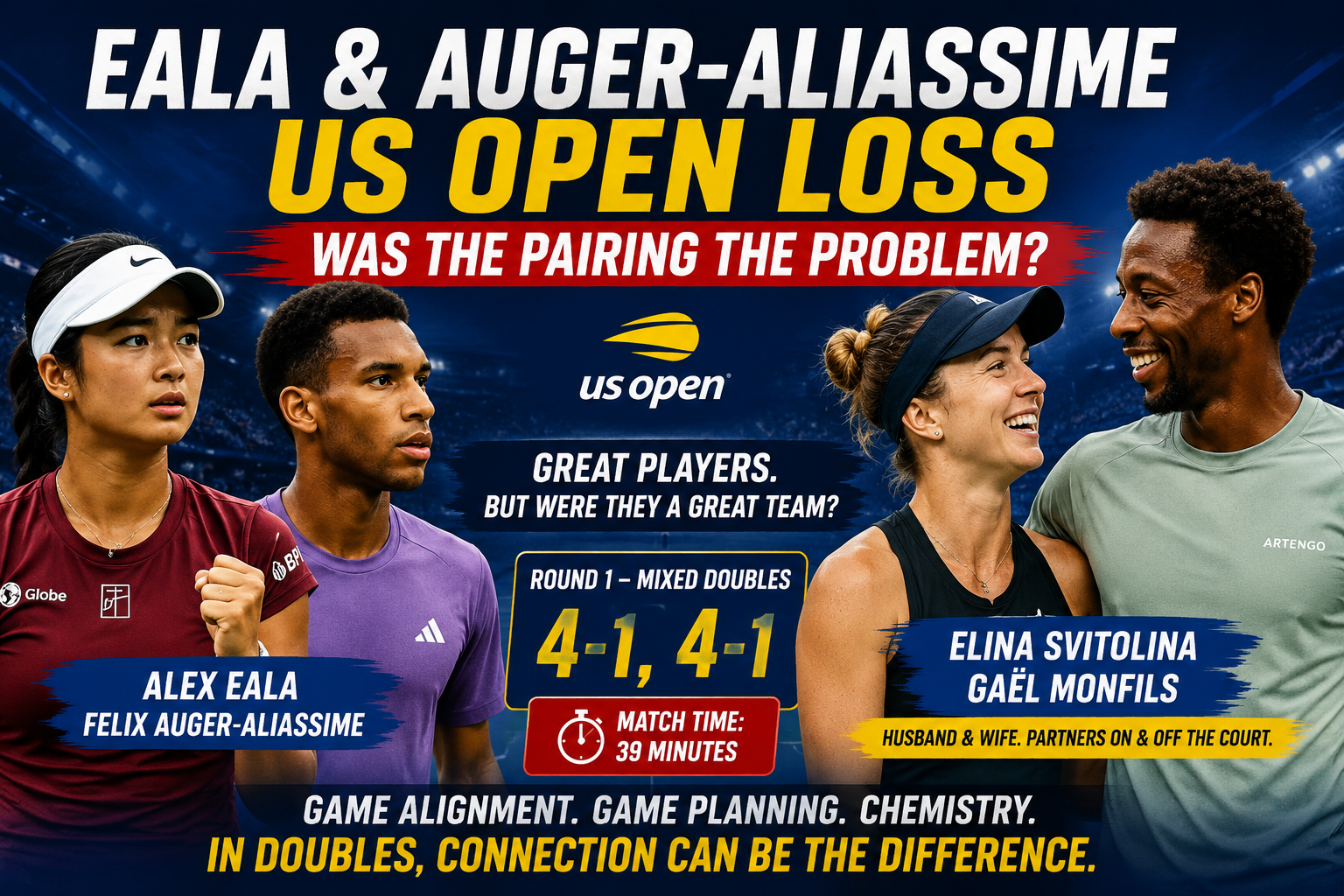
Alex Eala and Felix Auger-Aliassime entered the 2026 US Open mixed doubles with something every team needs: individual quality.
Eala has the speed, anticipation and fearless court coverage of a rising singles star. Auger-Aliassime brings explosive serving, athleticism and heavy baseline power. On paper, the pairing looked dangerous.
But mixed doubles is not simply about putting two great players together.
It is about alignment.
And against Elina Svitolina and Gaël Monfils, the difference was clear.
The husband-and-wife team defeated Eala and Auger-Aliassime 4–1, 4–1 in just 39 minutes. The first three rounds of this year's mixed doubles used short sets to four games, no-ad scoring and a match tiebreak instead of a third set, making every point and every tactical decision extremely important.
Great Players Do Not Automatically Make a Great Team
This is the key lesson.
Eala is a very good player. Auger-Aliassime is a very good player. But were they a naturally good mixed-doubles pairing?
That is a different question.
In singles, a player controls the majority of the tactical decisions. In doubles, players must constantly coordinate:
-
Who takes the middle?
-
Who protects the alley?
-
Who attacks the return?
-
Who moves forward?
-
Who covers the lob?
-
Who takes the decisive ball under pressure?
-
When should one player poach?
-
When should both players stay disciplined?
The best doubles teams make these decisions almost instinctively.
Svitolina–Monfils Had Something Money Cannot Buy
Svitolina and Monfils brought an unusual advantage to the court:
They already understand each other's emotions, reactions and tendencies.
They are husband and wife, but their advantage was not simply romantic. It was communication chemistry.
Svitolina has explained that the pair understand each other's reactions and moods, allowing them to find the right words quickly during a match. That can be extremely valuable in mixed doubles, where there is very little time to recover from a mistake.
That is what I call emotional alignment.
They know when to encourage.
They know when to stay quiet.
They know when the other player needs confidence.
And, most importantly, they appear comfortable making tactical adjustments together.
The Tactical Difference
Eala and Auger-Aliassime had the weapons.
But Svitolina and Monfils appeared to have the team structure.
The French-Ukrainian pair immediately established control after Eala and Auger-Aliassime won the opening game. Svitolina and Monfils then won four consecutive games to close out the first set.
That is extremely significant in a short-format match.
There is almost no time to experiment.
A traditional doubles match gives a team time to settle into patterns. The shortened US Open format punished slow tactical adjustment.
Svitolina and Monfils were already synchronized.
Eala and Auger-Aliassime were still developing their partnership.
The "Middle" Is More Than a Physical Position
One of the biggest elements of mixed doubles is understanding the middle of the court.
The middle creates uncertainty.
If both players move toward it, the alley opens.
If neither player takes it, opponents can attack through the center.
The best teams develop an almost automatic understanding of who owns the next ball.
This is where established chemistry becomes valuable.
Svitolina and Monfils looked comfortable making those decisions together.
Eala and Auger-Aliassime had less competitive history as a team, meaning their instincts were naturally less synchronized.
That does not mean they lacked quality.
It means they lacked repetition.
Power vs. Connection
Auger-Aliassime possesses one of the biggest weapons in the matchup: his serve.
Eala brings exceptional movement, anticipation and aggressive shot-making.
But mixed doubles often rewards something different from singles.
It rewards:
Connection + positioning + communication + first-ball execution.
The team that creates the better two-player pattern can neutralize individual weapons.
That is exactly what Svitolina and Monfils demonstrated.
The Mental Game
There was another important difference.
For Eala and Auger-Aliassime, the match was a new competitive partnership.
For Svitolina and Monfils, the court was almost an extension of an existing relationship.
They had already spent years understanding each other's personalities.
That matters when the score becomes uncomfortable.
A doubles partner needs to know:
"How do I bring you back into the match?"
Svitolina and Monfils seemed to have that answer.
But This Does NOT Mean Eala and Auger-Aliassime Were a Bad Pair
This is important.
One match should not define a partnership.
Eala and Auger-Aliassime simply faced a team that was exceptionally well aligned for this particular format.
Their loss does not diminish either player's individual level.
In fact, with more practice together, the pairing could potentially become much more dangerous.
The ingredients are there.
Eala — movement and anticipation.
Auger-Aliassime — serve and power.
The missing ingredient was simply team synchronization.
The US Tennis Lesson: Alignment Beats Talent Alone
From a US tennis perspective, this match provides a fascinating lesson.
When selecting a doubles partner, don't ask only:
"Who is the better player?"
Ask:
"Who makes my game better?"
That is the real question.
A great doubles partnership is not necessarily two superstars.
It is two players whose strengths connect.
Svitolina and Monfils showed exactly that.
Their relationship created a natural communication system, and their tennis developed around that connection.
Their run became even more impressive when they defeated experienced doubles specialists Katerina Siniakova and Henry Patten 5–4, 4–5, [10–8] to reach the semifinals.
Final Verdict
Alex Eala + Felix Auger-Aliassime
Individual talent: ⭐⭐⭐⭐⭐
Power: ⭐⭐⭐⭐⭐
Athletic ability: ⭐⭐⭐⭐⭐
Doubles experience together: ⭐⭐⭐
Communication alignment: ⭐⭐⭐
Tactical synchronization: ⭐⭐⭐
Elina Svitolina + Gaël Monfils
Individual talent: ⭐⭐⭐⭐⭐
Doubles chemistry: ⭐⭐⭐⭐⭐
Communication: ⭐⭐⭐⭐⭐
Emotional connection: ⭐⭐⭐⭐⭐
Tactical synchronization: ⭐⭐⭐⭐⭐
The Bottom Line
Eala and Auger-Aliassime had the talent.
Svitolina and Monfils had the partnership.
And in mixed doubles, especially under a shortened format where there is almost no time to recover, partnership alignment can be more important than individual ranking or power.
The lesson for Eala and Auger-Aliassime is not simply "play better."
It is:
Build the connection. Build the patterns. Build the trust.
Because in doubles tennis, two great players are not automatically a great team.
Sometimes, the strongest weapon on the court is not the serve, forehand or return.
It is knowing exactly what your partner is going to do before the ball even crosses the net.