MCL Sprain Overview
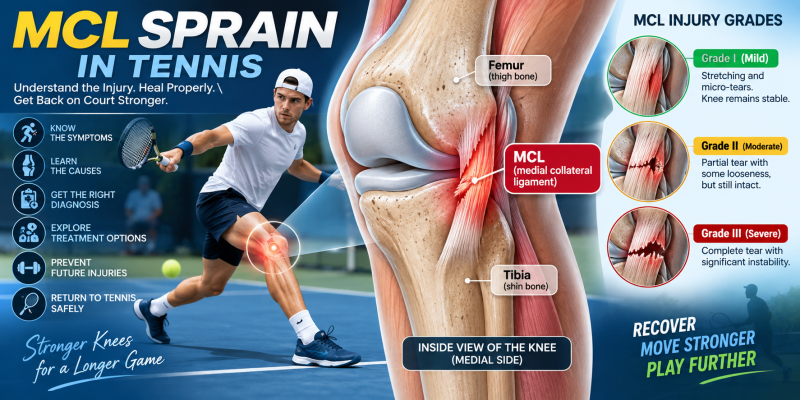
A medial collateral ligament (MCL) sprain is an injury to the strong ligament running along the inner side of the knee. The MCL connects the femur (thighbone) to the tibia (shinbone) and helps prevent the knee from collapsing inward.
For tennis players, the MCL is particularly important during lateral movement, sudden stops, open-stance hitting, recovery steps, and changes of direction.
MCL injuries are commonly classified into three grades:
- Grade I — Mild: The ligament is stretched with microscopic tearing. The knee generally remains stable.
- Grade II — Moderate: The ligament is partially torn, producing pain and some looseness when the knee is stressed.
- Grade III — Severe: The MCL is completely torn and significant instability may occur. Other knee ligaments may also be injured.
Tennis doctor perspective: An MCL injury does not automatically mean you need surgery. Many isolated MCL injuries heal successfully with appropriate protection and progressive rehabilitation.
MCL Sprain Symptoms
The symptoms depend on the severity of the injury, but common signs include:
1. Inner Knee Pain
Pain is usually felt directly along the medial or inner side of the knee, particularly when walking, turning, or applying sideways stress to the knee.
2. Tenderness
The injured MCL may be painful when you press along the inner knee.
3. Swelling and Bruising
Swelling may develop around the inner knee, while bruising can appear over the ligament, particularly with a more significant tear.
4. Knee Instability
A player may feel that the knee is:
- Giving way
- Unstable
- Weak during lateral movement
- Unsafe when changing direction
This symptom is particularly important for tennis because the sport requires repeated side-to-side movement.
5. Reduced Range of Motion
Pain and swelling can make it difficult to fully bend or straighten the knee.
6. Catching or Locking
Catching or locking is not a classic isolated MCL symptom and should raise suspicion for another injury, such as a meniscus problem or associated ligament injury.
What Causes an MCL Sprain in Tennis?
An MCL injury occurs when excessive force stretches the ligament beyond its normal capacity.
Sudden Cutting or Pivoting
A player plants the foot while rapidly changing direction, placing stress on the inside of the knee.
Awkward Recovery Step
During a wide ball, the player may reach outside the normal hitting position and land with the knee moving inward.
Sudden Deceleration
Stopping quickly after a sprint can place substantial forces through the knee.
Valgus Stress
A force pushes the knee inward relative to the foot. This is the classic mechanism of an MCL injury.
Awkward Landing
Landing from a jump or split step with poor knee alignment can increase stress on the medial knee structures.
Contact or Collision
Although less common in tennis than in contact sports, a collision with another player, equipment, or court structure can produce an MCL injury.
How Is an MCL Sprain Diagnosed?
Diagnosis begins with a detailed history and physical examination.
Physical Examination
A sports medicine or orthopedic clinician will typically assess:
- Location of tenderness
- Knee swelling
- Range of motion
- Knee stability
- Walking pattern
- Strength
- Associated meniscus or ligament symptoms
The valgus stress test, commonly performed with the knee at different degrees of flexion, helps assess MCL stability.
X-Ray
X-rays do not directly show the MCL well, but they can help identify fractures or other bone abnormalities.
MRI
An MRI can provide detailed information about the MCL and surrounding structures and is particularly useful when the diagnosis is uncertain, the injury appears severe, or an associated ACL, meniscus, or other ligament injury is suspected.
Important: MRI findings should be interpreted together with the physical examination. The image alone does not determine when a tennis player is ready to return.
MCL Sprain Treatment
Treatment depends on the grade of injury, symptoms, knee stability, and whether other structures are injured.
Grade I MCL Sprain
A mild injury may be managed with:
- Relative rest
- Ice for symptom relief
- Compression
- Elevation when swelling is present
- Early controlled movement
- Progressive strengthening
- Gradual return to tennis
Complete immobilization is generally unnecessary for an uncomplicated mild injury.
Grade II MCL Sprain
A moderate injury may require:
- Temporary reduction of activity
- A hinged knee brace when clinically indicated
- Controlled range-of-motion exercises
- Progressive quadriceps and hamstring strengthening
- Hip and core strengthening
- Balance and proprioception training
- Gradual running and change-of-direction work
Grade III MCL Sprain
A complete MCL tear requires a more careful assessment.
Many isolated MCL tears can still be treated without surgery, but a Grade III injury should be evaluated by an orthopedic or sports medicine specialist, particularly if there is significant instability or suspicion of combined ligament damage.
Surgery may be considered in selected cases, including certain complex injuries or persistent instability.
MCL Rehabilitation for Tennis Players
Rehabilitation should progress from basic knee function to tennis-specific movement.
Phase 1 — Protect and Restore Movement
Primary goals:
- Reduce pain and swelling
- Restore comfortable walking
- Regain knee extension
- Gradually restore flexion
- Maintain appropriate muscle activation
Low-impact cardiovascular exercise may be introduced when tolerated.
Phase 2 — Build Strength
Once symptoms permit, rehabilitation progresses toward:
- Squats
- Step-ups
- Controlled lunges
- Leg strengthening
- Hamstring exercises
- Calf strengthening
- Glute strengthening
- Core stability
- Single-leg balance
Phase 3 — Running and Movement
The player can gradually progress to:
- Straight-line jogging
- Acceleration and deceleration
- Controlled lateral movement
- Tennis-specific footwork
- Split-step drills
- Progressive change-of-direction exercises
Phase 4 — Tennis-Specific Return
The final stage should reproduce the demands of tennis.
Start with:
Rallying → controlled movement → wider court movement → moderate-intensity drills → point play → full practice → competitive match
Aggressive sliding, explosive lateral recovery, and maximal cutting should be introduced progressively rather than immediately.
How Long Does an MCL Sprain Take to Heal?
Recovery varies according to the injury grade and whether other structures are involved.
A general guide is:
Injury
Typical Recovery Consideration
Grade I
Often a few weeks
Grade II
Often several weeks
Grade III
Commonly several weeks to a few months
These are general ranges, not guaranteed timelines.
A player with a mild MCL injury may return relatively quickly, while a Grade III injury combined with an ACL or meniscus injury can require substantially more rehabilitation.
The goal should be a criteria-based return rather than simply waiting for a certain number of weeks.
Return to Tennis After an MCL Sprain
As a tennis doctor and tennis injury specialist, I would not clear a player simply because the calendar says they have completed six or eight weeks.
Before returning to competitive tennis, the player should ideally demonstrate:
- Full or near-full pain-free knee motion
- No significant swelling
- No medial knee tenderness that limits activity
- Stable knee examination
- Normal or near-normal walking and running mechanics
- Adequate quadriceps and hamstring strength
- Good single-leg control
- Ability to accelerate and decelerate without pain
- Ability to perform lateral movements without instability
- Confidence in the injured knee
- Successful tennis-specific functional testing
Strength and hop-testing targets should be individualized rather than relying on one universal percentage.
A Tennis-Specific Return-to-Play Progression
Stage 1: Fitness Without Court Stress
Walking, cycling, strengthening and controlled rehabilitation.
Stage 2: Straight-Line Running
Jogging followed by gradual acceleration and deceleration.
Stage 3: Lateral Movement
Controlled side shuffles and progressively faster directional changes.
Stage 4: Tennis Drills
Begin with controlled baseline hitting and predictable movement.
Stage 5: Open-Court Movement
Introduce wider balls, recovery movements and more unpredictable direction changes.
Stage 6: Point Play
Begin controlled points before progressing toward full-intensity competitive play.
Stage 7: Match Return
Start with manageable match intensity and increase workload progressively.
How Can Tennis Players Prevent an MCL Sprain?
You cannot eliminate the risk of knee injury, but you can improve your ability to control the knee under athletic loads.
Strengthen the Lower Body
Maintain balanced strength in the:
- Quadriceps
- Hamstrings
- Glutes
- Calves
Improve Hip and Core Control
Strong hip and trunk muscles can help maintain better lower-limb alignment during cutting and landing.
Train Deceleration
Tennis players often focus on acceleration but underestimate the importance of braking mechanics.
Practice controlled stopping and directional changes.
Improve Footwork
Efficient tennis footwork reduces awkward reaching, uncontrolled planting and poorly positioned recovery steps.
Use Appropriate Tennis Shoes
Choose footwear designed for your court surface with appropriate lateral support and traction.
When Should You See a Doctor?
Seek medical evaluation if you experience:
- Significant inner-knee pain after an injury
- Rapid swelling
- Difficulty putting weight on the leg
- A sensation that the knee is giving way
- Significant bruising
- Persistent pain despite rest
- Locking or catching
- Inability to fully straighten the knee
- A suspected Grade II or Grade III injury
- Symptoms that are not improving with rehabilitation
A particularly important warning sign for tennis players is instability. If your knee repeatedly gives way during lateral movement, continuing to play can increase the risk of additional injury.
MCL Sprain vs. Meniscus or ACL Injury
Inner-knee pain does not always mean an MCL injury.
Other injuries can produce overlapping symptoms.
Injury
Common Clues
MCL sprain
Pain/tenderness along inner knee, especially with valgus stress
Meniscus injury
Joint-line pain, catching or locking, pain with twisting
ACL injury
Pop at injury, rapid swelling, instability, difficulty with pivoting
Pes anserine irritation
Inner knee pain below the joint line
Bone injury
Significant focal pain, difficulty bearing weight
Because these conditions can overlap, persistent symptoms should be properly assessed rather than self-diagnosed.
Can You Play Tennis With an MCL Sprain?
It depends on the severity.
Playing through a very mild injury may sometimes be possible under professional guidance, but pain, swelling or instability should not be ignored.
For a moderate or severe MCL injury, continuing competitive tennis before adequate healing and rehabilitation can expose the knee to repeated valgus and rotational forces.
If the knee feels unstable during a split step, lateral shuffle, or change of direction, you are not ready for competitive tennis.
Tennis Doctor's Bottom Line
An MCL sprain is one of the more common ligament injuries affecting the knee, and the outlook is often good—particularly when the injury is isolated and appropriately rehabilitated.
The biggest mistake is returning to tennis simply because the pain has improved.
Your knee must also tolerate the demands of tennis: sprinting, braking, lateral movement, pivoting, split steps and repeated changes of direction.
A successful return means more than being able to walk without pain. It means being able to trust the knee when the next ball pulls you wide.
If you suspect an MCL injury, get an appropriate clinical assessment before returning to full-intensity tennis.