
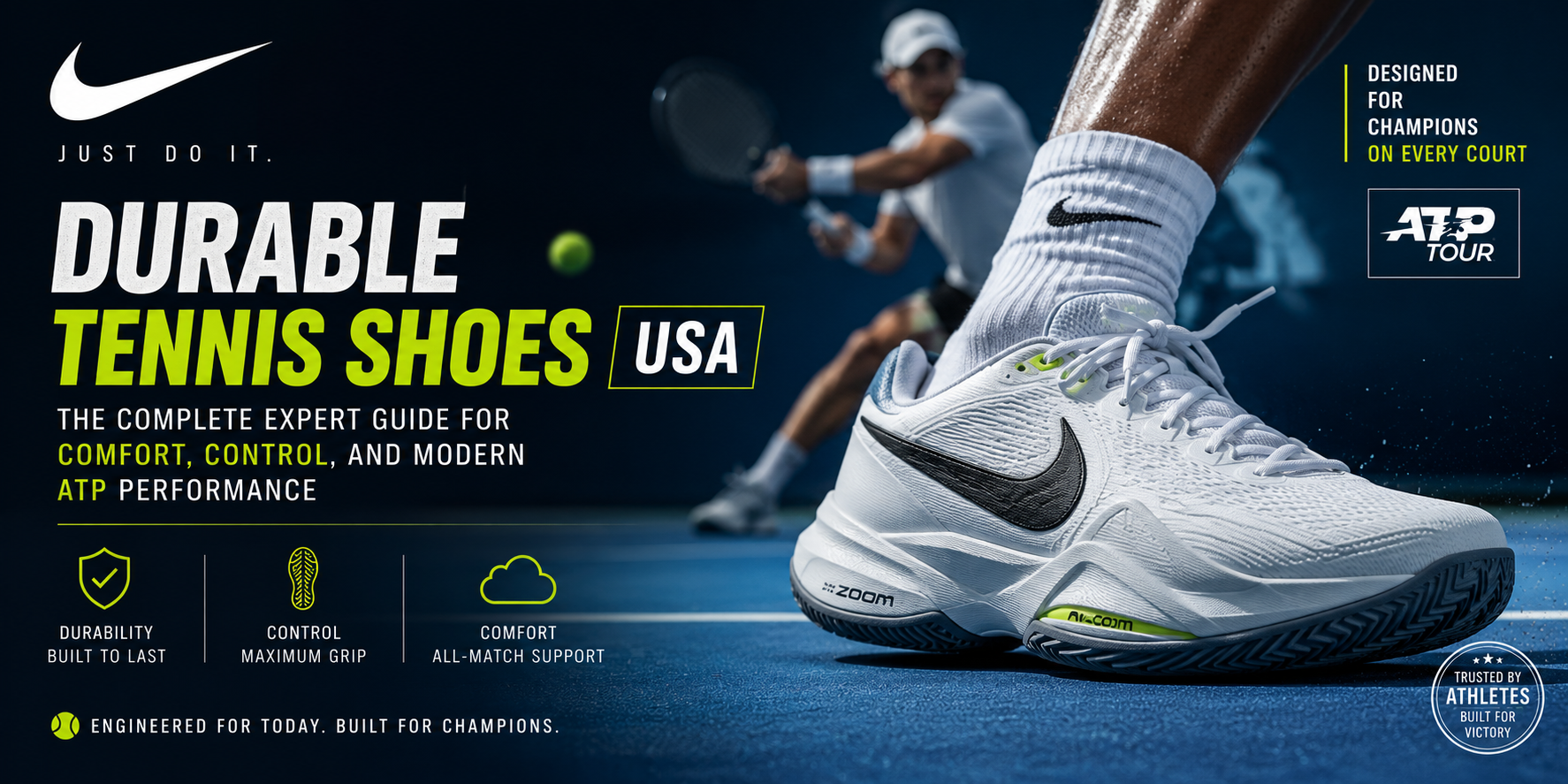
Tennis is one of the toughest sports on footwear. Unlike running, tennis demands explosive side-to-side movement, sudden stops, rapid acceleration, aggressive sliding, and constant pressure on the ankles, knees, and feet. That is why durable tennis shoes are one of the most important investments any player can make.
Whether you are a beginner learning topspin forehands or an advanced competitor playing long hard-court rallies, your shoes directly affect your:
- Comfort
- Movement
- Control
- Balance
- Power transfer
- Injury prevention
- Court confidence
Modern ATP tennis has changed the way players move. Today’s professional game is faster, more physical, and more explosive than ever before. Players now slide on hard courts, attack with heavy topspin, and defend from impossible positions. Because of this, durable tennis shoes have become a major performance tool rather than just simple footwear.
This complete USA tennis guide explains how to choose durable tennis shoes, the differences between surfaces, how ATP-style movement influences modern shoe design, and what players should look for when buying tennis footwear.
Why Durable Tennis Shoes Matter
Many beginner players underestimate the importance of tennis shoes.
They often use:
- Running shoes
- Basketball shoes
- Casual sneakers
This is one of the biggest mistakes in tennis.
Tennis involves unique movement patterns that require specialized support.
Tennis Movement Is Different From Running
Running mainly involves forward movement.
Tennis involves:
- Lateral cuts
- Split steps
- Rotational movement
- Sliding
- Sudden stops
- Direction changes
Regular athletic shoes are not designed for these movements.
Common Problems Caused by Poor Tennis Shoes
Using low-quality or incorrect shoes may lead to:
Foot Pain
Thin cushioning increases pressure on the feet during long matches.
Ankle Injuries
Weak lateral support increases ankle rolling risk.
Knee Stress
Poor shock absorption transfers impact directly into the knees.
Faster Fatigue
Heavy or unstable shoes reduce movement efficiency.
Loss of Court Control
Poor traction reduces balance and recovery speed.
What Makes Tennis Shoes Durable?
Durability means more than simply lasting longer.
A durable tennis shoe must maintain:
- Stability
- Cushioning
- Grip
- Structural support
- Comfort
even after intense court use.
Key Features of Durable Tennis Shoes
Outsole Durability
The outsole is the bottom part of the shoe.
Hard courts destroy outsoles quickly because of abrasive court surfaces.
Durable tennis shoes usually include:
- Reinforced rubber
- High-density compounds
- Thick tread patterns
Hard-court players especially need strong outsoles.
Upper Material Strength
The upper supports the foot during movement.
Durable uppers prevent:
- Tearing
- Stretching
- Side collapse
Modern ATP-style shoes often use:
- Engineered mesh
- TPU reinforcement
- Synthetic support layers
Cushioning Longevity
Some shoes feel comfortable initially but lose cushioning rapidly.
High-quality tennis shoes maintain comfort over time.
Good cushioning helps players during:
- Long rallies
- Repetitive jumping
- Aggressive baseline play
Toe Drag Protection
Many tennis players drag their back foot during serves and slides.
Durable tennis shoes often include:
- Reinforced toe caps
- Rubber drag guards
- Extended outsole coverage
Hard Court vs Clay Court Tennis Shoes
Court surface matters tremendously.
Using the wrong shoes can hurt movement and durability.
Hard Court Tennis Shoes
Hard courts are the most demanding surface for shoes.
Key Features
Hard-court shoes prioritize:
- Durability
- Cushioning
- Shock absorption
- Stability
These shoes usually have:
- Thicker soles
- Strong rubber outsoles
- Extra support structures
Benefits
Hard-court shoes help players:
- Absorb impact
- Prevent fatigue
- Protect joints
- Improve balance
Best For
Ideal for:
- Recreational players
- Competitive hard-court players
- Players with knee pain
- Heavy movers
Clay Court Tennis Shoes
Clay courts require different movement mechanics.
Players slide more frequently and rely heavily on traction control.
Key Features
Clay shoes often include:
- Herringbone tread pattern
- Flexible outsole
- Better clay release
- Sliding-friendly traction
Benefits
Clay shoes help players:
- Slide safely
- Recover faster
- Maintain balance
- Generate topspin movement patterns
Important Note
Clay shoes usually wear out faster on hard courts.
Grass Court Shoes
Grass is less common in the USA but still important.
Grass Court Features
Grass shoes focus on:
- Grip stability
- Low-profile movement
- Fast directional control
Grass courts favor quick reaction movement and lower bounce tennis.
ATP Modern Tennis Influence on Shoe Design
Modern ATP tennis has completely changed footwear development.
Today’s professional players move more aggressively than previous generations.
Heavy Topspin Movement
Modern players use extreme topspin mechanics.
Topspin requires:
- Strong leg drive
- Rotational balance
- Explosive recovery
Tennis shoes now support these movements with:
- Wider bases
- Strong lateral stability
- Enhanced grip systems
Baseline Power Tennis
Players now hit harder than ever.
Power-based tennis increases:
- Court coverage demands
- Sliding frequency
- Joint stress
Durable shoes help players maintain control during aggressive rallies.
Defensive Sliding on Hard Courts
One major ATP influence is hard-court sliding.
Players now slide even on hard surfaces to recover faster.
This requires shoes with:
- Controlled traction
- Stability balance
- Durable side support
Comfort vs Control in Tennis Shoes
One of the biggest buying decisions is balancing comfort and control.
Comfort-Focused Tennis Shoes
Comfort shoes prioritize:
- Soft cushioning
- Shock absorption
- Foot protection
These shoes are excellent for:
- Beginners
- Older players
- Long recreational sessions
- Players with foot pain
Control-Focused Tennis Shoes
Control-oriented shoes emphasize:
- Court feel
- Stability
- Fast reactions
- Precise movement
Competitive players often prefer these shoes.
Finding the Right Balance
The best durable tennis shoe combines:
- Comfort
- Stability
- Responsiveness
- Durability
without sacrificing movement speed.
How Tennis Shoes Affect Topspin, Power, and Control
Shoes influence performance more than many players realize.
Topspin Production
Topspin relies heavily on lower-body mechanics.
Stable shoes improve:
- Leg drive
- Rotational balance
- Recovery positioning
Good traction helps players push upward and brush aggressively on the ball.
Power Generation
Power starts from the ground.
Explosive movement transfers energy through:
- Feet
- Legs
- Core
- Upper body
- Racquet
Unstable shoes reduce power efficiency.
Shot Control
Stable shoes improve:
- Balance
- Timing
- Weight transfer
which directly affects shot control.
Tennis Shoe Weight: Heavy vs Lightweight
Modern tennis shoes vary greatly in weight.
Lightweight Tennis Shoes
Benefits include:
- Faster movement
- Quicker recovery
- Less fatigue
However, lightweight shoes sometimes sacrifice durability.
Heavier Stability Shoes
Benefits include:
- Better support
- More cushioning
- Increased durability
These shoes are ideal for aggressive movers.
Which Is Better?
It depends on:
- Playing style
- Fitness level
- Surface
- Injury history
Beginner Tennis Shoe Buying Guide
Beginners should prioritize:
Comfort First
Never buy uncomfortable shoes hoping they will “break in.”
Proper Fit
There should be enough room near the toes without excessive movement.
Surface Compatibility
Buy shoes designed for your main playing surface.
Stability
Lateral support is critical for safety.
Understanding Tennis Racquet Basics
Although this article focuses on shoes, understanding racquet basics helps complete modern tennis performance.
Racquet Weight Explained
Racquet weight affects:
- Power
- Stability
- Swing speed
- Control
Lightweight Racquets
Advantages:
- Easier swing
- Better for beginners
- Faster reactions
Disadvantages:
- Less stability
- Reduced control against heavy pace
Heavier Racquets
Advantages:
- More stability
- Better control
- Greater plow-through
Disadvantages:
- More physically demanding
Head Size Explained
Head size affects forgiveness and control.
Larger Head Sizes
Benefits:
- Bigger sweet spot
- More power
- Easier topspin
Great for beginners.
Smaller Head Sizes
Benefits:
- More precision
- Better control
- Cleaner response
Preferred by advanced players.
Grip Size Explained
Grip size is extremely important.
Incorrect grip size may cause:
- Wrist discomfort
- Tennis elbow
- Reduced control
Small Grip Problems
Too-small grips force excessive hand squeezing.
Large Grip Problems
Oversized grips reduce wrist mobility and spin production.
ATP Players and Grip Customization
Many ATP professionals customize grips carefully for:
- Comfort
- Spin generation
- Hand positioning
- Stability
Grip feel strongly affects confidence and racquet control.
Tennis Shoes for Different Playing Styles
Not every player needs the same shoe.
Aggressive Baseliner
Aggressive baseliners need:
- Strong durability
- Heavy lateral support
- Reinforced toe protection
Defensive Counterpuncher
Counterpunchers prioritize:
- Speed
- Recovery movement
- Lightweight responsiveness
Serve-and-Volley Players
These players benefit from:
- Fast forward movement
- Court feel
- Quick transitions
Junior Tennis Players
Junior players should focus on:
- Comfort
- Support
- Proper fit
- Injury prevention
Avoid extremely stiff or overly heavy shoes.
Signs Your Tennis Shoes Need Replacement
Many players use shoes too long.
Replace tennis shoes when you notice:
- Worn outsole tread
- Side instability
- Flattened cushioning
- Foot pain
- Reduced traction
How Long Durable Tennis Shoes Last
Durability depends on:
- Surface
- Playing frequency
- Movement style
- Body weight
Recreational Players
Average lifespan:
- 6–12 months
Competitive Players
Competitive hard-court players may replace shoes every:
- 2–4 months
Practical Buying Advice
Always Try Shoes On
Fit varies greatly between brands.
Wear Tennis Socks
Use proper socks when testing fit.
Prioritize Stability Over Style
Performance matters more than appearance.
Consider Injury History
Players with knee or ankle issues need extra support.
Match Shoes to Surface
Hard-court players need durability-focused models.
Common Tennis Shoe Buying Mistakes
Buying Running Shoes
This is the biggest mistake beginners make.
Choosing Fashion Over Function
Stylish shoes may lack durability.
Ignoring Width
Wide-foot players need proper width support.
Buying Too Small
Tennis movement requires toe space.
Modern Tennis and Injury Prevention
Modern tennis is physically intense.
Durable shoes help reduce:
- Joint stress
- Foot fatigue
- Ankle injuries
- Knee overload
Proper footwear is part of long-term tennis health.
Future Tennis Shoe Technology
The tennis shoe industry continues evolving rapidly.
Future trends may include:
- Smart cushioning systems
- AI movement analysis
- Advanced energy return
- Custom-fitted support
- Improved lightweight durability
ATP influence will continue shaping footwear innovation.
Comparison Section: Comfort vs Durability vs Speed
| Feature | Comfort Shoes | Durable Stability Shoes | Speed Shoes |
|---|---|---|---|
| Cushioning | Excellent | Very Good | Moderate |
| Durability | Moderate | Excellent | Moderate |
| Speed | Moderate | Moderate | Excellent |
| Stability | Good | Excellent | Good |
| Best For | Recreational | Aggressive players | Fast movers |
Comparison Section: Hard Court vs Clay Court Shoes
| Feature | Hard Court Shoes | Clay Court Shoes |
|---|---|---|
| Cushioning | Higher | Moderate |
| Durability | Excellent | Moderate |
| Sliding | Limited | Excellent |
| Traction Pattern | Mixed | Herringbone |
| Best Surface | Hard courts | Clay courts |
FAQs
What are the most durable tennis shoes for hard courts?
Hard-court tennis shoes with reinforced rubber outsoles and strong lateral support are generally the most durable.
Are running shoes okay for tennis?
No. Running shoes lack the lateral support required for tennis movement.
How often should tennis shoes be replaced?
Competitive players may replace shoes every few months, while recreational players may use them for 6–12 months depending on wear.
Do tennis shoes improve topspin and control?
Yes. Stable shoes improve balance, recovery, and lower-body positioning, which help generate topspin and shot control.
Are lightweight tennis shoes less durable?
Often yes. Lightweight designs may sacrifice long-term durability for speed.
What is the best tennis shoe for beginners?
Beginners should prioritize comfort, stability, cushioning, and proper fit.
Why do ATP players slide on hard courts now?
Modern tennis movement has evolved. Controlled sliding helps players recover faster and reduce stopping stress.
Does grip size affect tennis performance?
Yes. Correct grip size improves comfort, control, spin production, and injury prevention.
How does racquet weight affect power?
Heavier racquets provide more stability and plow-through, while lighter racquets offer easier swing speed.
Conclusion
Durable tennis shoes are one of the most important investments for any tennis player in the USA. Modern ATP tennis has transformed the sport into a physically explosive battle requiring elite movement, stability, and recovery.
The right tennis shoes improve:
- Comfort
- Topspin mechanics
- Court control
- Movement efficiency
- Power transfer
- Injury prevention
Whether you are a beginner learning the fundamentals or a competitive player chasing ATP-style performance, choosing the correct shoes can dramatically improve your tennis experience.
Remember that no single shoe fits every player. The best tennis shoe depends on:
- Your playing style
- Court surface
- Movement patterns
- Physical needs
- Comfort preferences
Combine proper footwear with the correct racquet weight, head size, and grip size, and you build a complete foundation for better tennis performance.
In modern tennis, movement is everything — and great movement starts from the ground up.