
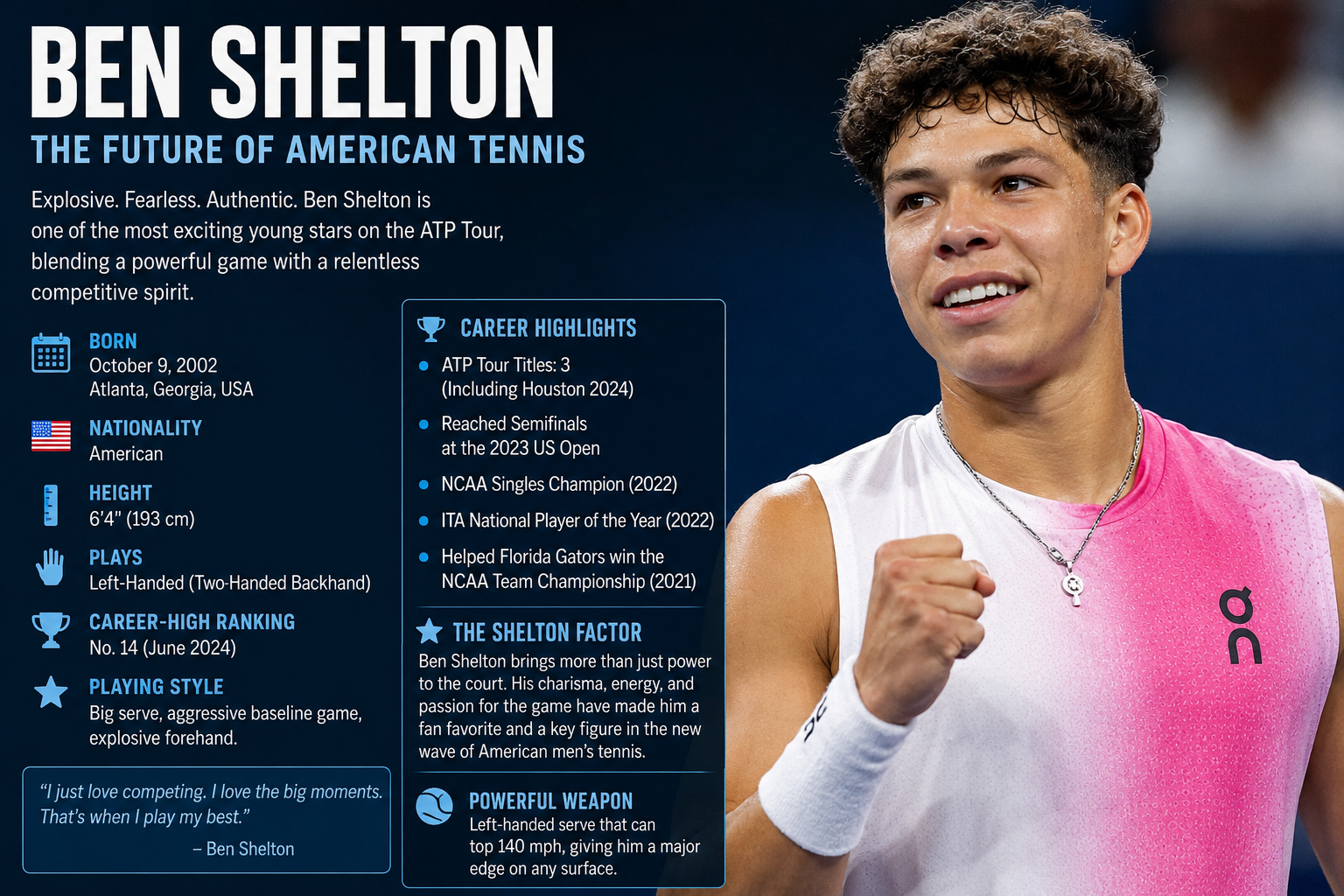
In an era where many professional tennis players begin intensive training before they enter elementary school, Ben Shelton's rise to the top of men's tennis stands out as refreshingly unconventional. While today's elite players often spend their childhoods traveling the world competing in junior tournaments, Shelton developed at a slower pace, taking a route that emphasized personal growth, education, and gradual athletic development.
That journey has transformed him from a talented American teenager into one of the most exciting players on the ATP Tour.
With his explosive left-handed serve, charismatic personality, fearless shot-making, and growing tactical maturity, Shelton has emerged as one of the leading faces of a new generation of American men's tennis. His ascent has been remarkable not only because of his achievements but also because of how quickly they arrived after turning professional.
Behind the highlights and powerful serves lies a story rooted in family, patience, discipline, and belief. Shelton's success is not the result of a rushed development plan or an aggressive push toward professional tennis at an early age. Instead, it is the product of years of structured growth guided by a family deeply connected to the sport.
Today, Shelton represents much more than a rising ATP star. He symbolizes a modern approach to player development, proving that athletes do not need to sacrifice education or personal growth to reach the highest levels of professional sports.
His story continues to inspire young players across the United States and around the world.
Growing Up in a Tennis Family
Ben Shelton was born on October 9, 2002, in Atlanta, Georgia, before spending much of his childhood in Gainesville, Florida.
From the moment he entered the world, tennis was part of his environment.
His father, Bryan Shelton, enjoyed a successful professional tennis career during the late 1980s and early 1990s. Bryan reached the ATP Top 60, captured ATP titles, and later transitioned into one of the most respected coaches in American collegiate tennis.
His mother, Lisa Shelton, was also an accomplished athlete, competing at the collegiate level.
Athletic excellence was therefore a family tradition.
Yet despite growing up around tennis courts, professional players, and coaching discussions, Ben was not immediately captivated by the sport.
Unlike many future professionals who become obsessed with tennis from childhood, Shelton's first sporting love was football.
He enjoyed the physicality, speed, and excitement of the game. During his early years, football occupied much of his attention, and tennis was simply one activity among many.
This distinction is important because it helped shape Shelton into the athlete he would later become.
His athletic development was broader than many of his peers. Rather than specializing too early, he developed coordination, speed, strength, and competitive instincts through multiple sports.
Those qualities would eventually become major assets on the tennis court.
Discovering His Passion
By his own admission, Shelton did not fully commit to tennis until approximately age 11.
That realization marked a turning point.
As he spent more time on the court, he began to appreciate the strategic complexity of tennis. Unlike team sports, every decision, adjustment, and outcome depended entirely on the individual player.
The challenge appealed to him.
More importantly, he discovered the competitive fire necessary to pursue excellence.
Talent alone is rarely enough to reach professional sports. Athletes must possess a deep internal motivation that drives them through years of training, setbacks, and sacrifices.
For Shelton, that motivation gradually emerged during his pre-teen years.
His father recognized the potential but resisted the temptation to rush his development.
Instead of treating Ben like a future professional from childhood, Bryan emphasized fundamentals, athletic development, and enjoyment of the game.
That balanced approach allowed Shelton to build a healthy relationship with tennis.
Rather than feeling pressured, he developed genuine enthusiasm for improvement.
The foundation created during these years would prove critical later when the demands of elite competition intensified.
Learning Under Bryan Shelton
Few young players have the opportunity to learn from someone who understands tennis from virtually every perspective.
Bryan Shelton had experienced life as a professional player, collegiate athlete, and elite coach.
That unique background allowed him to guide Ben through each stage of development.
Importantly, Bryan never attempted to create a copy of himself.
Instead, he encouraged Ben to develop his own identity.
The younger Shelton's game evolved differently from his father's. Ben possessed greater raw power, exceptional athleticism, and a naturally aggressive mindset.
Bryan's role became helping his son harness those weapons effectively.
Their relationship extended beyond technical instruction.
Bryan taught professionalism, accountability, resilience, and respect for the game.
These lessons would later become invaluable when Ben entered the demanding environment of professional tennis.
Many parent-child coaching relationships struggle under pressure.
The Shelton family has largely avoided those difficulties because the foundation of trust was established long before professional success arrived.
Today, their partnership remains one of the most admired coaching relationships in tennis.
The USTA Development System
As Shelton progressed through his teenage years, he became increasingly involved in national competition.
He competed in prestigious junior tournaments throughout the United States and benefited from resources provided through the USTA development system.
Unlike some future ATP stars who dominate international junior rankings, Shelton's junior career was solid rather than legendary.
He was respected as a promising prospect but was not universally viewed as a future superstar.
This reality makes his subsequent rise even more impressive.
Many highly ranked juniors struggle during the transition to professional tennis.
Shelton experienced the opposite trajectory.
His greatest development occurred after adolescence.
While other players may have peaked early, Shelton continued improving dramatically throughout his late teenage years and early twenties.
This growth reflected both his physical maturation and the effectiveness of his long-term development plan.
Choosing College Tennis
One of the most significant decisions of Shelton's career came after high school.
Rather than immediately pursuing professional tennis, he chose to attend the University of Florida.
In today's tennis landscape, that choice is increasingly uncommon among elite prospects.
Many top juniors bypass college entirely in pursuit of ATP rankings and professional prize money.
Shelton and his family believed a different path would better serve his long-term development.
The decision proved transformative.
At Florida, Shelton entered one of the strongest collegiate tennis programs in the United States.
The university offered world-class facilities, elite competition, academic opportunities, and a team-oriented environment.
Most importantly, he continued working under his father's guidance.
The college experience provided stability during a critical developmental stage.
Rather than facing the isolation often associated with professional tennis, Shelton learned within a supportive team culture.
Those years accelerated his growth in ways that rankings alone could never measure.
Florida Gators Success
Shelton's impact on the Florida Gators program was immediate.
His combination of athleticism, power, and competitiveness made him one of the most dangerous players in college tennis.
The team achieved historic success during his tenure.
In 2021, Florida captured its first NCAA men's tennis national championship.
The achievement represented a landmark moment for the program and a defining experience for Shelton.
Winning as part of a team taught lessons that individual sports often cannot provide.
Players learn to support teammates, handle collective pressure, and contribute to goals larger than themselves.
Shelton embraced those responsibilities.
His performances consistently elevated Florida during crucial matches.
The championship validated years of work by players, coaches, and support staff.
For Shelton, it also reinforced his belief that college tennis could serve as an effective pathway toward professional success.
Becoming the NCAA Champion
The pinnacle of Shelton's collegiate career arrived in 2022.
That season, he captured the NCAA Men's Singles Championship.
The accomplishment immediately placed him among the most accomplished players in college tennis.
Winning the NCAA title requires extraordinary consistency.
Players must navigate a field filled with future professionals while handling immense pressure.
Shelton thrived in that environment.
His aggressive style overwhelmed opponents throughout the tournament.
His serve became one of the most feared weapons in collegiate tennis.
His confidence continued growing with every victory.
By the end of the season, Shelton had established himself as the best player in American college tennis.
Recognition followed naturally.
He earned ITA National Player of the Year honors and solidified his status as one of the country's premier tennis prospects.
The collegiate chapter of his career had been an overwhelming success.
The next challenge awaited.
Turning Professional
When Shelton officially transitioned to professional tennis, expectations were high.
Even so, few observers anticipated how quickly he would adapt.
Professional tennis presents enormous challenges for new players.
The physical demands increase dramatically.
Opponents become stronger, faster, and more experienced.
Travel schedules intensify.
Mental pressure grows exponentially.
Yet Shelton embraced the transition with remarkable confidence.
His game translated naturally to the ATP Tour.
The left-handed serve immediately became a major weapon.
Capable of exceeding 140 miles per hour, it generated free points even against elite opponents.
Combined with his athletic movement and explosive forehand, Shelton possessed tools that few players could match.
His fearlessness also distinguished him.
Rather than feeling intimidated by established stars, he attacked matches aggressively and trusted his strengths.
That mindset accelerated his progress.
Within months, he was competing with some of the best players in the world.
The Weapon: A World-Class Serve
Every elite tennis player possesses a signature strength.
For Shelton, it is unquestionably his serve.
The combination of speed, spin, disguise, and left-handed angles creates enormous challenges for opponents.
When Shelton serves well, returners often feel helpless.
His motion generates tremendous power while maintaining consistency.
The left-handed delivery adds another layer of difficulty.
Balls swing away from right-handed opponents, opening the court for aggressive first-strike tennis.
The serve allows Shelton to control matches.
It reduces pressure during service games and creates opportunities on return.
Perhaps most importantly, it provides confidence during critical moments.
Champions frequently rely on trusted weapons when facing pressure.
For Shelton, that weapon is his serve.
It remains one of the most dangerous shots in men's tennis.
Beyond Power: The Evolution of His Game
Early in his professional career, critics occasionally questioned whether Shelton relied too heavily on power.
While his athleticism was undeniable, some wondered whether his tactical understanding would develop sufficiently.
The answer has been increasingly clear.
Shelton continues evolving into a more complete player.
His return game has improved significantly.
His shot selection has become more disciplined.
His net play has grown more effective.
His movement and defensive capabilities continue advancing.
Most importantly, his tactical awareness has matured.
He now understands when to attack and when to remain patient.
That balance separates elite players from talented shot-makers.
As his experience grows, Shelton's versatility continues expanding.
The result is a player capable of succeeding on multiple surfaces and in varying conditions.
Mental Toughness and Competitive Spirit
Perhaps Shelton's greatest attribute is his mentality.
Professional tennis frequently becomes a battle of emotional resilience.
Players face constant adversity, momentum swings, injuries, travel challenges, and public scrutiny.
Shelton consistently demonstrates the ability to respond positively.
His energy remains visible throughout matches.
His body language projects confidence.
Even when trailing, he believes he can win.
That belief influences opponents.
Players recognize that Shelton rarely concedes mentally.
They understand that closing him out requires sustained excellence.
This competitive spirit has become a defining feature of his identity.
It explains many of his comeback victories and breakthrough performances.
Elite talent opens doors.
Mental toughness determines how far players ultimately go.
The Father-Son Partnership
One of the most fascinating aspects of Shelton's career remains his relationship with Bryan Shelton.
In 2023, Bryan stepped away from his role as Florida's head coach to join Ben full-time on the professional tour.
The move demonstrated extraordinary commitment.
Coaching a family member at the highest level is not easy.
Boundaries become complicated.
Expectations intensify.
Communication must remain exceptionally strong.
The Sheltons have managed these challenges impressively.
Their partnership combines trust, experience, and shared purpose.
Bryan understands Ben as both a player and a person.
Ben respects Bryan's expertise and guidance.
Together, they continue refining every aspect of his game.
The arrangement has become one of professional tennis's most compelling coaching stories.
Representing a New Era of American Tennis
American men's tennis has spent years searching for its next generation of stars.
Shelton has emerged as one of the leading answers.
Alongside several talented contemporaries, he represents a new wave of players capable of competing for major championships.
His charisma has helped broaden his appeal.
Fans appreciate his authenticity, enthusiasm, and willingness to express emotion.
He connects with younger audiences while maintaining respect for tennis traditions.
That combination makes him a valuable ambassador for the sport.
As his results continue improving, his influence will likely expand further.
Looking Ahead
The future appears exceptionally bright for Ben Shelton.
His physical tools remain among the best on tour.
His tactical understanding continues improving.
His support system is strong.
His confidence grows with every season.
Most importantly, he still possesses significant room for development.
The player who captured NCAA titles and rapidly climbed ATP rankings is not yet the finished product.
That reality should excite both fans and competitors.
If Shelton continues progressing at his current rate, Grand Slam titles and sustained top-level success appear increasingly realistic.
His journey is still unfolding.
Conclusion
Ben Shelton's rise to professional tennis prominence is a story of patience, family, education, and relentless improvement.
Unlike many modern stars, he did not follow a conventional path. He discovered his passion later than most elite players, embraced college tennis, matured within a team environment, and transitioned to the professional game only after building a strong foundation.
Today, he stands among the brightest talents in men's tennis.
Guided by his father, strengthened by collegiate experiences, and driven by an unwavering competitive spirit, Shelton has transformed from a promising junior into one of the ATP Tour's most exciting competitors.
His powerful serve may grab headlines, but the true secret behind his success lies in his character, resilience, and commitment to continuous growth.
As he continues chasing Grand Slam glory and higher rankings, one thing is clear: Ben Shelton's story is only beginning, and the next chapters could be even more remarkable than the first.