
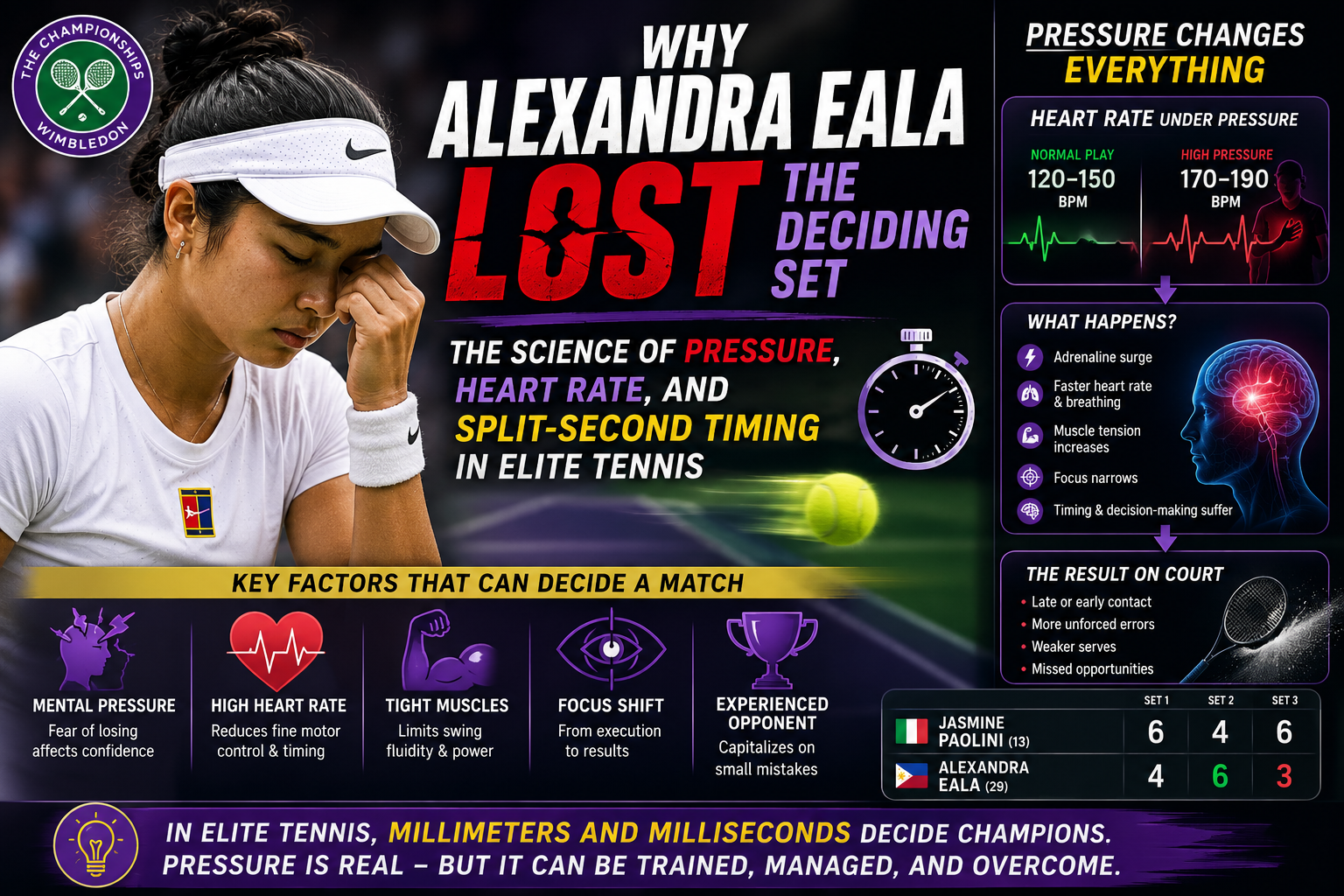
What happened to Alexandra Eala is common in elite tennis. When a match reaches its most important moments, the body and brain enter a high-stress state that changes heart rate, breathing, muscle control, and decision-making.
1. The heart rate rises dramatically
During routine rallies, a professional player's heart rate may be around 120–150 beats per minute (bpm).
During critical moments—such as break points, serving to stay in the match, or deciding sets—it can climb to 170–190 bpm, depending on the length of rallies and the player's stress response.
This happens because the sympathetic nervous system releases adrenaline (epinephrine).
The body prepares for "fight or flight" by:
- Increasing heart rate.
- Pumping more oxygen to the muscles.
- Raising blood pressure.
- Releasing glucose for quick energy.
2. Pressure changes the brain
In pressure situations, the brain shifts priorities.
Instead of relying on automatic, well-practiced movements, players may begin consciously thinking about their technique.
This can lead to:
- Slightly later racket preparation.
- Tighter grip pressure.
- Less fluid footwork.
- Slower decision-making.
- Reduced confidence on aggressive shots.
This phenomenon is often described in sports psychology as "choking under pressure," though not every late-match error qualifies as choking.
3. Small changes become costly
A difference of only a few milliseconds can matter enormously.
Under pressure:
- Split-step timing may be slightly late.
- Recovery steps can become slower.
- Legs may feel heavier.
- First-serve percentage often declines.
- Ball toss consistency may decrease.
Against an experienced opponent like Jasmine Paolini, those small changes are frequently enough to decide a match.
4. Muscle tension reduces shot quality
When adrenaline rises too much:
- Forearm muscles tighten.
- Shoulder movement becomes less relaxed.
- Wrist acceleration decreases.
- Swing speed may become less natural.
The result can be:
- More balls landing short.
- Slightly less topspin.
- Reduced serve accuracy.
- More unforced errors.
5. Why experienced players often prevail
Veteran players are not necessarily calmer—they also experience elevated heart rates.
The difference is that they often recover between points more effectively by:
- Slowing their breathing.
- Following a consistent pre-serve routine.
- Focusing on one point at a time.
- Accepting pressure instead of resisting it.
These habits help them maintain better decision-making despite physiological stress.
What likely happened in Eala's match
Eala demonstrated that she can compete at a very high level by pushing Paolini into a deciding set. However, in the closing stages, a combination of factors may have influenced the outcome:
- Physical fatigue from a demanding match.
- Increased heart rate and adrenaline.
- Slight reductions in first-serve effectiveness.
- Paolini's experience handling crucial moments.
- Small tactical or execution differences on a handful of key points.
That does not necessarily mean Eala "collapsed." In high-level tennis, matches are often decided by just a few points. One break of serve, a missed return, or a well-executed aggressive play can determine the winner.
The positive takeaway
For a young player like Eala, matches like this are valuable. Learning to perform under Grand Slam pressure is part of the development process. Many top champions—including Iga Świątek, Aryna Sabalenka, and Coco Gauff—lost close matches early in their careers before consistently winning them.
If Eala continues improving her physical conditioning, serve reliability, and ability to manage high-pressure moments, she is likely to become even more competitive in future Grand Slam tournaments.