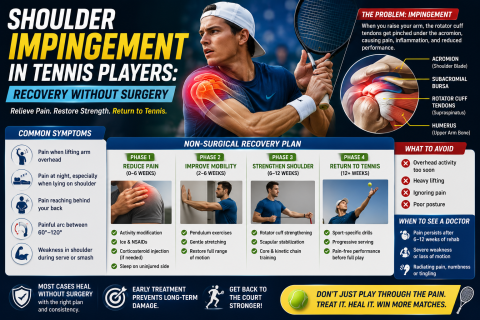

Biceps tendinitis is a common cause of pain at the front of the shoulder, particularly in athletes who perform repetitive overhead movements. For tennis players, serving, overhead smashes, and repeated shoulder rotation can place substantial stress on the long head of the biceps tendon.
The goal of treatment is not simply to make the pain disappear. A successful recovery should identify the cause of the overload, restore shoulder mobility and strength, improve movement mechanics when necessary, and gradually rebuild the player's ability to tolerate tennis-specific activity.
This article is for educational purposes and does not replace an examination by a physician, sports-medicine specialist, or physical therapist.
Quick Overview
Condition: Biceps tendinitis or tendinopathy involving the biceps tendon, most commonly the long head of the biceps at the shoulder.
Typical pain: Pain at the front of the shoulder that may extend into the upper arm.
Common triggers: Serving, overhead shots, repetitive shoulder rotation, lifting, and sudden increases in training volume.
Typical onset: Often gradual, although significant tendon injuries can occur after acute trauma.
Diagnosis: Medical history, physical examination, and, when necessary, ultrasound or MRI.
First-line treatment: Activity modification, rehabilitation, progressive strengthening, and appropriate pain management.
Surgery: Considered in selected cases involving significant tendon damage, instability, associated shoulder pathology, or persistent symptoms despite appropriate conservative treatment.
Return to tennis: A gradual, criteria-based progression rather than simply waiting a predetermined number of days.
What Is Biceps Tendinitis?
The biceps muscle is located at the front of the upper arm and contributes to elbow flexion and forearm supination.
The long head of the biceps tendon travels through the shoulder and attaches near the top of the shoulder joint. Because of its location and role in shoulder movement and stability, the tendon can be exposed to repeated stress during overhead sports.
The term biceps tendinitis traditionally refers to inflammation of the tendon. Persistent tendon problems may instead involve tendinopathy, which can include structural changes and degeneration as well as inflammation.
For tennis players, repeated overhead activity can gradually increase the workload placed on the tendon.
Why Can Tennis Cause Biceps Tendon Problems?
Tennis places significant demands on the shoulder.
The serve combines shoulder external rotation, rapid internal rotation, arm elevation, trunk rotation, scapular movement, elbow extension, and high-speed racket acceleration.
The problem is often not one individual serve. Instead, the tendon can become overloaded through the accumulation of repeated activity without sufficient recovery.
Risk can increase when a player suddenly increases:
Serve volume
Practice duration
Match frequency
Overhead drills
Strength-training volume
Tournament participation
A player returning from a long break can also be vulnerable if normal training volume is resumed too quickly.
Symptoms of Biceps Tendinitis
The most characteristic symptom is pain at the front of the shoulder.
A tennis player may experience pain during:
Serving
Overhead shots
Reaching above the head
Lifting objects
Carrying a tennis bag
Repeated shoulder rotation
Raising the arm
Sleeping on the affected shoulder
Pain may be described as aching, sharp with certain movements, or deep discomfort in the front of the shoulder.
Some players also experience pain after tennis rather than immediately during the activity.
Night pain can occur with shoulder tendon disorders.
It is important to remember that anterior shoulder pain does not automatically mean biceps tendinitis. Rotator-cuff problems, labral injuries, shoulder impingement, arthritis, and other conditions can produce similar symptoms.
Symptoms That Should Not Be Ignored
A tennis player should seek medical evaluation if shoulder pain:
Persists despite reducing tennis activity
Gets progressively worse
Produces significant weakness
Causes loss of shoulder movement
Interferes with normal daily activities
Produces painful clicking or catching
Follows a fall or direct trauma
Is accompanied by sudden bruising
Occurs after a sudden popping sensation
Causes visible deformity
A sudden pop followed by bruising, deformity, or substantial weakness may indicate a more significant biceps tendon injury rather than simple tendinitis.
Causes of Biceps Tendinitis
Repetitive Overhead Activity
The tennis serve is one of the most demanding movements for the shoulder.
Repeated serving can progressively increase tendon stress, particularly when the player is serving at high intensity.
Sudden Training Increase
A player who normally serves 50 balls during a practice session and suddenly begins serving 150 to 200 balls may exceed the shoulder's current ability to tolerate the workload.
Tendons need time to adapt to increased training demands.
Serve Mechanics
Technique can influence the forces placed on the shoulder.
Potential contributing factors can include:
Insufficient leg drive
Poor trunk rotation
Limited shoulder mobility
Poor scapular control
Excessive dependence on the arm
However, technique is rarely the only factor. Training volume, physical conditioning, recovery, age, previous injuries, and other factors can also influence injury risk.
Rotator-Cuff Problems
Biceps tendon symptoms can occur together with rotator-cuff pathology.
This is important because treating the biceps alone may not resolve the underlying shoulder problem.
Labral Problems
The long head of the biceps has an important anatomical relationship with the upper portion of the shoulder joint and labrum.
Persistent anterior shoulder pain may therefore require evaluation for associated labral pathology.
Insufficient Recovery
Repeated tennis sessions without enough recovery can gradually exceed the tendon’s ability to adapt.
This can become particularly important during tournaments, intensive training blocks, or periods when a player suddenly increases playing frequency.
How Is Biceps Tendinitis Diagnosed?
Diagnosis begins with a detailed medical history.
A clinician may ask:
When did the pain begin?
Did it develop gradually or suddenly?
Does serving reproduce the pain?
Does overhead activity make it worse?
Do you experience night pain?
Have you recently increased training?
Did the problem follow an injury?
Do you have weakness?
Do you experience clicking or catching?
The physical examination may evaluate:
Shoulder range of motion
Shoulder strength
Tenderness
Rotator-cuff function
Scapular movement
Shoulder stability
Elbow and forearm function
Speed's Test
Speed's test may be used to reproduce symptoms associated with the biceps tendon.
Yergason's Test
Yergason's test may be used to assess biceps-related pain and tendon stability.
These tests should not be interpreted independently. Several shoulder conditions can produce similar symptoms, so the complete clinical examination is important.
Imaging
Imaging is not always required.
Many shoulder tendon problems can initially be assessed through medical history and physical examination.
When imaging is considered appropriate, ultrasound or MRI may be used.
Ultrasound
Musculoskeletal ultrasound can evaluate the biceps tendon and can provide dynamic information about the tendon during movement.
MRI
MRI provides a more comprehensive evaluation of the shoulder and may help identify:
Tendon damage
Partial tearing
Rotator-cuff pathology
Labral pathology
Other structural abnormalities
Treatment
Activity Modification
The first step is usually relative rest rather than complete inactivity.
A tennis player may temporarily need to reduce or stop:
Serving
Overhead shots
High-volume hitting
Heavy shoulder exercises
Pain-provoking movements
The goal is to reduce the aggravating load while maintaining appropriate physical conditioning.
Physical Therapy
Physical therapy is an important component of recovery.
A rehabilitation program may address:
Shoulder mobility
Rotator-cuff strength
Scapular control
Biceps strength
Upper-back strength
Core stability
Whole-body tennis mechanics
For tennis players, rehabilitation should not focus exclusively on the shoulder.
The legs, hips, trunk, scapula, shoulder, elbow, and wrist work together during the tennis serve.
Medication
A physician may recommend medication such as an NSAID when appropriate to help control pain and inflammation.
Medication should not be considered the primary solution.
If a player uses pain medication and immediately returns to high-volume serving, the underlying workload problem remains.
Ice and Symptom Management
Ice may temporarily reduce discomfort following activity.
It can be useful for symptom management, but it does not restore tendon capacity.
The long-term objective remains appropriate rehabilitation and progressive loading.
Injections
In selected cases, a physician may consider an injection when symptoms remain troublesome despite appropriate conservative treatment.
The specific diagnosis and injection location are important because the biceps tendon is a vulnerable structure.
An injection should not be viewed as a shortcut back to unrestricted tennis.
When Is Surgery Considered?
Surgery is not automatically required when a tennis player develops biceps tendon pain.
Surgery may be considered when there is:
Persistent pain despite appropriate rehabilitation
Significant tendon damage
Biceps tendon instability
Substantial tearing
Associated rotator-cuff pathology
Labral pathology
Acute traumatic injury
Failure of appropriate non-operative treatment
Two surgical procedures commonly discussed for significant biceps tendon problems are biceps tenotomy and biceps tenodesis.
Biceps Tenotomy
Tenotomy involves releasing the damaged biceps tendon from its attachment.
Potential advantages include a relatively straightforward procedure and rehabilitation in selected cases.
One potential disadvantage is the possibility of a visible Popeye deformity caused by retraction of the biceps muscle.
The decision depends on the individual patient, activity requirements, associated shoulder problems, and surgeon assessment.
Biceps Tenodesis
Tenodesis involves releasing the problematic portion of the tendon and securing it to the humerus.
The objective is to maintain a more normal biceps contour and function.
Rehabilitation is generally more protective initially. Restrictions on active elbow flexion and heavy loading depend on the surgical technique and the patient's individual circumstances.
There is no universal four-to-six-week return-to-tennis rule.
The actual recovery period depends on the surgical procedure, associated injuries, tissue healing, strength, range of motion, and rehabilitation progress.
Preventing Biceps Tendinitis in Tennis
Prevention is largely about managing shoulder workload before the tendon becomes overloaded.
Warm Up Properly
A tennis warm-up should progressively prepare the body for tennis-specific movements.
A warm-up may include:
Light cardiovascular activity
Dynamic shoulder movements
Resistance-band exercises
Scapular activation
Progressive groundstrokes
Gradually increasing serve intensity
Manage Serve Volume
Avoid suddenly doubling the number of serves in a training session.
After a break from tennis, gradually increase serving volume and intensity.
A useful progression is:
Volume
Intensity
Complexity
Match conditions
The goal is to allow the shoulder and tendon to adapt.
Monitor Pain
Do not repeatedly train through worsening shoulder pain.
Increasing pain during tennis or significant pain after training can indicate that the current workload exceeds the shoulder's capacity.
Persistent symptoms should be evaluated rather than repeatedly masked.
Strengthen the Tennis Shoulder
A well-designed tennis conditioning program may include:
Rotator-cuff strengthening
Scapular stabilization
Biceps strengthening
Triceps strengthening
Upper-back strengthening
Core training
Hip strengthening
Leg strengthening
The goal is not simply to strengthen the biceps.
The objective is to develop a shoulder and kinetic chain capable of producing and absorbing the forces required for tennis.
Return to Tennis
Returning to tennis should be gradual.
Feeling better does not necessarily mean that the tendon is ready for unrestricted competition.
Stage One: Daily Activities
The player should be able to perform normal activities with minimal or no symptoms.
Stage Two: Rehabilitation
Restore appropriate:
Shoulder range of motion
Rotator-cuff strength
Scapular control
Biceps strength
Stage Three: Groundstrokes
Begin with controlled groundstrokes.
Start at lower intensity and monitor symptoms during and after the session.
Stage Four: Controlled Serving
Gradually reintroduce serves.
Start with:
Lower volume
Lower intensity
Longer recovery periods
Stage Five: Overheads
Progressively introduce overhead shots and more demanding serving patterns.
Stage Six: Practice Sets
Once the shoulder tolerates training, progress toward match-like situations.
Stage Seven: Competition
Return to competition when shoulder strength, movement, tennis-specific loading tolerance, and symptoms are satisfactory.
Return-to-Tennis Checklist
Before returning to full competitive tennis, a player should discuss readiness with a qualified medical professional when the injury has been significant.
Important considerations include:
Minimal or no shoulder pain during daily activities
Appropriate shoulder range of motion
Appropriate strength
No significant pain with resisted shoulder movements
Groundstrokes tolerated
Serving tolerated progressively
Overhead shots tolerated
No significant symptom flare after training
Tennis-specific movements feel controlled
Confidence has returned
The Tennis-Specific Lesson
Biceps tendinitis is not simply a shoulder inflammation problem.
For tennis players, it can be a warning that the relationship between training load, recovery, strength, mobility, and technique has become unbalanced.
The wrong approach is:
Pain followed by medication followed by an immediate return to full tennis.
A better approach is:
Identify the problem.
Reduce the aggravating workload.
Restore movement.
Rebuild strength.
Progressively reload the tendon.
Gradually return to tennis.
This approach addresses both the symptoms and the factors that may have contributed to the injury.
When Should a Tennis Player See a Doctor?
Professional evaluation is recommended when:
Shoulder pain persists despite reducing tennis.
Pain continues to worsen.
Significant weakness develops.
Normal shoulder movement becomes difficult.
Clicking or catching occurs.
Night pain becomes persistent.
The injury follows a fall or significant trauma.
A sudden popping sensation occurs.
Bruising or deformity develops.
A tendon tear is suspected.
A sports-medicine physician can determine whether the problem is actually biceps tendinitis or another shoulder condition requiring a different treatment approach.
Conclusion
Biceps tendinitis can be particularly frustrating for tennis players because serving and overhead strokes repeatedly load the shoulder.
Successful recovery usually requires more than simply waiting for the pain to disappear.
The player should identify the source of the problem, reduce aggravating activity, restore shoulder movement and strength, address contributing factors, and progressively rebuild tolerance to tennis-specific loading.
Most importantly, returning to tennis should be based on function, strength, symptoms, and rehabilitation progress rather than simply the number of days since the injury.
Persistent anterior shoulder pain deserves appropriate medical evaluation because biceps tendon problems can overlap with rotator-cuff injuries, labral pathology, and other shoulder conditions.