
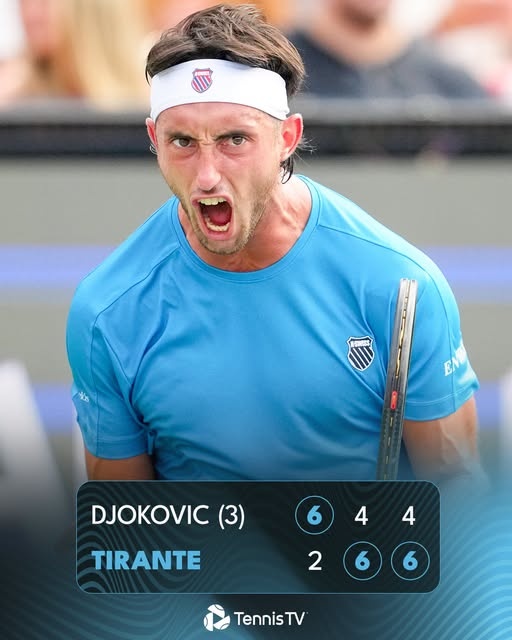
The scoreboard in the provided image tells the story: Novak Djokovic (3) lost to Thiago Agustín Tirante 2–6, 6–4, 6–4 at the 2026 Cincinnati Open.
One important correction to the original match description: the player shown on the scoreboard is Thiago Agustín Tirante, not Juan Manuel Cerúndolo or Tomás Martín Etcheverry. This was a genuine first meeting between Djokovic and Tirante, and the result represented one of the biggest wins of the Argentine's career.
From a tennis perspective, however, the most interesting part is not simply that Djokovic lost. It is how the match changed after the first set.
Djokovic appeared to have the contest under control at 6–2. Tirante then changed the emotional and tactical temperature of the match, while Djokovic's physical problems in Cincinnati's heat and humidity became an increasingly important factor.
1. The First Set: Djokovic Creates the Perfect Trap
The opening set was classic Djokovic tennis.
At 6–2, he had established the match on his terms. His objective was straightforward:
- absorb Tirante's initial aggression;
- redirect pace with depth;
- make the Argentine play additional balls;
- pressure the serve;
- turn neutral rallies into defensive situations.
For an underdog, this is psychologically difficult.
When a player enters a match against Djokovic, there is often an initial temptation to play too safely. The problem is that Djokovic is exceptionally comfortable against predictable tennis.
If Tirante simply continued trading safe baseline balls, Djokovic could gradually take away his court position.
Instead, Tirante eventually found another solution.
2. The Mental Turning Point
The most important adjustment was psychological.
After losing the first set 6–2, Tirante had very little reason to continue playing as though he needed to protect the score.
He could attack.
That distinction matters enormously in professional tennis.
An underdog facing Djokovic can become trapped by the thought:
"I cannot make mistakes."
That mindset usually produces short swings, conservative targets and passive positioning.
Tirante increasingly behaved as though the match was still available to him.
That allowed him to take more aggressive swings and compete for court position rather than simply trying to survive.
From a USA coaching perspective, this is one of the strongest lessons from the match:
When you are the underdog, sometimes your best mental strategy is not to reduce risk—it is to choose the right risks.
3. Tirante's Tactical Adjustment
Tirante's comeback was not simply an emotional surge.
He began to make Djokovic work under different conditions.
The Argentine used his forehand and serving patterns to create more pressure, while Djokovic was no longer able to dictate every exchange as comfortably as he had in the opening set. Contemporary match reports specifically noted Tirante's strong serving and forehand play during the comeback.
The tactical principle was simple:
Do not allow Djokovic to settle into his preferred rhythm.
That means:
- Take opportunities to attack shorter balls.
- Use the forehand to open the court.
- Avoid giving Djokovic repetitive, comfortable patterns.
- Make him defend rather than simply counterpunch.
- Compete aggressively when break opportunities appear.
Tirante did not need to dominate every rally.
He needed to change enough rallies to prevent Djokovic from controlling the match automatically.
4. The Physical Factor Changed the Match
This is where the Cincinnati conditions become impossible to ignore.
Reports from the match indicate that Djokovic struggled significantly with the heat and humidity. He required medical attention during the second set and visibly experienced physical difficulties as the contest continued.
That does not diminish Tirante's victory.
In fact, recognizing an opponent's physical decline and adjusting intelligently is itself an important part of elite tennis.
Tirante had to make a difficult calculation:
Should I continue attacking, or should I become too conservative because Djokovic is struggling?
The correct answer was to remain disciplined.
A player who becomes overly cautious against an injured or exhausted opponent can actually allow that opponent to recover.
Tirante continued competing for the match.
5. Djokovic's Mental Challenge
For Djokovic, the psychological challenge was very different.
He entered the second set having just won the opening set 6–2. Normally, that creates enormous confidence.
But when physical discomfort appears, the mental equation changes.
The player must constantly evaluate:
- How much energy can I spend?
- Should I shorten points?
- Can I still defend the baseline effectively?
- Should I attack earlier?
- Can I protect my serve without overextending physically?
This is especially difficult for a player whose identity has historically been built around extraordinary physical resilience.
Djokovic has made a career out of surviving situations where opponents believe he is finished.
That reputation can become psychologically complicated.
The player may continue searching for another level even when the body is no longer providing it.
6. Why 6–4, 6–4 Was So Significant
The second and third sets were essentially about maintaining pressure.
Tirante did not need a spectacular scoreline.
He needed to win the important games.
That is a crucial distinction.
Against an elite player, an underdog does not necessarily need to dominate statistically. He needs to capitalize when the match provides an opening.
The scoreboard shows that Tirante achieved exactly that:
6–2, 4–6, 4–6
The first set belonged to Djokovic.
The next two belonged to Tirante.
That demonstrates an important mental characteristic: Tirante was able to separate the match into phases rather than mentally carrying the 6–2 deficit into the second set.
7. The Pressure-Point Battle
At the highest level, momentum is rarely created by every point.
It is created by a handful of points that change the geometry of the match.
A break point saved can prevent a collapse.
A break point converted can transform belief.
A long service game can produce frustration.
A missed forehand at 30–30 can change the next four games.
This is why tennis is such a psychological sport.
Tirante's biggest achievement was not merely winning two sets.
It was maintaining enough composure to keep competing when Djokovic still had the reputation, experience and scoreboard advantage.
8. Djokovic's Adjustment Came Too Late
From a tactical coaching perspective, Djokovic's problem was not that he lacked solutions.
The issue was that his physical condition limited the number of solutions he could execute.
When a player is physically compromised, the answer is often to simplify.
For example:
- shorten the points when possible;
- serve for specific locations rather than maximum power;
- attack the first manageable ball;
- avoid unnecessary extended defensive exchanges;
- use changes of direction selectively;
- protect energy between points.
But those adjustments only work if the body can execute them.
In Cincinnati, the heat and humidity became a major part of the match equation.
9. Tirante's Biggest Mental Victory
The most impressive part of Tirante's performance may have been his ability to believe after being thoroughly beaten in the opening set.
At 2–6, many players would subconsciously think:
"Maybe Djokovic is simply too good."
Instead, Tirante appears to have found the opposite response:
"I can change this match."
That mental switch is enormous.
Professional tennis players constantly talk about momentum, but momentum is often created by a player's interpretation of what is happening.
The same 6–2 score can produce two completely different reactions:
Negative reaction:
"I am being dominated."
Competitive reaction:
"I need to change the pattern."
Tirante chose the second.
10. The Underdog's Winning Formula
If I were explaining this match to an American junior or college player, I would reduce Tirante's comeback to five principles.
1. Forget the previous set
A 6–2 loss is already history.
The second set begins at 0–0.
2. Increase purposeful aggression
Do not attack every ball.
Attack the balls that allow you to take court position.
3. Make the favorite uncomfortable
Elite players are most dangerous when they are playing familiar patterns.
Change the rhythm.
4. Stay emotionally neutral
Do not celebrate every point as if you have won the match.
The comeback must be built point by point.
5. Recognize physical changes
If the opponent is struggling physically, adjust your strategy without becoming reckless.
That is competitive intelligence.
11. What Djokovic Can Take From This Match
There is also an important lesson for Djokovic.
The loss should not simply be classified as an upset.
It demonstrates the increasing importance of physical management during the hard-court season.
Djokovic had not played since Wimbledon, and Cincinnati represented an important preparation point before the US Open. Reuters reported that Djokovic's focus now turns toward recovering and preparing for the US Open, where he is pursuing a historic 25th major title.
For a 39-year-old champion managing a demanding late-career schedule, preparation is no longer simply about hitting tennis balls.
It includes:
- heat acclimatization;
- recovery;
- match-specific conditioning;
- energy management;
- tournament scheduling;
- recovery between matches;
- knowing when to shorten points.
These factors can determine whether an elite player survives the first week of a tournament.
12. The Bigger Tour Context
This upset also fits a broader pattern in men's tennis.
The gap between established stars and ambitious younger or lower-ranked players is not always as large as the rankings suggest.
A player ranked around No. 50 can possess world-class weapons.
The difference is often consistency, experience and the ability to reproduce that level against elite opposition.
Tirante's victory therefore represents more than one surprising result.
It is evidence that when an underdog combines:
belief + physical commitment + tactical aggression + pressure-point execution
a ranking gap can disappear very quickly.
13. Final USA Tennis Expert Assessment
From a coaching standpoint, I would describe the match as a two-part contest.
Set 1: Djokovic controlled the tactical environment.
Sets 2–3: Tirante changed the competitive environment.
That distinction is critical.
The Argentine did not simply wait for Djokovic to collapse. He remained aggressive enough to take advantage of the changing conditions.
Djokovic, meanwhile, faced an unusually difficult combination of an opponent gaining confidence and significant physical discomfort in extreme Cincinnati conditions.
The final 2–6, 6–4, 6–4 scoreline therefore tells only part of the story.
The deeper lesson is about adaptation.
In professional tennis, the first game plan is rarely the final game plan.
The best competitors recognize when the match has changed—and they change with it.
Final Takeaway
Tirante won the match mentally before he won it on the scoreboard.
He lost the first set 6–2, but instead of allowing Djokovic's dominance to define the match, he changed his level of belief, increased his willingness to attack and continued applying pressure as Djokovic's physical condition deteriorated.
For Djokovic, the lesson is equally clear:
Dominating the opening set is not enough when the physical and tactical conditions change dramatically.
For every developing player watching this match, the message is even more valuable:
Never confuse losing the first set with losing the match.
Tirante's Cincinnati victory is a powerful example of how mental resilience, tactical adjustment and intelligent aggression can transform an apparently one-sided match into one of the biggest victories of a player's career.