
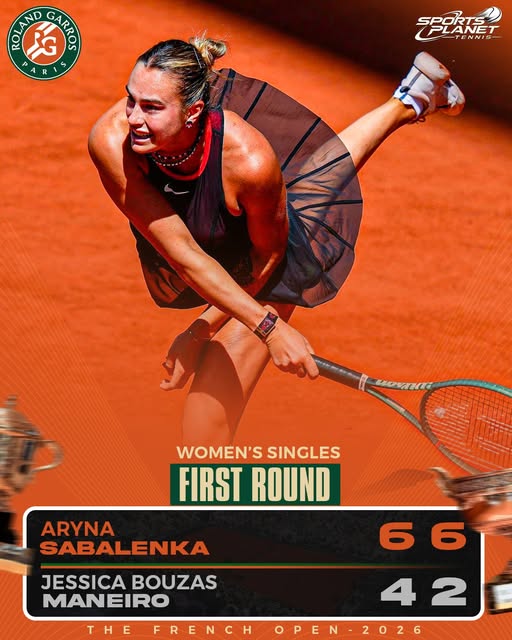
The message from Aryna Sabalenka at French Open was immediate, powerful, and impossible to ignore.
The World No. 1 began her Roland-Garros campaign in dominant fashion, securing a commanding 6-4, 6-2 victory to move confidently into the second round as she continues pursuing the one major title still missing from her growing legacy — the French Open crown.
But what made this performance truly impressive was not simply the scoreline.
It was the way Sabalenka controlled the match mentally and tactically.
Many players hit hard.
Many players play aggressively.
Many players dominate physically.
But Aryna Sabalenka has evolved into something far more dangerous:
A player who can recognize problems instantly and make game adjustments at elite speed.
That ability separates good players from Grand Slam champions.
And at Roland Garros 2026, Sabalenka already looks locked in mentally, emotionally, and tactically.
Sabalenka’s Biggest Improvement: Mental Focus Under Pressure
Earlier in her career, Sabalenka was known primarily for explosive power.
Her game featured:
- Massive groundstrokes
- Huge serving
- Fearless aggression
- High-risk shot-making
But there was also inconsistency.
When pressure increased:
- Errors sometimes exploded
- Emotions became unstable
- Tactical discipline disappeared
That version of Sabalenka still frightened opponents.
But the current version is far more complete.
Today, Aryna Sabalenka combines:
- Elite power
- Emotional composure
- Tactical intelligence
- Fast adjustment ability
- Improved patience
This transformation is why she became World No. 1.
And it is why she may now be the favorite to win Roland Garros.
Roland Garros Requires More Than Power
Clay courts expose weaknesses brutally.
At the French Open:
- Points become longer
- Movement becomes harder
- Recovery matters more
- Tactical patience becomes essential
Players who rely only on power eventually struggle.
But Sabalenka’s game has matured significantly on clay.
Against her first-round opponent, she demonstrated several elite-level qualities:
- Controlled aggression
- Smarter point construction
- Better rally tolerance
- Improved defensive transitions
- Faster tactical adaptation
That combination becomes terrifying on slow courts.
First Set Analysis: Sabalenka Solves Problems Quickly
The opening set finished 6-4, but it was tactically fascinating.
Early in the match, Sabalenka’s opponent attempted to disrupt rhythm through:
- Higher topspin
- Slower tempo
- Extended rallies
- Wide-angle movement patterns
This strategy initially created mild discomfort.
For a few games, Sabalenka looked slightly rushed.
But here is what separates elite champions:
She adjusted almost immediately.
ATP Expert Breakdown: Sabalenka’s Fast Game Adjustments
One of the most underrated skills in professional tennis is adjustment speed.
Some players recognize tactical problems too late.
Others panic emotionally.
Some refuse to adapt entirely.
Sabalenka belongs to a rare category:
She identifies tactical issues extremely quickly.
That skill changes everything.
Adjustment 1: More Margin Over the Net
Early in the first set, Sabalenka missed several aggressive balls long.
Instead of stubbornly forcing low-margin power, she adjusted intelligently.
She added:
- More topspin
- Safer height
- Better net clearance
This reduced unforced errors immediately.
Elite players understand that aggression does not always mean maximum power.
Sometimes smart aggression wins more matches than reckless aggression.
Adjustment 2: Better Court Positioning
Initially, Sabalenka stood slightly too far behind the baseline during neutral rallies.
This gave her opponent extra time.
She corrected this quickly by:
- Holding baseline position more aggressively
- Taking balls earlier
- Stepping inside during shorter exchanges
This instantly shifted pressure back onto the opponent.
At professional level, court positioning controls momentum.
Adjustment 3: Smarter Shot Selection
One major improvement in Sabalenka’s modern game is point construction.
Earlier in her career, she often attempted outright winners too early.
Now she understands:
- When to attack
- When to build points
- When to defend patiently
Against her Roland Garros opponent, she gradually increased pressure instead of forcing immediate knockout shots.
That patience broke resistance down systematically.
Sabalenka’s Forehand Is Still One of the Most Dangerous Weapons in Tennis
Even with her tactical evolution, Sabalenka’s raw power remains elite.
Her forehand continues to terrorize opponents because:
- The pace arrives extremely heavy
- The ball penetrates deep
- The contact timing stays aggressive
- She redirects crosscourt angles brutally
On clay courts, heavy forehands become even more dangerous because high bounce pushes opponents backward constantly.
Once Sabalenka established forehand rhythm, the match began slipping away quickly from her opponent.
The Serve Was a Major Factor
One huge difference between old Sabalenka and current Sabalenka is serve reliability.
Earlier in her career:
- Double faults created emotional chaos
- Service games became unpredictable
- Pressure affected mechanics
Now her serve looks calmer and more repeatable.
Against her first-round opponent:
- First-serve placement was excellent
- Wide serves opened the court beautifully
- Second serves carried more confidence
This prevented opponents from attacking her service games consistently.
At Grand Slam level, free service holds become priceless.
The Emotional Difference Is Massive
Perhaps the biggest evolution in Aryna Sabalenka’s game is emotional stability.
This version of Sabalenka handles adversity differently.
Earlier versions:
- Reacted emotionally to errors
- Lost tactical discipline under stress
- Allowed frustration to spread
Now:
- She resets faster
- Maintains focus better
- Controls body language
- Stays tactically organized
This emotional maturity is championship-level.
Second Set: Sabalenka Took Complete Control
Once Sabalenka solved the early tactical problems, the second set became one-sided.
The scoreline of 6-2 reflected complete momentum control.
Several things became obvious:
- Her opponent’s confidence dropped
- Sabalenka’s aggression increased
- Rally quality improved dramatically
- Court positioning became dominant
This is what elite champions do.
They absorb early resistance.
Then they slowly suffocate opponents mentally and physically.
Why Sabalenka Is So Dangerous at Roland Garros 2026
Many analysts now believe Sabalenka has become the most complete power player in women’s tennis.
Several factors explain why.
1. She Adjusts Faster Than Most Players
This may be her greatest weapon now.
Grand Slam tennis constantly changes:
- Conditions shift
- Opponent patterns evolve
- Momentum swings happen
Players who adjust fastest survive longest.
Sabalenka’s tactical adaptation speed is elite.
2. She Combines Power With Patience
This combination is rare.
Some aggressive players lack patience.
Some patient players lack finishing power.
Sabalenka now has both.
That balance makes her extremely difficult to defeat.
3. She Moves Better Than People Realize
Earlier criticism suggested Sabalenka relied too heavily on power.
But her movement has improved dramatically.
She now:
- Slides more efficiently on clay
- Recovers faster
- Defends wider angles better
- Transitions offense-to-defense smoothly
Those improvements matter enormously at Roland Garros.
4. Her Confidence Is Massive
Confidence changes everything in tennis.
When players believe deeply in their systems:
- Decision-making improves
- Aggression becomes freer
- Recovery from mistakes accelerates
Sabalenka currently carries champion-level belief.
That mental edge becomes terrifying for opponents.
ATP Expert Analysis: Why Fast Adjustments Matter So Much
Tennis is not just physical execution.
It is problem-solving under pressure.
Every match presents questions:
- How do you attack this opponent?
- Which patterns are working?
- Which shots are failing?
- What emotional momentum exists?
Players who solve these questions fastest usually win.
Sabalenka now processes matches like an elite tactical competitor.
That is why she looks so dangerous.
The Evolution of Aryna Sabalenka’s Tennis IQ
One misconception about power players is that they rely only on force.
But Sabalenka’s tennis IQ has grown enormously.
She now understands:
- Rally pacing
- Opponent discomfort zones
- Shot tolerance
- Momentum management
- Risk selection
This intellectual growth transformed her career.
Why Opponents Fear Sabalenka
Facing Aryna Sabalenka creates enormous psychological stress.
Opponents know:
- She can end rallies instantly
- She can dominate physically
- She can recover emotionally
- She adjusts quickly
- She punishes hesitation
That pressure causes many players to overhit early.
Once errors begin, Sabalenka attacks even harder.
What Sabalenka Must Still Improve
Even dominant victories still reveal areas for refinement.
If Sabalenka wants her first Roland Garros title, several areas remain important.
1. Avoid Short Emotional Dips
Although improved dramatically, occasional frustration still appears briefly.
Against elite clay-court specialists, even small emotional dips become dangerous.
2. Continue Protecting Second Serve Confidence
Her serving is much stronger now, but high-pressure moments later in the tournament will test it further.
3. Stay Physically Fresh
Roland Garros demands brutal physical endurance.
Energy management across two weeks becomes critical.
The Mentality of a Champion
One major reason Sabalenka looks different now is mindset evolution.
Champions think differently.
They understand:
- Every point matters
- Emotional control matters
- Tactical flexibility matters
- Focus matters daily
Sabalenka now carries herself like a player expecting to win tournaments, not simply compete in them.
That psychological transformation changes career trajectories.
Lessons Young Tennis Players Can Learn From Sabalenka
This performance offers huge lessons for developing players.
Do Not Panic During Bad Starts
Sabalenka did not panic early when rhythm looked uncomfortable.
Instead:
- She analyzed
- Adjusted
- Simplified
Young players often panic emotionally too quickly.
Smart Aggression Beats Reckless Aggression
Big hitting alone is not enough.
Controlled aggression wins more consistently.
Emotional Recovery Matters
Errors happen constantly in tennis.
Elite players recover mentally faster.
Sabalenka demonstrated this beautifully.
Adaptability Wins Matches
The best players adjust continuously.
Tennis rewards problem-solvers.
Could This Finally Be Sabalenka’s Roland Garros Year?
The possibility feels very real.
Several conditions now favor her:
- Improved clay movement
- Greater tactical patience
- Massive confidence
- Emotional maturity
- Elite serving
Most importantly:
She no longer looks emotionally fragile under pressure.
That may be the biggest change of all.
The Rest of the Draw Should Be Worried
When World No. 1 players begin tournaments with calm, controlled dominance, the locker room notices.
Sabalenka did not merely win.
She looked:
- Focused
- Sharp
- Disciplined
- Physically strong
- Mentally aggressive
That combination sends a message to the entire field.
Final Thoughts: Aryna Sabalenka Looks Ready for a Serious Roland Garros Run
Aryna Sabalenka opened her French Open campaign exactly how elite champions should:
with authority, composure, and tactical intelligence.
The 6-4, 6-2 victory was not just about power.
It was about:
- Fast game analysis
- Smart adjustments
- Emotional control
- Strategic aggression
- Championship mentality
Sabalenka’s ability to identify problems quickly and adapt immediately may now be the most dangerous weapon in women’s tennis.
And if she continues playing with this level of focus and tactical maturity, Roland Garros 2026 could finally become the tournament where Aryna Sabalenka captures the Paris crown she has been chasing for years.