
The Hidden Metric That Defines Control
If you ask most players what determines success in tennis, they’ll say power, spin, or movement. But from a coaching perspective—especially at the elite level in the United States—there is one underrated metric that quietly governs all three:
Net clearance.
Net clearance is the vertical distance a ball travels above the net during a rally. It directly influences margin, consistency, spin production, and tactical intent. In simple terms:
- Too low → high risk, low margin
- Too high → safe, but potentially attackable
- Just right → controlled aggression
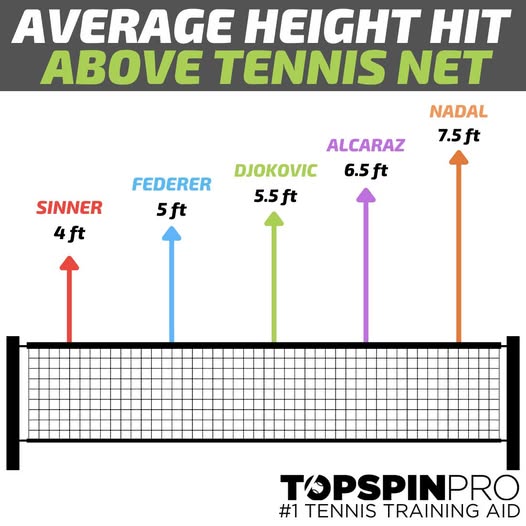
Recent data comparing top ATP players reveals a fascinating spectrum of styles, from ultra-flat hitters to extreme topspin specialists. Let’s break it down.
Average Net Clearance of Elite ATP Players
Here’s how some of the most recognizable names in men’s tennis compare across all surfaces:
- Jannik Sinner — ~4 ft
- Roger Federer — ~5 ft
- Novak Djokovic — ~5.5 ft
- Carlos Alcaraz — ~6.5 ft
- Rafael Nadal — ~7.5 ft
These numbers are not random—they represent distinct tactical identities.
Understanding Net Clearance: The Physics and the Strategy
Before comparing players, you need to understand what net clearance actually controls.
1. Margin Over Error
A ball that clears the net by:
- 3–4 ft → aggressive, tight margin
- 5–6 ft → balanced
- 7+ ft → heavy topspin safety
2. Spin Production
Higher clearance usually means:
- More topspin
- Greater dip into the court
- Higher bounce after landing
3. Court Positioning
- Low clearance → early ball striking
- High clearance → deeper positioning, more time
This is why net clearance is not just a stat—it’s a philosophy of play.
Player-by-Player Breakdown
Jannik Sinner — The Low-Clearance Precision Striker
Average Net Clearance: ~4 ft
Sinner operates at the lowest margin among elite players. That’s not a weakness—it’s a deliberate design.
What it means:
- Flatter ball trajectory
- Faster penetration through the court
- Less time for opponents to react
Advantages:
- Takes time away from opponents
- Dominates on faster surfaces (hard courts, indoor)
- Creates pressure with depth and pace
Trade-offs:
- Smaller margin for error
- Requires perfect timing
- Slightly more vulnerable under defensive stress
Coaching Insight:
Sinner’s game is built on timing over spin. This is extremely difficult to replicate unless you have elite ball-striking consistency.
Roger Federer — The Balanced Artist
Average Net Clearance: ~5 ft
Federer represents one of the most efficient balances in tennis history.
What it means:
- Moderate topspin
- Clean, flowing ball trajectory
- Ability to transition forward
Advantages:
- Versatility across surfaces
- Precision without sacrificing margin
- Seamless transition to net play
Trade-offs:
- Requires exceptional technique
- Less extreme spin compared to modern players
Coaching Insight:
Federer’s clearance reflects economy of motion and control—a model for advanced players seeking all-court balance.
Novak Djokovic — The Elastic Defender
Average Net Clearance: ~5.5 ft
Djokovic sits slightly higher than Federer, and that difference is crucial.
What it means:
- More spin and safety
- Greater rally tolerance
- Defensive resilience
Advantages:
- Exceptional consistency
- Ability to reset points
- Dominates long rallies
Trade-offs:
- Less outright aggression compared to flatter hitters
Coaching Insight:
Djokovic’s clearance supports his identity as the best counterpuncher in modern tennis.
Carlos Alcaraz — The Dynamic Hybrid
Average Net Clearance: ~6.5 ft
Alcaraz blends modern power with classic clay-court shape.
What it means:
- Heavy topspin
- Explosive acceleration
- Aggression with safety
Advantages:
- High margin without losing offense
- Excellent on clay and hard courts
- Creates high-bouncing, uncomfortable balls
Trade-offs:
- Can occasionally overhit when accelerating
Coaching Insight:
Alcaraz represents the future model—combining spin, power, and athleticism.
Rafael Nadal — The King of Clearance
Average Net Clearance: ~7.5 ft
Nadal operates at the highest clearance among elite players.
What it means:
- Extreme topspin
- Massive net margin
- High, kicking bounce
Advantages:
- Dominates on clay
- Forces opponents out of strike zones
- Incredible consistency under pressure
Trade-offs:
- Less effective on very fast surfaces
- Requires heavy physical effort
Coaching Insighte:
Nadal’s game is built on spin dominance and physical control of rallies.
Comparative Analysis: What These Differences Really Mean
Low vs High Clearance
| Category | Low Clearance (Sinner) | High Clearance (Nadal) |
|---|---|---|
| Risk | High | Low |
| Spin | Low | Very High |
| Speed | Fast | Moderate |
| Margin | Small | Large |
| Surface Advantage | Hard | Clay |
The Spectrum of Playing Styles
- 4–5 ft → Aggressive baseliners
- 5–6 ft → Balanced all-court players
- 6–8 ft → Heavy topspin grinders
Each range reflects a different competitive philosophy, not a better or worse approach.
Why Sinner Has the Lowest Net Clearance
This is the key discussion point.
Sinner’s low clearance is driven by:
- Early Contact Point
He takes the ball earlier than most players. - Linear Swing Path
Less vertical brushing, more forward drive. - Court Positioning
Plays closer to the baseline, reducing need for height. - Aggressive Intent
Every shot is designed to pressure.
Bottom line:
Sinner sacrifices margin to gain time and control of tempo.
Practical Coaching Application: What Should Your Net Clearance Be?
Here’s the truth most players don’t hear:
You should not copy the pros blindly.
Instead, your ideal net clearance depends on:
Skill Level
- Beginner → 6–8 ft
- Intermediate → 5–7 ft
- Advanced → 4–6 ft
Playing Style
- Aggressive → Lower clearance
- Defensive → Higher clearance
- All-court → Moderate
How to Measure Your Net Clearance
You don’t need expensive tech.
Simple Method:
- Record your match or practice
- Pause at net crossing
- Estimate height relative to net (3 ft baseline reference)
Advanced Method:
- Use ball-tracking apps
- Analyze trajectory frame-by-frame
Drills to Improve Net Clearance Control
1. Target Window Drill
Place a visual target 5–6 ft above the net (imaginary or with rope).
Goal:
- Train consistent arc
2. Spin vs Flat Alternation
Alternate between:
- High clearance topspin
- Low clearance drive
Goal:
- Develop adaptability
3. Depth + Height Drill
Aim:
- Deep baseline + controlled arce
This builds match-ready consistency.
Common Mistakes Players Make
- Hitting too flat too early in development
- Confusing power with effectiveness
- Ignoring spin mechanics
- Trying to copy Sinner without his timing
The Evolution of Net Clearance in Modern Tennis
Over the past 20 years:
- Players have increased net clearance
- Spin rates have gone up significantly
- Rally tolerance is higher than ever
The shift from Federer → Djokovic → Nadal → Alcaraz shows a clear trend:
Modern tennis favors higher clearance with controlled aggression.
Final Expert Take
As a USA-based pro coach, here’s the reality:
- There is no “perfect” net clearance
- There is only effective clearance for your game
Sinner proves you can succeed with low margin—but only with elite timing. Nadal proves you can dominate with high margin—but only with extreme spin.
Most players fall somewhere in between.
Closing Question
Here’s the one that matters most:
Do you know your own average net clearance?
If you don’t, you’re guessing—not training.
Start measuring. Start adjusting. That’s how you level upp.
Hashtags
#tennis #topspinpro #tennislesson #tennistraining #tennistips