
Speaker: Expert Game Analyst / Sports Psychologist
Audience: Athletes, Coaches, Sports Psychologists, Tennis Players
Duration: 20 minutes
Tone: Authoritative, practical, motivational
Opening Statement
Good morning.
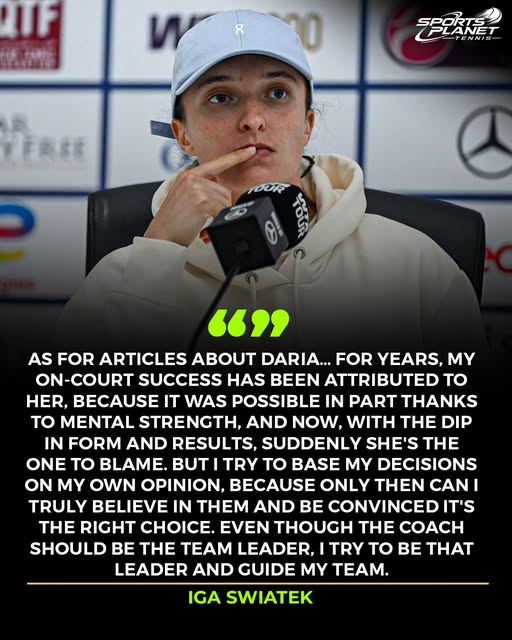
I want to start with a quote from the world number one. Iga Swiatek said this recently when asked about outside criticism regarding her team and her longtime sports psychologist, Daria Abramowicz.
Quote: "I try to base my decisions on my own opinion, because only then can I truly believe in them."
Unquote.
That sentence is not just nice words for a press conference. That sentence is a competitive blueprint. That sentence is the difference between players who crumble under pressure and players who lift trophies.
Today, we are going to talk about confidence. Not fake confidence. Not rah-rah speeches. Real confidence. The kind that comes from inside. The kind that Iga Swiatek has mastered.
And we are going to give you practical tools to boost your own confidence during a match when everything is falling apart.
Part One: The Problem with Outside Noise
Let me paint a picture you have all experienced.
You are down a break in the second set. Your coach is yelling something from the box. You are not sure what. The crowd is reacting to the other player. Someone in the stands just shouted something about your last match. Your phone back in the locker room has fourteen messages. Some supportive. Some not.
Your brain is now processing:
-
What did my coach say?
-
Did that fan just boo me?
-
What is my ranking going to do after this loss?
-
Maybe I should change my technique?
-
Maybe I should change my coach?
-
Maybe I am not good enough.
That is the noise. And noise loses matches.
Iga Swiatek learned something early that most players never learn. She learned that other people opinions are not her responsibility. Her responsibility is her own belief.
Part Two: The Abramowicz Collaboration
Let us talk about Daria Abramowicz.
Iga Swiatek has worked with Abramowicz, a sports psychologist, for years. When Swiatek wins, the media praises the partnership. When Swiatek loses, the same media asks: Is it time for a change? Is she too dependent on psychology? Is the mental approach holding her back?
Swiatek calls that fake news. And she is right.
Here is the expert analysis: The Abramowicz partnership is not a weakness. It is a competitive advantage. Swiatek has built a mental system that works for her. She trusts it. She defends it. And she does not let reporters or former players or social media influencers shake that trust.
| Outside Perception | Reality |
|---|---|
| She relies too much on a psychologist | She uses a proven mental system that helped her win multiple Grand Slams |
| She should change her team after a loss | Consistency in team builds trust and speeds up recovery |
| The mental approach is overrated | Tennis is 70 percent mental at the professional level |
| She needs to be tougher alone | No elite athlete succeeds alone. Team matters. |
Swiatek understands something fundamental: Confidence is not built by winning. Winning is built by confidence. And confidence comes from trusting your decisions. Not other people's decisions.
Part Three: How to Boost Confidence During a Match
Now let us get practical. You are on the court. You are losing. Your confidence is draining out of you like water from a cracked glass. What do you do?
Here are five expert techniques. These are used by Swiatek and other elite competitors. They work.
Technique One: The Reset Breath
When Swiatek loses three points in a row, she does something visible. She turns her back to the court. She faces her team box or the back wall. She takes one slow breath in for four seconds. She holds for four seconds. She exhales for four seconds.
That is it. Sixteen seconds total.
Why it works: The breath activates the parasympathetic nervous system. It lowers heart rate. It tells your brain: we are not panicking. We are resetting.
Do this between points. Do it between games. Do it every single time you feel doubt creeping in.
Technique Two: The One-Point Match
Confidence crumbles when you think about the future. What if I lose this set? What if I get bageled? What if I drop in the rankings?
Elite players shrink the game. They play one point at a time.
Here is the drill: Tell yourself that the match is tied at 5-5 in the third set. The only point that matters is the next one. Everything before is gone. Everything after does not exist.
Swiatek has said in interviews that she does not think about winning the tournament. She thinks about winning the next rally. That is the secret.
Technique Three: The Physical Anchor
Confidence is not just mental. It is physical. How you hold your body changes how you feel.
Try this right now. Slump your shoulders. Drop your head. Look at the floor. Now try to feel confident. You cannot. It is impossible.
Now stand up straight. Lift your chin. Push your shoulders back. Take up space.
Swiatek does this between points. She walks tall. She adjusts her racket strings slowly. She takes her time. These are physical anchors that say to her brain: I am in control.
During a match, check your body. Are you shrinking? Are you rushing? Fix your posture first. The confidence will follow.
Technique Four: The Self-Talk Script
What do you say to yourself when you are losing?
Most players say things like: Do not double fault. Do not miss. Do not lose.
That is negative framing. Your brain does not hear the word do not. It only hears double fault, miss, lose.
Swiatek uses positive framing. She says: Move your feet. Watch the ball. Find the forehand.
Create your own three-word script. Write it down before the match. Memorize it. When confidence dips, repeat the script out loud or in your head.
Examples:
-
One ball at a time.
-
Trust your feet.
-
Heavy forehand deep.
-
Stay in the rally.
Technique Five: The Process Check
Swiatek has said that she bases decisions on her own opinion. That is a process check.
During a match, ask yourself three questions:
-
Am I executing my game plan?
-
Am I controlling what I can control?
-
Do I believe in what I am doing?
If the answer to any question is no, you have identified the problem. Now fix it. Adjust your strategy. Breathe. Reset. Do not ask what your coach thinks. Do not ask what the crowd thinks. Ask yourself. Trust your answer.
Part Four: Case Study - Swiatek Under Pressure
Let me give you a real example.
At the 2024 French Open, Swiatek was down a set and a break in the second round against Naomi Osaka. Most players would have folded. The crowd was loud. Osaka was playing some of her best tennis in years.
Swiatek did something remarkable. She did not change her strategy. She did not start blasting winners. She did not look at her box for answers.
She breathed. She reset. She played one point at a time.
And she came back to win.
After the match, she was asked how she turned it around. She said: I just trusted what I have been doing. I believed in my game.
That is the answer. That is the only answer.
Part Five: Common Confidence Killers and How to Fix Them
| Confidence Killer | Expert Fix |
|---|---|
| Thinking about the ranking | Write ranking on a piece of paper before the match. Crumple it. Throw it away. It does not exist during play. |
| Listening to coach mid-match too much | Agree on one or two simple cues before the match. That is all you process during play. |
| Watching opponent celebrate | Look away. Adjust strings. Breathe. Their celebration is not about you. |
| Making two double faults in a row | Slow down. Use the reset breath. Aim for 70 percent instead of 100 percent. Get the ball in play. |
| Feeling the crowd turn against you | Pick one person in the stands who supports you. Look at them between points. Block out everyone else. |
| Remembering a past loss to this opponent | That match does not exist. This is a new match. You are a different player. |
Part Six: Building Long-Term Self-Trust
Confidence during a match starts long before you walk on court. It is built in practice. It is built in your daily decisions.
Iga Swiatek said she bases decisions on her own opinion. That does not mean she ignores her coaches. It means she takes information, processes it, and makes the final call herself.
Here is how you build that long-term self-trust:
Step One: Make small decisions alone.
In practice, decide your own drills. Decide your own rest periods. Decide when to stop. The more small decisions you make, the more you trust your judgment.
Step Two: Keep a confidence journal.
After every practice and every match, write down three things you did well. Not what your coach said you did well. What you noticed yourself. This trains your brain to see your own strengths.
Step Three: Reject fake news immediately.
Someone will tell you that you need to change something. Your technique. Your team. Your approach. Before you react, ask: Does this person know my journey? Do they have my best interests at heart? If the answer is no, let it go. Swiatek calls it fake news for a reason.
Step Four: Celebrate your process, not just results.
Winning feels good. But winning is not always in your control. Your effort is. Your focus is. Your preparation is. Celebrate those things. That builds unshakable confidence.
Closing Statement
Iga Swiatek is not the tallest player on tour. She is not the strongest. She does not have the biggest forehand or the fastest serve.
What she has is something harder to measure and harder to beat. She has self-trust. She has built a mental system that works for her. She defends it. She believes in it. And she does not let anyone shake that belief.
You can do the same.
Base your decisions on your own opinion. Shut out the noise. Trust your process. And when you walk on that court, remember: the only voice that matters is yours.
Thank you.
Q&A Preparation
Be ready for these questions from the audience:
Q: What if my own opinion is wrong?
A: Wrong opinions can be corrected. But borrowed opinions will never feel true. Trust yourself to adjust. That is growth.
Q: How do I ignore my coach during a match?
A: Do not ignore them. Filter them. Agree on one cue word before the match. That is all you process.
Q: Does this work for team sports?
A: Yes. The principles are the same. Trust your role. Trust your preparation. Block out crowd and media noise.
Q: What if I genuinely need to change my technique or team?
A: That is a decision for practice, not for match play. Evaluate after the tournament. During competition, commit fully to what you have.
Session Handout Summary
| Key Takeaway | Action Step |
|---|---|
| Base decisions on your own opinion | Make three small solo decisions in practice today |
| Shut out fake news | Identify one outside opinion you will ignore this week |
| Use the reset breath | Practice 4-4-4 breathing for two minutes daily |
| Play one point at a time | Say "next point" out loud after every rally |
| Physical anchors | Check posture between every point for one full practice |
| Positive self-talk script | Write your three-word script before your next match |
Final Quote for the Room
"I try to base my decisions on my own opinion, because only then can I truly believe in them."
Go believe in yours.
Conference talk based on Iga Swiatek mindset philosophy | Expert game analysis | Practical confidence techniques