
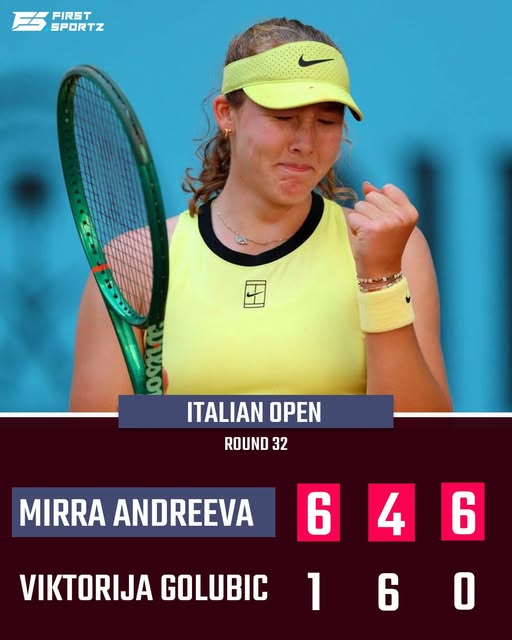
MIRRA STAYS LOCKED IN.
That phrase perfectly captures the mindset of one of the most exciting young stars in world tennis today. At an age where many players are still learning how to manage pressure, Mirra Andreeva is already displaying the mentality, consistency, and tactical maturity of a future championn.
Her latest victory in Rome showed exactly why so many coaches, analysts, and former players believe she has the potential to eventually become World No. 1.
Mirra Andreeva defeated Viktorija Golubic 6-1, 4-6, 6-0 in a match that revealed something deeper than talent:
her ability to adjust under pressure.
After dominating the opening set, she suddenly lost rhythm in the second. Against experienced professionals, many young players emotionally collapse after momentum swings like that. Instead, Andreeva completely reset mentally, raised her level, and destroyed the third set with fearless authority.
The final set score — 6-0 — was not accidental.
It was the result of elite focus, emotional discipline, and growing Tennis IQ.
Now her recent numbers are becoming impossible to ignore:
- Won 14 of her last 16 matches
- Second Rome Round of 16 appearance
- 28th win of the season
- Madrid finalist
- Linz champion
This is no longer simply “young talent.”
This is the early construction of a future elite champion.
The Most Dangerous Quality: Hunger for Greatness
Many young players possess talent.
Far fewer possess true hunger.
Mirra Andreeva competes with visible ambition every single match. There is intensity in the way she:
- chases balls
- resets after errors
- manages pressure moments
- studies opponents
- fights during momentum swings
That internal hunger matters enormously in professional tennis.
Natural talent may open the door.
But obsession with improvement keeps players rising toward the top.
From a professional tennis perspective, Andreeva already shows the mentality of someone chasing greatness rather than temporary success.
Why Her Rome Victory Was So Important
The scoreline tells a fascinating psychological story.
First Set: Total Control
Andreeva entered the match aggressively and controlled tempo beautifully.
She:
- attacked early
- redirected pace sharply
- moved Golubic constantly
- maintained deep rally pressure
The opening set showed complete tactical clarity.
Second Set: Emotional Test
Golubic adjusted intelligently in the second set by:
- extending rallies
- varying spin
- slowing rhythm
- exposing movement patterns
For younger players, these tactical changes often create frustration.
Andreeva temporarily lost momentum.
But this is where the match became important for her long-term development.
Third Set: Champion Response
Instead of mentally fading, Andreeva completely elevated her level.
The third set was ruthless:
- cleaner aggression
- smarter shot selection
- stronger movement
- better emotional control
- higher intensity
Winning the final set 6-0 revealed elite competitive instincts.
Tennis IQ: The Hidden Strength Behind Her Rise to power
Mirra’s rise is not built only on athleticism or power.
Her Tennis IQ is developing remarkably fast.
Elite Tennis IQ includes:
- recognizing patterns
- adjusting tactically
- managing pressure
- understanding momentum
- constructing points intelligently
Andreeva already demonstrates advanced understanding in these areas.
She studies opponents carefully and adjusts mid-match with increasing maturity.
That is rare for a teenager.
Why Experience of Defeat Is Accelerating Her Growth
One of the most important reasons Andreeva continues improving is her relationship with defeat.
Many young players fear losses emotionally.
Elite players learn from them.
Every difficult loss teaches:
- pressure management
- tactical weaknesses
- emotional triggers
- physical limitations
- decision-making flaws
Andreeva appears to process defeats intelligently rather than emotionally.
This mindset is critical for future World No. 1 potential.
Because champions are often shaped more by difficult matches than comfortable wins.
The Mental Reset That Changed the Match
The biggest sign of maturity in Rome was her ability to emotionally reset after losing the second set.
That skill is incredibly difficult.
Many players:
- panic negative view
- overhit
- rush points
- lose tactical discipline
Andreeva did the opposite.
She:
- calmed down
- simplified patterns
- trusted her movement
- recommitted to aggressive structure
This emotional reset transformed the match completely.
Focus and Consistency: The Foundation of Champions
Winning occasional big matches is impressive.
Winning consistently is far harder.
Andreeva’s recent results prove that consistency is becoming part of her identity.
Consistency in tennis requires:
- physical endurance
- emotional discipline to win
- recovery management
- technical reliability
- tactical adaptability
Her 14 wins in 16 matches demonstrate all these qualities developing together.
Why Her Competitive Focus Is So Dangerous
One of Andreeva’s most impressive qualities is concentration.
During matches, she often looks deeply engaged in:
- point construction
- opponent patterns
- emotional momentum
- tactical timing
This focus helps stabilize her level under pressure.
Young players often fluctuate emotionally.
Andreeva is beginning to reduce those fluctuations.
That is championship behavior.
The Forehand: Growing Into a Major Weapon
Her forehand continues improving rapidly.
Earlier in her development, the shot occasionally lacked consistent penetration under pressure.
Now it is becoming:
- heavier
- more aggressive
- more stable
- tactically smarter
She uses it effectively to:
- open the court
- pressure weaker wings
- change rally direction
- attack short balls
As this stroke continues evolving, her ceiling rises dramatically.
The Backhand: Already Elite Potential
Her backhand is already one of the cleanest shots among younger players on tour.
Technically, it is:
- compact
- balanced
- early-timed
- aggressive
- stable under pressure
She redirects pace beautifully and changes direction confidently.
This gives her tremendous control during baseline exchanges.
Movement and Defensive Growth
Another major improvement area is movement.
Andreeva’s court coverage continues becoming more efficient.
She now:
- recovers faster
- balances better during defense
- transitions offense quicker
- defends wider angles effectively
Modern tennis demands elite movement.
Her development here is critical for future Grand Slam success.
Why Young Champions Need Pressure Experience
Pressure is not something players avoid.
It is something they must survive repeatedly.
Andreeva’s increasing exposure to:
- deep tournament runs
- difficult matches
- media attention
- expectations
- pressure moments
is accelerating her maturity.
This experience cannot be replicated in practice.
Every high-pressure match sharpens future composure.
The Emotional Side of Her Development
One reason fans connect with Andreeva is visible emotion.
She competes passionately.
But importantly, she is learning emotional control simultaneously.
This balance matters.
Pure emotion creates inconsistency.
Controlled emotion creates champions.
Recently, she appears better at:
- resetting after errors
- staying tactically disciplined
- managing frustration
- maintaining focus during momentum swings
These are elite-level developments.
Hunger for the No. 1 Ranking
Andreeva does not appear satisfied simply becoming a top player.
Her body language, competitive energy, and ambition suggest much bigger goals.
Players who eventually become World No. 1 usually share:
- obsession with improvement
- emotional resilience
- extreme competitiveness
- tactical curiosity
- relentless focus
Andreeva is showing early signs of all these qualities.
Why Coaches Believe in Her Future
From a professional tennis coaching perspective, several things make Andreeva extremely exciting long term.
1. Coachability
She appears eager to learn and adjust.
2. Tactical Intelligence
She already understands point construction at advanced level.
3. Competitive Fire
She competes aggressively without fear.
4. Emotional Resilience
She recovers well after difficult moments.
5. Technical Foundation
Her mechanics remain relatively clean under pressure.
These qualities are difficult to teach.
The Importance of Learning Through Momentum Swings
The Rome match offered another valuable lesson:
champions must survive instability.
Momentum swings happen constantly in elite tennis.
The best players learn how to:
- stabilize emotionally
- adjust tactically
- trust patterns under pressure
Andreeva’s third-set response showed tremendous progress in this area.
Why Rome Is Important for Her Development
Clay courts expose weaknesses more clearly than fast surfaces.
Clay demands:
- patience
- movement
- endurance
- tactical discipline
- emotional control
Andreeva succeeding consistently on clay is a major sign of long-term potential.
It means her game is becoming complete rather than surface-dependent.
Scaling Toward Championship Tennis
Several areas suggest her game could continue scaling rapidly.
Improved Physical Conditioning
As her body matures physically, her endurance and power will likely increase.
Tactical Experience
More matches against elite players sharpen Tennis IQ quickly.
Emotional Maturity
Handling pressure repeatedly strengthens composure.
Shot Development
Her forehand and serve still possess major growth potential.
This combination makes her ceiling extremely high.
Why Her Consistency Matters More Than Flash
Many young players produce exciting highlights.
Andreeva is producing sustainable results.
That distinction matters enormously.
Consistency:
- builds rankings
- creates confidence
- strengthens identity
- develops championship habits
Her ability to repeatedly go deep in tournaments is becoming one of her greatest strengths.
Great Highlights of Her 2026 Rise
Highlight 1: Madrid Final Run
Proved she can survive multiple elite-level matches consecutively.
Highlight 2: Linz Title
Showed her ability to close tournaments successfully.
Highlight 3: Rome Recovery Against Golubic
The third-set dominance revealed major emotional growth.
Highlight 4: 28 Wins This Season
Demonstrates sustained elite-level performance.
Highlight 5: Fearless Competitive Identity
She already competes like someone expecting to win big matches.
The Future World No. 1 Conversation
It is still early.
But discussions about Andreeva’s future are growing rapidly for good reason.
Future World No. 1 players usually reveal themselves through:
- consistency
- adaptability
- emotional resilience
- tactical growth
- competitive hunger
Andreeva is checking those boxes remarkably early.
The Biggest Remaining Growth Areas
Like every young player, development remains ongoing.
Key areas include:
- serve consistency under pressure
- physical endurance for long tournaments
- emotional stability during difficult stretches
- managing expectations
- maintaining aggressive discipline
But the trajectory looks extremely promising.
Why Tough Matches May Help Her Most
Interestingly, difficult matches like the Golubic battle may help her more than easy wins.
Why?
Because pressure creates growth.
The ability to:
- lose momentum
- recover mentally
- adjust tactically
- dominate late
is exactly what champions must master.
Andreeva showed all of those qualities in Rome.
Final Thoughts
Mirra Andreeva’s victory over Viktorija Golubic in Rome was more than another win.
It was another glimpse into the mentality of a future elite champion.
After losing the second set, she responded not with panic, but with higher-level tennis. Her ability to reset emotionally, raise tactical aggression, and dominate the final set reflected maturity far beyond her years.
Her recent consistency:
- 14 wins in 16 matches
- deep tournament runs
- strong clay-court performances
- emotional resilience
shows that her rise is becoming increasingly sustainable.
From a professional tennis perspective, Andreeva now possesses several qualities associated with future World No. 1 players:
- hunger for greatness
- elite focus
- developing Tennis IQ
- emotional toughness
- fearless competitiveness
- willingness to learn through defeat
And perhaps most importantly, she appears obsessed with improvement.
That combination is dangerous for the rest of the WTA Tour.
Because talent may create stars.
But focus, consistency, resilience, and hunger create champions.
And Mirra Andreeva is beginning to look very much like a future champion in the making.