
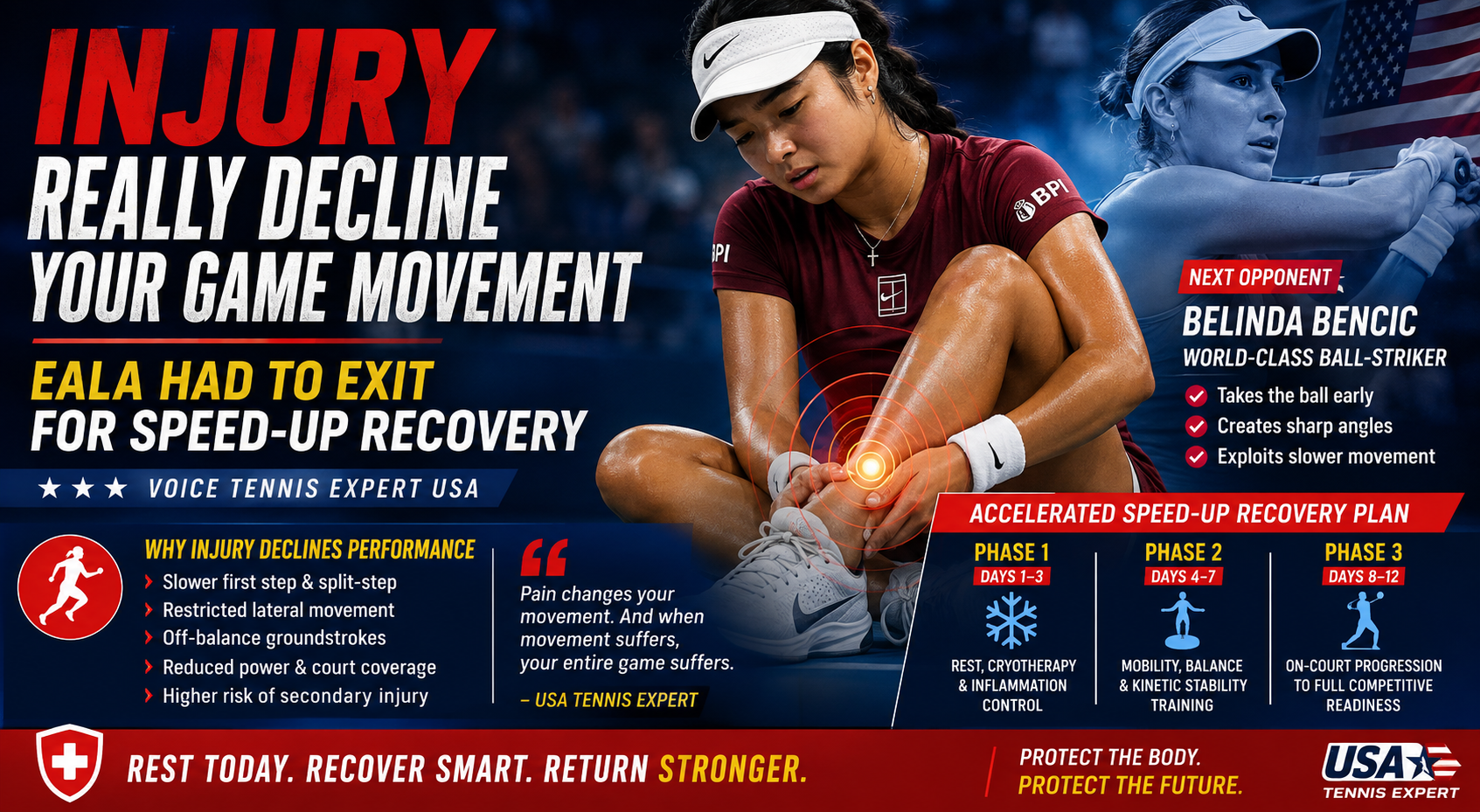
A High-Performance USA Tennis Expert & Sports Science Analysis
In professional tennis, an injury does not have to completely stop a player to dramatically change the way she competes.
Sometimes the biggest warning sign is not that a player cannot hit the ball. It is that she can no longer move normally to hit it.
That distinction is extremely important for Alex Eala.
Eala enters the Canadian hard-court swing with enormous momentum after winning her first WTA singles title at the Mubadala Citi DC Open. She then fought through another demanding three-set match against Caty McNally in Toronto, winning 6-3, 5-7, 6-4. During that match, Eala required treatment after an issue involving her right foot/ankle area. She subsequently acknowledged feeling the physical effects of the battle.
From a U.S. high-performance tennis perspective, that matters enormously.
Because in elite tennis, movement is the foundation of everything else.
1. Injury Can Change the Entire Tennis Kinetic Chain
A healthy tennis player does not simply swing a racket with the arm.
Power begins from the ground.
The sequence is approximately:
Ground contact → ankle → knee → hip → trunk rotation → shoulder → arm → racket
When the ankle or foot becomes painful, that chain can become disrupted.
A player may still be able to produce a technically beautiful forehand during a stationary drill. But once the opponent starts moving her from side to side, the problem becomes much more obvious.
Eala's game depends heavily on:
- explosive first-step movement;
- rapid lateral recovery;
- aggressive baseline positioning;
- early preparation;
- defensive sliding and recovery;
- quick transitions from defense to offense;
- creating angles with her left-handed forehand and backhand patterns.
Take away even a small percentage of that movement and the entire tactical structure can begin to deteriorate.
The key point:
You don't have to lose your stroke to lose your game. You can lose your movement first.
2. The First Thing That Changes: The Split-Step
At the highest level, tennis is decided in fractions of a second.
Before an opponent strikes the ball, the receiving player performs a split-step. That movement allows the player to react explosively in multiple directions.
But an injured ankle or foot can make the athlete subconsciously protect the affected side.
Instead of:
Split → load → explode
the sequence becomes:
Split → hesitate → protect → move
That tiny hesitation can be devastating against a world-class opponent.
A few hundred milliseconds can be the difference between reaching the ball comfortably and arriving late.
And once a player starts arriving late, everything downstream changes.
3. Lateral Movement Is Where the Problem Becomes Obvious
Tennis players rarely run in a straight line.
They constantly perform:
- lateral shuffles;
- crossover steps;
- braking steps;
- open-stance recovery;
- emergency lunges;
- rotational deceleration;
- explosive changes of direction.
This places tremendous demand on the ankle and lower leg.
If Eala is protecting the injured area, her lateral movement may become more conservative.
Instead of attacking the ball, she may begin thinking:
"Can I reach this without hurting myself?"
That is a completely different neurological state from:
"I'm going to attack this ball."
For a player whose game is built around aggressive court positioning, that difference can dramatically reduce effectiveness.
4. Why Belinda Bencic Is a Particularly Difficult Opponent
This becomes even more important against Belinda Bencic.
Bencic has long been one of the WTA's most effective players at taking the ball early and redirecting pace. She can compress an opponent's reaction time by taking shots early and using precise changes of direction.
That creates a nightmare scenario for a player with restricted movement.
If Eala is 100% healthy, she can attempt to:
hit → recover → reposition → attack again.
If she is physically compromised, the sequence can become:
hit → recover slowly → arrive late → defend → lose court position.
Once Bencic gains that advantage, Eala could be forced farther behind the baseline.
That reduces her ability to dictate.
5. Groundstrokes Can Also Decline When Movement Declines
This is one of the most misunderstood aspects of tennis injuries.
People often look at a player's racket swing and ask:
"Does she still have power?"
That is not the complete question.
The better question is:
"Can she get her body into position to use that power?"
A powerful groundstroke requires timing, spacing and balance.
If an injured player cannot reach the correct hitting position, she may have to compensate with the upper body.
That can produce:
- shorter preparation;
- reduced hip rotation;
- less weight transfer;
- weaker contact position;
- shorter follow-through;
- more defensive shots;
- reduced depth;
- increased unforced errors.
The racket is still moving.
But the body is no longer supporting the racket in the same way.
6. The Serve Can Be Affected Too
An ankle or foot problem does not necessarily affect only running.
The serve also requires a powerful connection with the ground.
The player loads the legs, transfers force upward, rotates the pelvis and trunk, and finally releases the racket through the shoulder and arm.
If the athlete cannot comfortably load the affected leg, she may subconsciously reduce the amount of force generated from the lower body.
The result can be:
less leg drive → less upward force → reduced serve efficiency.
Even if the serve speed does not collapse dramatically, placement and consistency can suffer.
And against an elite returner, a slightly weaker serve can become a major tactical problem.
7. The Biggest Danger Is Compensation
From a sports-science perspective, the greatest concern is not necessarily the original injury.
It can be the compensation that follows.
When an athlete protects one body part, another part often absorbs additional workload.
For example:
Ankle protection → altered foot strike → increased knee loading → altered hip mechanics → additional trunk compensation
That does not mean a secondary injury is guaranteed.
But it explains why professional teams take movement restrictions seriously.
A player may be able to "fight through" one match but pay a much larger physical price afterward.
For a young player with a long career ahead, that calculation matters.
8. Why Stepping Away Can Actually Be a Competitive Decision
Fans sometimes interpret withdrawal or stepping away from competition as weakness.
High-performance sport sees it differently.
If a player cannot move properly, continuing to compete may not represent the player's true level.
And worse, it can increase the possibility of turning a manageable problem into a longer-term interruption.
For Eala, the objective should not simply be:
"Can she finish today's match?"
The bigger question is:
"Can she protect the next several months of her career?"
That is a completely different decision-making framework.
If medical and performance staff determine that continued competition carries unacceptable risk, stepping away can be the correct professional decision.
9. The Eala–McNally Match Was Already a Significant Physical Load
Eala's victory over McNally was not a routine match.
She won 6-3, 5-7, 6-4 after a physically demanding battle, extending her winning streak to seven matches. Reports also noted the right-foot/ankle concern and the treatment she received during the match.
That matters because fatigue and injury interact.
A player can sometimes tolerate discomfort early in a tournament.
But after multiple long matches, the physical margin becomes smaller.
The athlete is no longer recovering from one isolated movement.
She is recovering from:
match load + accumulated fatigue + repeated acceleration + repeated deceleration + previous tissue stress.
That is where elite performance management becomes critical.
10. What a High-Performance Recovery Plan Should Look Like
Rather than simply prescribing a fixed number of recovery days, a professional team should make the return-to-play decision based on function.
Phase 1 — Protect and Assess
Immediately after competition, the priority should be appropriate medical assessment and load reduction.
The team should establish:
- exact injury location;
- pain level;
- swelling;
- range of motion;
- ability to bear weight;
- walking mechanics;
- single-leg stability;
- functional movement tolerance.
The goal is not simply to make the athlete feel better.
The goal is to determine whether the athlete can safely perform tennis-specific movements.
Phase 2 — Restore Movement
Once medically appropriate, rehabilitation can progress toward:
- ankle mobility;
- calf and lower-leg strength;
- balance;
- proprioception;
- controlled single-leg loading;
- progressive acceleration;
- controlled deceleration.
The athlete should regain confidence in the injured limb.
Phase 3 — Tennis-Specific Return
The progression should then move from simple to complex:
Stationary hitting
↓
Controlled forward/backward movement
↓
Lateral movement
↓
Change of direction
↓
Full-court patterns
↓
Competitive points
↓
Full-intensity match
That progression is far more useful than simply saying, "She rested for three days, so she should be fine."
11. The Return-to-Play Test Is About Movement, Not Just Pain
One of the biggest mistakes in sports is treating pain reduction as the same thing as recovery.
A player might say:
"It doesn't hurt much anymore."
But can she:
- split-step explosively?
- push laterally?
- stop suddenly?
- change direction?
- recover after a wide ball?
- defend from the corner?
- land safely?
- serve repeatedly?
- play a 20-ball rally without changing mechanics?
Those questions are much more relevant to tennis.
The objective should be functional readiness, not simply temporary pain relief.
12. Eala's Long-Term Career Is More Important Than One Match
This is where I would take a strong position as a U.S. high-performance tennis analyst:
Do not sacrifice a developing elite career for one tournament result.
Eala has already demonstrated that she belongs on the biggest stages.
Her Washington title showed what happens when her movement, confidence and shot-making are synchronized.
Toronto has now presented another test.
The question is no longer whether Eala can fight.
She has already demonstrated that.
The question is whether she can learn when not to fight through a physical limitation.
That is part of becoming an elite professional.
13. Final USA Tennis Expert Assessment
Alex Eala's greatest weapon is not simply her forehand, backhand or serve.
It is the complete movement system that allows those weapons to function.
When that system is compromised, her entire game can decline.
A restricted first step affects court coverage.
Reduced court coverage affects positioning.
Poor positioning affects stroke quality.
Reduced stroke quality affects offensive pressure.
And reduced offensive pressure allows the opponent to control the match.
That is why an injury can make a player look dramatically different even when her racket skills have not changed.
If Eala's medical and performance team determines that her foot or ankle is preventing normal movement, stepping away from competition—or limiting her workload—should not be viewed as giving up.
It can be viewed as an investment in the next match, the next tournament, and ultimately the next decade of her career.
The goal is not simply to get Alex Eala back onto a tennis court.
The goal is to get Alex Eala back moving freely, explosively and confidently.
Because when Eala moves at full speed, her tennis becomes a completely different proposition.
And that is the version of Eala that the WTA Tour should be preparing for.