Tennis Game Analysis | Doubles Strategy | Teamwork | Tactical Adjustments
Italian Fighters Strike Again: The Power of Team Chemistry
In professional tennis, individual talent can win matches, but in doubles tennis, the chemistry between two players can make the difference between victory and defeat.
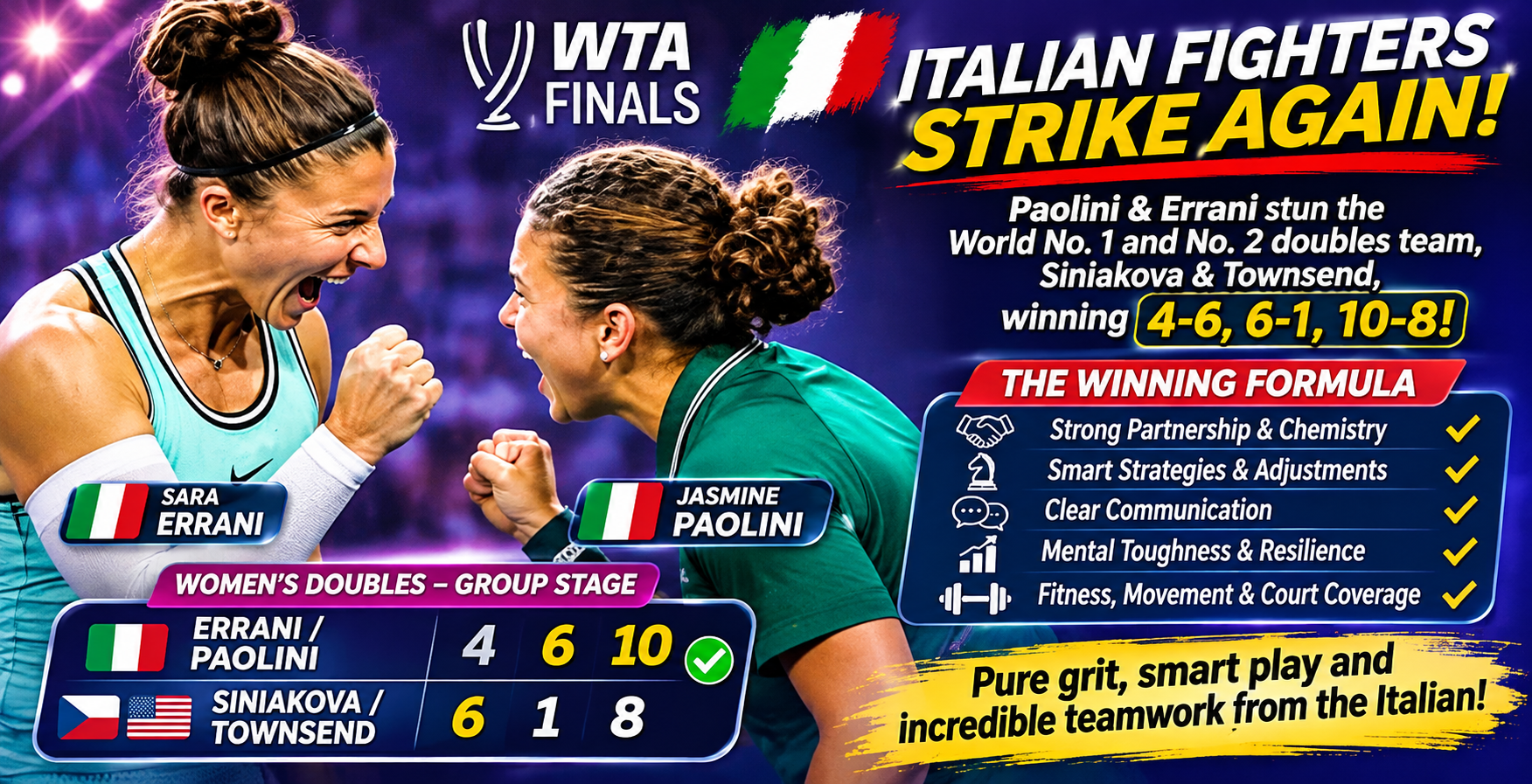
Sara Errani and Jasmine Paolini delivered an impressive performance at the WTA Finals, defeating the world's No. 1 and No. 2 doubles team, Katerina Siniakova and Taylor Townsend, with a dramatic 4-6, 6-1, 10-8 victory.
The Italian partnership demonstrated something every tennis player and coach should understand: winning doubles is not simply about having two talented players sharing the same court. It requires communication, trust, intelligent positioning, tactical adjustments and the ability to support one another under pressure.
Their comeback was a powerful example of how teamwork can overcome even the strongest opposition.
1. Partnership Chemistry: Two Players, One Strategy
One of the most important elements of successful doubles tennis is understanding your partner.
Every player has different strengths, weaknesses, movement patterns and decision-making habits.
A successful partnership requires both players to understand their responsibilities.
Sara Errani: Experience and Tactical Intelligence
Errani brings extensive doubles experience, excellent court awareness and an understanding of positioning. Her ability to read opponents and anticipate shots is an important asset in doubles competition.
Jasmine Paolini: Energy, Aggression and Baseline Power
Paolini contributes aggressive groundstrokes, movement, intensity and the ability to put opponents under pressure from the baseline.
Together, their different strengths create a complementary partnership.
The lesson for developing doubles players is simple:
-
Understand your partner's strengths.
-
Communicate before and during every match.
-
Avoid competing against your own teammate.
-
Support your partner after mistakes.
-
Develop a shared strategy rather than playing two separate individual games.
A good partnership creates confidence. Players become more comfortable taking risks because they know their teammate is ready to support them.
2. Tactical Adjustments: How the Italians Changed the Match
The score tells an interesting story.
First set: 4-6
Siniakova and Townsend demonstrated why they are among the strongest doubles teams in the world. Their coordination, court coverage and aggressive positioning created problems for the Italian pair.
Errani and Paolini lost the opening set, but they did not abandon their game plan.
Second set: 6-1
The Italians responded with a strong tactical adjustment. They increased their intensity, improved their execution and began putting more pressure on their opponents.
Winning the second set 6-1 completely changed the momentum.
Match tiebreak: 10-8
The deciding tiebreak became a test of concentration, communication and composure.
At this stage, every point mattered. One poor decision, weak return or communication breakdown could determine the outcome.
The Italians maintained their competitive focus and completed the comeback.
Important tactical lessons
A. Control the middle of the court
In doubles, the middle of the court is one of the most important areas to protect.
Players must communicate about who takes the ball when both teammates can reach it.
Poor communication creates hesitation, confusion and unnecessary errors.
B. Improve return positioning
A strong return can immediately put the serving team under pressure.
Players should consider:
-
Returning deep toward the baseline.
-
Attacking the middle to create confusion.
-
Using angles to move opponents away from their preferred positions.
-
Targeting weaker or less comfortable volleys when opportunities appear.
C. Use intelligent net positioning
The net player must remain active.
Instead of simply standing and waiting, the player should anticipate opportunities to intercept volleys, close angles and finish short balls.
D. Change the rhythm of the game
When opponents establish control, repeating the same strategy can become predictable.
Changing return direction, ball height, depth and pace can disrupt their coordination.
3. The Mental Game: Staying Together When Losing
One of the biggest challenges in doubles is maintaining a positive relationship when the match is not going well.
Imagine losing the first set against the world's best doubles team.
Frustration can quickly develop. One player might blame the other for a missed volley, poor return or incorrect positioning.
This is where partnership chemistry becomes extremely important.
Errani and Paolini demonstrated the importance of continuing to compete together.
For amateur players, remember these principles:
-
Never blame your partner after losing a point.
-
Communicate positively between points.
-
Discuss tactical adjustments calmly.
-
Celebrate successful teamwork.
-
Stay mentally connected during difficult moments.
Your partner should be your biggest supporter, not another opponent.
4. Why Communication Is a Winning Weapon
Communication is not limited to shouting instructions.
It includes understanding body language, positioning and anticipation.
Before every point, doubles partners should establish:
-
Who covers the middle?
-
Where should the net player position themselves?
-
Which direction should the return go?
-
Should the serving team use an aggressive or defensive formation?
-
What happens when the lob goes over the net player?
These small decisions can have a major impact on the match.
A team that communicates effectively can often outperform a pair with greater individual power but weaker coordination.
5. The Importance of Physical Conditioning in Doubles
Doubles tennis may involve shorter running distances than singles, but it still requires explosive movement and fast reactions.
Players must repeatedly accelerate, stop, change direction and react to fast exchanges at the net.
Important conditioning areas include:
-
Lateral movement and agility.
-
Explosive leg strength.
-
Shoulder stability.
-
Core strength and rotational control.
-
Reaction speed.
-
Cardiovascular endurance.
Players should also develop recovery routines between matches.
Good physical preparation helps maintain movement quality and concentration during decisive moments.
6. Training Drills for Developing a Winning Doubles Partnership
Coaches can use the following exercises to develop teamwork and tactical awareness.
Drill 1: Middle-Court Communication
Purpose: Improve communication and prevent collisions.
Instructions:
-
Position two players on each side of the court.
-
Feed balls toward the middle.
-
Players must communicate before hitting.
-
Alternate between forehand and backhand coverage.
-
Increase the speed of feeding as players improve.
Drill 2: Return and Net Attack
Purpose: Develop aggressive doubles positioning.
Instructions:
-
One player serves.
-
The opposing player returns deep.
-
The net player attempts to intercept the next ball.
-
Continue the point.
-
Rotate positions after each sequence.
Drill 3: Two Against One
Purpose: Improve teamwork and court coverage.
Instructions:
-
Two players work together against one baseline player.
-
The doubles team must maintain proper positioning.
-
The singles player attempts to create gaps.
-
Focus on communication and shot selection.
-
Rotate players regularly.
Drill 4: Match Tiebreak Simulation
Purpose: Develop mental toughness under pressure.
Instructions:
-
Play a doubles match tiebreak to 10 points.
-
Start with the score at 7-7.
-
Partners must agree on a tactical plan.
-
After every three points, briefly discuss adjustments.
-
Practice maintaining composure when behind.
7. Lessons Every Tennis Coach Should Teach
The Errani and Paolini partnership offers an important reminder for tennis coaches.
Do not train doubles players only to hit better forehands, backhands and volleys.
Teach them how to work together.
A complete doubles training program should include:
| Training area | Coaching objective |
|---|---|
| Communication | Develop trust and coordination |
| Positioning | Cover court space efficiently |
| Net play | Improve interception and volley skills |
| Return strategy | Create pressure from the first shot |
| Mental strength | Maintain confidence during difficult points |
| Tactical adjustments | Adapt to opponents during the match |
| Physical conditioning | Improve agility and reaction speed |
A player who understands doubles strategy becomes more valuable to their partner.
Final Thoughts: The Best Partnerships Are Built on Trust
Sara Errani and Jasmine Paolini demonstrated that successful doubles tennis requires much more than individual talent.
Their victory over Siniakova and Townsend was a demonstration of resilience, teamwork, intelligent adjustments and competitive chemistry.
Losing the first set did not break their partnership. Instead, they adjusted their approach, improved their execution and fought for every point.
For recreational players, competitive athletes and tennis coaches, the lesson is worth remembering:
You do not need two perfect players to build a winning doubles team. You need two players who understand each other, trust each other and are willing to fight together.
In doubles tennis, your partner is not just someone sharing the court. Your partner is part of your strategy, your confidence and your success.
Two players. One court. One strategy. One winning partnership.