
Tennis IQ, Mental Mindset, Match Results & Championship Analysis
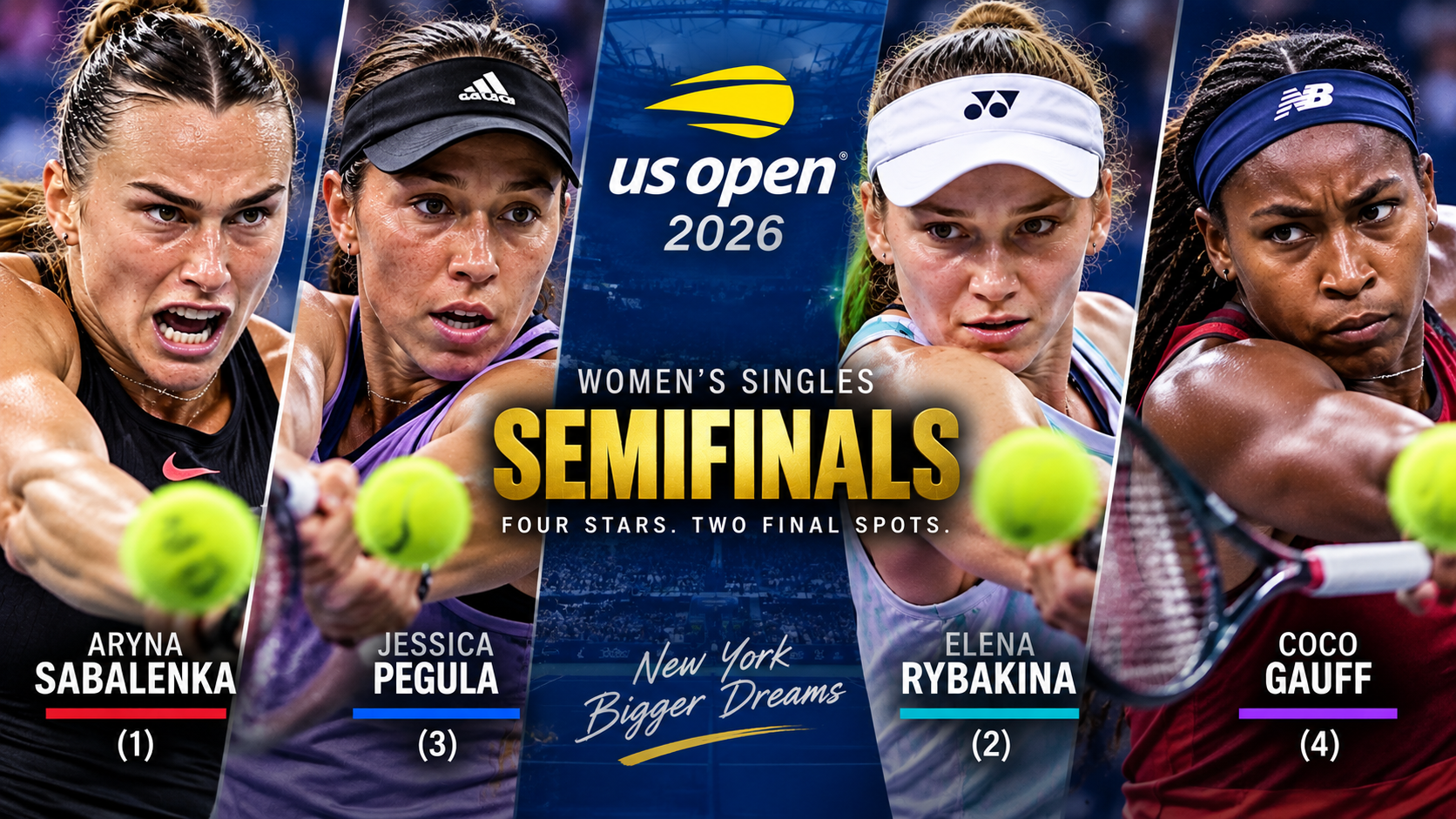
The 2026 US Open women’s singles semifinals featured four of the tournament’s top seeds: Aryna Sabalenka, Jessica Pegula, Elena Rybakina, and Coco Gauff.
Two matches. Two different winning formulas.
Aryna Sabalenka defeated Jessica Pegula in straight sets, while Elena Rybakina overcame Coco Gauff in a three-set battle.
From a tennis expert’s perspective, these semifinals provide a masterclass in aggressive tennis, tactical adjustments, mental toughness, and stamina.
2026 US Open Women’s Semifinal Results
Aryna Sabalenka (1) def. Jessica Pegula (3)
Final Score: 7–5, 6–2
Aryna Sabalenka advanced to the US Open final with a commanding straight-set victory over Jessica Pegula.
Elena Rybakina (2) def. Coco Gauff (4)
Final Score: 3–6, 6–4, 6–4
Elena Rybakina fought back after losing the opening set to defeat Coco Gauff and reach her first US Open final.
The results reveal two contrasting paths to victory: Sabalenka’s aggressive control and Rybakina’s ability to adapt under pressure.
Match Analysis 1: Aryna Sabalenka vs Jessica Pegula
Result: Sabalenka Wins 7–5, 6–2
Aryna Sabalenka entered the semifinal with the pressure of being the No. 1 seed. Jessica Pegula, the No. 3 seed, presented a difficult opponent with strong baseline consistency and court coverage.
The opening set was closely contested, but Sabalenka eventually won 7–5.
In the second set, Sabalenka increased her control and defeated Pegula 6–2.
First Set: The Battle of Patience and Power
The first set was decided by narrow margins.
Pegula’s ability to maintain rallies and defend effectively made it difficult for Sabalenka to dominate immediately.
However, Sabalenka’s powerful baseline game created constant pressure.
The key tactical battle was simple:
Could Pegula maintain her consistency long enough to prevent Sabalenka from taking control?
Sabalenka eventually found the breakthrough and secured the opening set.
Second Set: Sabalenka Takes Over
After winning the first set, Sabalenka played with greater confidence.
Her aggressive groundstrokes placed Pegula under increasing pressure.
When an opponent is forced to defend against heavy, deep balls, it becomes more difficult to execute a comfortable baseline game.
Sabalenka’s 6–2 second-set victory demonstrated the value of converting momentum into control.
Aryna Sabalenka’s Tennis IQ
1. Aggression With Purpose
Sabalenka is known for her explosive forehand and powerful serve.
But championship tennis is not about hitting every ball as hard as possible.
It is about recognizing the correct moment to attack.
A smart attacking player understands:
- When the opponent is out of position.
- When the ball is short enough to attack.
- When to change direction.
- When to continue building the point.
- When to finish with a winner.
Sabalenka’s semifinal performance showed the importance of aggressive tennis supported by tactical awareness.
2. Pressure on the Second Serve
One of the most important tactical opportunities against a powerful opponent is attacking the second serve.
The second serve can give the returner more time to step inside the baseline and take control.
Sabalenka’s aggressive return strategy created pressure on Pegula before the rally fully developed.
Expert lesson: The return is not just a defensive shot. It can be the first attacking weapon.
3. Serve Plus One
Sabalenka’s ideal attacking pattern is:
Strong serve → Weak return → Powerful forehand → Dictate the rally.
This is one of the most effective patterns in modern aggressive tennis.
The objective is not always to hit an ace.
The objective is to create a favorable next ball.
Aryna Sabalenka’s Mental Mindset
Sabalenka had to handle the pressure of being the tournament’s top seed and one of the favorites to win the championship.
A Grand Slam semifinal can create emotional pressure:
- Expectations from fans.
- Media attention.
- The importance of every point.
- The desire to reach the final.
- The fear of making mistakes.
The champion’s response is to remain focused on execution.
Mental Lesson From Sabalenka
Confidence comes from trusting your weapons.
A player must believe in the shots that brought her to the semifinal.
Sabalenka’s power is a major strength, but using it effectively requires composure and discipline.
A powerful player who becomes impatient may overhit.
A powerful player who remains calm can turn pressure into control.
Jessica Pegula’s Game Analysis
Jessica Pegula’s tennis is built around consistency, court coverage, and intelligent baseline play.
Against Sabalenka, her biggest challenge was preventing the match from becoming a pure power contest.
What Pegula Needed to Do
1. Keep the ball deep.
Deep shots reduce the opponent’s ability to attack comfortably.
2. Make Sabalenka hit extra balls.
Longer rallies can create opportunities for errors.
3. Use variation.
Changing rally direction and pace can prevent a power player from finding a comfortable rhythm.
4. Attack short balls.
When Sabalenka gives a shorter ball, Pegula must recognize the opportunity.
5. Stay disciplined on serve.
A strong serving pattern is essential against a powerful returner.
Pegula’s Mental Lesson
Against a player like Sabalenka, frustration can become dangerous.
When the opponent hits a spectacular winner, the correct response is to reset.
The goal is not to win every rally.
The goal is to keep creating opportunities.
Match Analysis 2: Elena Rybakina vs Coco Gauff
Result: Rybakina Wins 3–6, 6–4, 6–4
The second semifinal delivered a different kind of championship battle.
Coco Gauff won the opening set 6–3, putting Rybakina under immediate pressure.
But Rybakina responded by winning the next two sets, 6–4, 6–4.
This was a test of tactical adjustment and mental resilience.
First Set: Coco Gauff Starts Strong
Gauff won the opening set 6–3.
Her aggressive start demonstrated the importance of establishing control early in a Grand Slam semifinal.
Against Rybakina, Gauff needed to use her movement and defensive skills to prevent Rybakina from dominating with her serve and groundstrokes.
Rybakina’s challenge was to find a way to disrupt Gauff’s rhythm.
Expert Observation
When a powerful player loses the first set, the solution is not always to increase power.
Sometimes the correct adjustment is to improve placement, change rally direction, and reduce unforced errors.
Second Set: Rybakina Finds the Adjustment
Rybakina won the second set 6–4.
This was the turning point of the match.
Instead of allowing Gauff to continue controlling the rhythm, Rybakina began to establish her own game.
Her serve became an important foundation for winning points quickly and reducing the number of opportunities Gauff had to attack.
Tactical Adjustment
Rybakina’s winning formula was built around:
- Strong first serves.
- Clean ball striking.
- Aggressive baseline positioning.
- Maintaining composure.
- Taking opportunities when Gauff was under pressure.
Tennis IQ lesson: A champion knows when to change the match’s rhythm.
Third Set: Rybakina Finishes the Comeback
Rybakina won the deciding set 6–4.
The third set required both physical and mental strength.
Gauff continued to fight, but Rybakina maintained enough control to close out the match.
A deciding set is not only a test of fitness.
It is a test of concentration.
A player must continue to make correct decisions while fatigue and pressure increase.
The Championship Moment
Rybakina’s ability to recover from losing the opening set demonstrated the importance of staying committed to the game plan.
She did not need to win every point.
She needed to win enough important points to control the final two sets.
Elena Rybakina’s Tennis IQ
1. Adaptation Is a Championship Skill
The greatest tennis players are not always the players who start best.
They are often the players who adjust best.
Rybakina’s comeback against Gauff illustrates this principle.
When the first set did not go her way, she had to find a better way to play.
2. The Serve Creates Control
Rybakina’s serve is one of her greatest weapons.
A powerful first serve can create:
- Shorter rallies.
- Weak returns.
- Easier first forehands.
- More control over service games.
- Less pressure on defense.
But the serve must be connected to the next shot.
A strong serve without a clear follow-up pattern may not create the full advantage.
3. Calmness Under Pressure
Rybakina’s semifinal required her to stay composed after losing the first set.
That is a major mental skill.
A player who becomes emotionally frustrated may begin rushing points.
A player who stays calm can continue executing the correct strategy.
Coco Gauff’s Game Analysis
Coco Gauff’s opening-set victory demonstrated her ability to challenge one of the tournament’s most powerful players.
Her strengths include athletic movement, court coverage, defensive resilience, and the ability to turn defense into attack.
What Gauff Needed to Do
1. Return with depth.
Deep returns can prevent Rybakina from immediately taking control.
2. Extend rallies.
Making Rybakina hit extra balls can create more opportunities.
3. Use court movement.
Gauff’s athleticism is a major part of her game.
4. Change rally direction.
Variation can disrupt Rybakina’s preferred patterns.
5. Stay aggressive.
Defending alone is not enough against a powerful opponent.
Gauff’s Mental Lesson
Winning the first set is an advantage, but it does not guarantee victory.
A Grand Slam semifinal can change quickly.
The important lesson is to remain tactically alert when the opponent starts adapting.
Tennis IQ Comparison: Sabalenka vs Rybakina
Two Different Championship Styles
Aryna Sabalenka
Primary identity: Explosive aggressive tennis.
Her strength is applying pressure through powerful serves, returns, and groundstrokes.
Her semifinal victory over Pegula demonstrated the value of imposing an attacking game plan.
Elena Rybakina
Primary identity: Powerful serve, clean ball striking, and controlled aggression.
Her semifinal victory over Gauff demonstrated the value of adapting after a difficult start.
The Key Difference
Sabalenka won her semifinal by controlling the match from the first set.
Rybakina won hers by recovering after losing the first set.
Both approaches are valuable.
A champion must know when to impose her game and when to adjust.
Mental Mindset: The Four Players’ Lessons
Aryna Sabalenka
Mental strength: Trust your weapons.
Use your power with discipline and confidence.
Jessica Pegula
Mental strength: Stay patient under pressure.
Do not abandon your game plan simply because the opponent is hitting powerful shots.
Elena Rybakina
Mental strength: Reset after losing a set.
A setback is not the end of the match.
Coco Gauff
Mental strength: Maintain focus after a strong start.
The opponent may change tactics. Be ready to respond.
Stamina Booster: The Physical Side of Championship Tennis
Tennis stamina is not simply about running long distances.
It is about maintaining quality movement, shot production, and decision-making throughout a demanding match.
Rybakina’s three-set semifinal is an excellent example of the importance of endurance.
The Four Types of Tennis Stamina
1. Aerobic endurance
Helps players recover between points and games.
2. Repeated sprint ability
Tennis requires explosive movement in short bursts.
3. Muscular endurance
Helps maintain stroke quality when fatigue increases.
4. Mental endurance
Helps players continue making good decisions under pressure.
How to Improve Tennis Stamina
A balanced tennis training program should include:
- Court movement drills.
- Aerobic conditioning.
- Strength training.
- Rally endurance.
- Recovery sessions.
- Proper hydration and nutrition.
Tennis-Specific Stamina Drill
Try this training pattern:
- Perform 20 seconds of side-to-side court movement.
- Recover for 20 seconds.
- Repeat for several rounds.
- Finish with controlled baseline rallies.
- Practice maintaining technique under moderate fatigue.
The goal is to connect physical endurance with actual tennis performance.
Important Training Advice
Do not train to exhaustion every day.
Stamina improves through progressive training, proper recovery, and consistent practice.
Players returning from injury should use an individualized program with qualified medical or sports-performance guidance.
The Final Championship Lesson
The 2026 US Open women’s singles semifinals featured two different winning formulas.
Aryna Sabalenka defeated Jessica Pegula with aggressive baseline tennis and pressure on the return.
Elena Rybakina defeated Coco Gauff by adapting after losing the opening set and maintaining control in the final two sets.
These matches demonstrate that championship tennis is not built on power alone.
It requires:
Tennis IQ + Mental Toughness + Stamina + Execution.
A player must understand the game.
A player must remain calm under pressure.
A player must maintain physical quality.
And a player must execute when the opportunity arrives.
Final Verdict
The road to a Grand Slam final is not always about dominating from the beginning.
Sometimes the champion must fight through difficult moments.
Sometimes the champion must change the game plan.
Sometimes the champion must trust her strongest weapon.
The most important lesson for every tennis player is simple:
Stay calm. Think clearly. Move with purpose. Compete until the final point.
That is the mindset of a champion.