Quick Overview
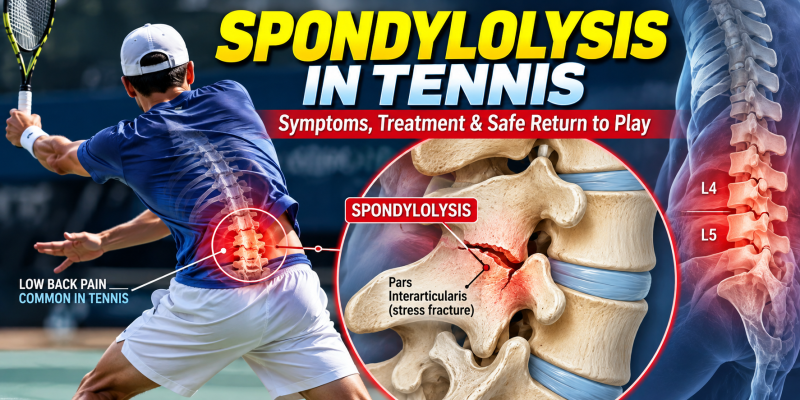
Spondylolysis is a stress injury or fracture of a small part of a vertebra called the pars interarticularis. It most commonly affects the lower lumbar spine, particularly L5.
For tennis players, spondylolysis is important because the sport repeatedly combines lumbar extension, rotation, and high-speed force production.
The tennis serve and overhead motion can place significant repetitive stress through the lower back. This is especially important in junior players whose bones are still developing.
Tennis doctor’s advice: Persistent lower back pain in a young tennis player should not automatically be dismissed as muscle soreness. Pain that repeatedly appears with serving, overheads, or bending backward deserves proper evaluation.
What Does Spondylolysis Feel Like?
Spondylolysis can develop gradually rather than causing one obvious injury.
Typical symptoms include:
- Persistent aching in the lower back
- Pain that increases during or after tennis
- Pain with back extension
- Pain with rotation
- Localized tenderness
- Lower-back muscle tightness
- Hamstring tightness
- Reduced tolerance for serving and overheads
Some players may have little pain at rest but develop symptoms after training.
Pain may sometimes extend into the buttocks, but significant leg numbness, tingling, or weakness suggests that another spinal problem may also need to be considered.
Why Is Spondylolysis Common in Tennis?
The lower back repeatedly absorbs forces during tennis.
1. Repetitive Extension and Rotation
The serve is one of the most demanding movements for the lumbar spine.
A player repeatedly extends and rotates the trunk while generating high racket-head speed.
When this movement is repeated hundreds or thousands of times during training, the pars interarticularis can experience repetitive stress.
2. Junior Tennis Players
Spondylolysis is particularly important in adolescent athletes.
During growth, the developing spine may be more vulnerable to repetitive loading.
A young player who suddenly increases:
- Serving volume
- Tournament frequency
- Training hours
- Strength training
- High-intensity court work
may place excessive stress on the developing spine.
3. High Training Volume
Bone needs time to adapt and repair.
Repeated high-load training without adequate recovery can allow small areas of bone stress to progress.
4. Limited Hip or Trunk Control
When the hips and trunk don't distribute movement efficiently, the lower back may compensate.
This doesn't mean tight hamstrings or weak abdominal muscles directly cause spondylolysis, but improving overall movement capacity and strength can help an athlete manage tennis loads more effectively.
A Warning Sign Tennis Players Shouldn't Ignore
One of the biggest mistakes is assuming:
"My back is sore because I played a long match."
Muscle soreness generally improves with recovery.
A stress injury may instead produce recurrent pain that returns every time the athlete trains, particularly with serving or back extension.
If a young tennis player repeatedly complains about the same area of the lower back, don't simply increase stretching or massage.
Get the problem assessed.
How Is Spondylolysis Diagnosed?
Diagnosis starts with a medical history and physical examination.
A clinician may evaluate:
- Pain location
- Spinal range of motion
- Extension and rotation
- Local tenderness
- Hamstring flexibility
- Hip movement
- Strength
- Neurological function
A single physical test cannot reliably confirm or exclude spondylolysis.
Imaging
Imaging may be required when a stress injury is suspected.
X-Ray
X-rays can identify some established or more obvious pars defects, but early stress injuries may not be visible.
MRI
MRI can detect bone stress reactions and is useful because it does not expose the athlete to ionizing radiation.
CT
CT provides excellent detail of bone and may be used to characterize a pars defect, particularly in certain chronic cases.
The choice of imaging depends on the athlete's age, symptoms, examination, and clinical situation.
Spondylolysis vs. Spondylolisthesis
These terms are related but not the same thing.
Spondylolysis
A stress injury or fracture involving the pars interarticularis.
Spondylolisthesis
A vertebra moves forward relative to the vertebra below it.
A pars defect can sometimes contribute to this type of vertebral slippage, but having spondylolysis does not automatically mean the player has spondylolisthesis.
Treatment for Tennis Players
Treatment depends on whether the injury represents an active stress reaction, an acute fracture, or an established chronic defect.
Activity Modification
During the painful phase, the athlete may need to stop activities that repeatedly load the injured area.
This can include:
- Serving
- Overheads
- Aggressive back extension
- Repetitive rotation
- High-impact running
- Heavy lifting
The purpose isn't simply to rest.
The purpose is to remove the stress that is preventing the bone from recovering.
Rehabilitation
Once symptoms are controlled, rehabilitation may focus on:
- Core endurance
- Hip strength
- Pelvic control
- Hip mobility
- Trunk control
- Progressive conditioning
- Tennis-specific movement
Exercises should be progressed according to symptoms and the clinician's assessment.
Bracing
A brace may occasionally be prescribed, particularly for selected young athletes with an active pars stress injury.
It is not necessary for every player.
The decision should be made by the treating clinician.
How Long Does Spondylolysis Take to Heal?
Recovery varies considerably.
An active stress reaction may respond to appropriate activity modification and rehabilitation, while an established fracture or chronic pars defect may behave differently.
Some athletes require several weeks to a few months away from tennis, depending on the severity and location of the injury.
Don't use a fixed six- or twelve-week timeline as permission to return automatically.
Bone healing and functional recovery are individual.
Prevention for Tennis Players
You cannot prevent every case of spondylolysis, but several strategies can reduce unnecessary training stress.
Manage Serving Volume
Serving is one of the highest-demand tennis movements for the lower back.
Junior players in particular should avoid sudden increases in serving volume.
Improve the Kinetic Chain
A good serve uses:
Legs → hips → trunk → shoulder → arm → racket
The objective isn't to eliminate lumbar movement.
It is to avoid relying excessively on the lower back to create power.
Strengthen the Core and Hips
Develop the ability to control the pelvis and trunk during:
- Rotation
- Single-leg movements
- Acceleration
- Deceleration
- Jumping
- Landing
Allow Recovery
Schedule recovery between demanding tennis sessions.
Watch for persistent soreness, declining performance, or pain that becomes progressively easier to reproduce.
Don't Ignore Junior Athlete Back Pain
This may be the most important prevention message.
A young athlete repeatedly reporting back pain deserves attention.
Early recognition of a bone stress injury may prevent it from progressing to a more established fracture.
Return to Tennis After Spondylolysis
Returning to tennis should be gradual and guided by the athlete's symptoms, clinical findings, strength, movement quality, and medical advice.
Phase 1 — Protect the Spine
Initially, remove the activities that provoke symptoms.
This may mean temporarily stopping:
- Tennis
- Serving
- Overheads
- Heavy lifting
- Repetitive extension
- High-impact activities
Walking and other comfortable activities may be maintained when permitted by the treating clinician.
Phase 2 — Rebuild General Conditioning
As symptoms settle, gradually introduce:
- Walking
- Stationary cycling
- Core stabilization
- Hip strengthening
- Balance exercises
- Controlled mobility
The objective is to restore general physical capacity before returning to the court.
Phase 3 — Shadow Tennis & Controlled Hitting
Progress to:
- Shadow swings
- Easy groundstrokes
- Controlled baseline rallies
- Light footwork
Initially minimize high-load serving and aggressive extension.
Phase 4 — Tennis-Specific Movement
Gradually introduce:
- Faster lateral movement
- Acceleration
- Deceleration
- Controlled changes of direction
- More powerful groundstrokes
- Overheads
Monitor symptoms during and after each progression.
Phase 5 — Progressive Return to Serving
Serving should be reintroduced gradually.
Start with controlled intensity and volume rather than immediately returning to maximum-power serves.
Increase:
Intensity → volume → complexity
one step at a time.
Phase 6 — Full Competition
Match play should come last.
Before returning to unrestricted competition, the player should have regained appropriate strength, movement control, tennis-specific conditioning, and confidence.
For athletes with a confirmed pars stress injury, the treating clinician should determine when it is safe to resume unrestricted sport.
When Should a Tennis Player See a Doctor?
Get medical evaluation when lower back pain:
- Persists despite rest
- Repeatedly returns during tennis
- Is triggered by serving or back extension
- Progressively worsens
- Prevents normal activity
- Occurs repeatedly in a young athlete
Seek urgent assessment if back pain is accompanied by significant neurological symptoms such as substantial leg weakness, loss of sensation, or bladder or bowel problems.
Tennis Doctor's Bottom Line
Spondylolysis isn't simply "a bad back." It is a bone stress injury that tennis players need to take seriously.
The warning pattern is often simple:
Serve → pain → rest → feels better → serve again → pain returns.
Don't keep repeating that cycle.
Especially in junior tennis, persistent extension-related back pain should be evaluated rather than repeatedly treated as muscle tightness.
The safest comeback is progressive:
Protect → rehabilitate → rebuild strength → controlled hitting → movement → serving → competition.
Your goal isn't just to become pain-free.
Your goal is to make your spine capable of handling the repetitive demands of tennis again.