Quick Overview
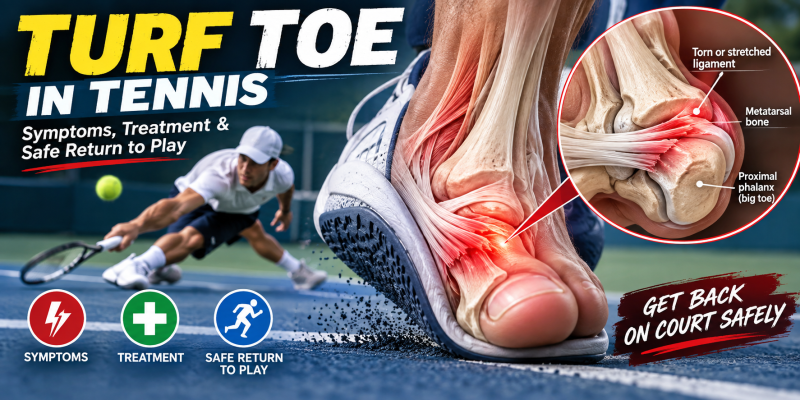
Turf toe is a sprain of the main joint at the base of the big toe, called the first metatarsophalangeal (MTP) joint.
For tennis players, this injury can happen when the big toe is suddenly forced upward while the heel is lifted. This commonly occurs during an aggressive serve, sprint, split step, sudden stop, or change of direction.
The big toe plays an important role in pushing off the court. When this joint is injured, even simple movements such as walking, accelerating, or changing direction can become painful.
Tennis doctor’s advice: Don't underestimate pain at the base of your big toe. Continuing to play through a turf toe injury can delay healing and may make the injury more difficult to treat.
What Does Turf Toe Feel Like?
Typical symptoms include:
-
Sharp pain at the base of the big toe, especially during push-off
-
Swelling around the MTP joint
-
Tenderness when pressing on the joint
-
Bruising or discoloration
-
Pain when bending the big toe upward
-
Reduced ability to push off the forefoot
-
Weakness or instability when changing direction
-
Difficulty walking normally after play
A tennis player may initially think, "It's just a sore toe." However, persistent pain after an aggressive movement can indicate a more significant ligament or plantar-plate injury.
Why Does Tennis Cause Turf Toe?
Tennis repeatedly loads the front of the foot.
1. Aggressive Push-Off
During a sprint or explosive first step, your heel rises while the big toe remains against the court. If the toe is forced too far upward, the structures underneath the MTP joint can become sprained.
2. Sudden Direction Changes
Hard lateral cuts place substantial force through the forefoot. A player who suddenly brakes and changes direction may overload the big toe.
3. Hard or High-Traction Courts
A shoe that grips the court extremely well can prevent the foot from naturally sliding during sudden deceleration. This can increase stress on the toe.
4. Flexible Tennis Shoes
A very flexible forefoot may allow excessive bending of the big toe during explosive movements.
5. Direct Trauma
The toe can also be injured when it is jammed into the court or another player's foot.
How Is Turf Toe Diagnosed?
A tennis doctor or sports-medicine professional will usually begin with a physical examination.
The clinician may assess:
-
Pain and tenderness
-
Big-toe range of motion
-
Joint stability
-
Ability to bear weight
-
Strength during push-off
-
Signs of plantar-plate or ligament injury
Turf toe injuries are commonly described using Grade 1, Grade 2, and Grade 3 severity.
Grade 1 — Mild
The supporting tissues are stretched or have very small tears.
The player may experience localized pain but can often still walk.
Grade 2 — Moderate
There is a partial tear with more significant pain, swelling, and difficulty pushing off.
Playing tennis normally is usually difficult.
Grade 3 — Severe
The supporting structures can be completely torn, producing substantial pain, swelling, instability, and difficulty bearing weight.
This requires medical assessment and may require prolonged protection or, in selected cases, surgery.
Do You Need an X-Ray or MRI?
An X-ray may be used to check for a fracture, bone injury, or damage around the sesamoid bones.
An MRI may be considered when a more serious soft-tissue injury is suspected, such as damage to the plantar plate, cartilage, or surrounding ligaments.
Not every case requires an MRI. The decision depends on the examination and severity of the injury.
What Should You Do Immediately?
If you develop sudden big-toe pain during tennis, stop playing rather than trying to "test it" repeatedly.
Protect the Toe
Avoid movements that force the big toe upward.
Ice
Apply a cold pack for approximately 15–20 minutes at a time, with a cloth between the ice and skin.
Elevate
If the foot is swollen, elevation can help reduce swelling.
Reduce Weight-Bearing
If walking is painful, reduce the amount of weight placed through the injured foot.
Get Evaluated
Significant swelling, bruising, inability to walk normally, severe pain, or a feeling of instability should be assessed by a qualified healthcare professional.
Treatment for Tennis Players
Treatment depends on the severity of the injury.
Taping
A rigid taping technique can restrict excessive upward movement of the big toe.
This can reduce stress on the injured structures while they heal.
Stiff Sole or Carbon-Fiber Insert
A stiff insert can reduce MTP joint movement during walking and tennis-related activities.
For some athletes, this can make returning to activity more comfortable.
Medication
Nonsteroidal anti-inflammatory drugs such as ibuprofen may help some people with pain and inflammation, but they are not appropriate for everyone.
Follow the medication label and consider your medical history and other medications. A clinician or pharmacist can advise whether an NSAID is appropriate for you.
Physical Therapy
Once the acute pain settles, rehabilitation may include:
-
Gentle range-of-motion exercises
-
Calf mobility
-
Foot-intrinsic strengthening
-
Balance exercises
-
Progressive calf strengthening
-
Controlled push-off drills
-
Tennis-specific movement training
The goal isn't simply to make the toe feel better.
The goal is to restore the ability to absorb and produce force safely.
When Is Surgery Necessary?
Most turf toe injuries are treated without surgery.
Surgery may be considered for selected severe injuries, particularly when there is:
-
Complete disruption of supporting structures
-
Significant joint instability
-
Displaced bone fragments
-
Certain severe plantar-plate injuries
-
Persistent problems despite appropriate conservative treatment
A sports-medicine or foot-and-ankle specialist should determine whether surgery is appropriate.
Return to Tennis: Don't Rush the Comeback
A common mistake is returning to tennis as soon as walking becomes comfortable.
Tennis requires much more than walking.
You need to tolerate:
Walking → jogging → acceleration → braking → lateral movement → explosive push-off → competitive play.
Phase 1 — Protect & Recover
Avoid running, cutting, jumping, and competitive tennis.
Focus on reducing pain and swelling and protecting the big toe.
Phase 2 — Straight-Line Movement
When symptoms improve, gradually introduce:
-
Normal walking
-
Light jogging
-
Controlled straight-line running
A stiff shoe or protective insert may be used when recommended by your clinician.
Phase 3 — Tennis-Specific Movement
Progress to:
-
Split steps
-
Side shuffles
-
Controlled changes of direction
-
Short acceleration drills
-
Shadow tennis
-
Light hitting
Increase one variable at a time rather than immediately returning to full-intensity drills.
Phase 4 — Full Tennis
A player should be able to perform tennis-specific movements without significant pain, swelling, weakness, or instability before returning to competitive play.
Protective taping or a stiff insert may be useful during the early return-to-play period when recommended by a healthcare professional.
How Long Does Turf Toe Take to Heal?
There is no single recovery time for every tennis player.
A mild injury may recover relatively quickly, while a moderate or severe injury can require substantially longer rehabilitation.
Recovery depends on:
-
Injury grade
-
Degree of ligament or plantar-plate damage
-
Treatment
-
Player age and conditioning
-
Previous injuries
-
How quickly the injury was protected
-
Demands placed on the toe during rehabilitation
Pain alone should not determine your return to tennis.
Your ability to push off, accelerate, stop, and change direction matters just as much.
How Tennis Players Can Prevent Turf Toe
Choose Supportive Tennis Shoes
Look for footwear with appropriate forefoot stability and torsional support rather than an excessively flexible sole.
Consider a Rigid Insert
Players with previous turf toe or repeated forefoot problems may benefit from a rigid insert or carbon-fiber plate when appropriately fitted.
Strengthen the Foot
Exercises such as short-foot exercises, controlled toe work, calf raises, and balance training can help improve foot strength and control.
Adapt to New Courts Gradually
When changing court surfaces or footwear, give your body time to adapt.
Don't Ignore Repeated Toe Pain
Recurring pain at the base of the big toe deserves attention, particularly if it affects your push-off or movement.
Tennis Doctor's Bottom Line
Turf toe isn't just a "toe injury."
For tennis players, the big toe is part of the body's force-production system. Every explosive sprint, recovery step, braking movement, and direction change can place stress through the MTP joint.
If you experience sudden pain, swelling, bruising, or instability after your toe is forced upward, stop playing and have the injury assessed if symptoms are significant or persistent.
The safest return to tennis is not based on the calendar.
It is based on pain-free movement, restored strength, stable push-off, and the ability to perform tennis-specific movements confidently.