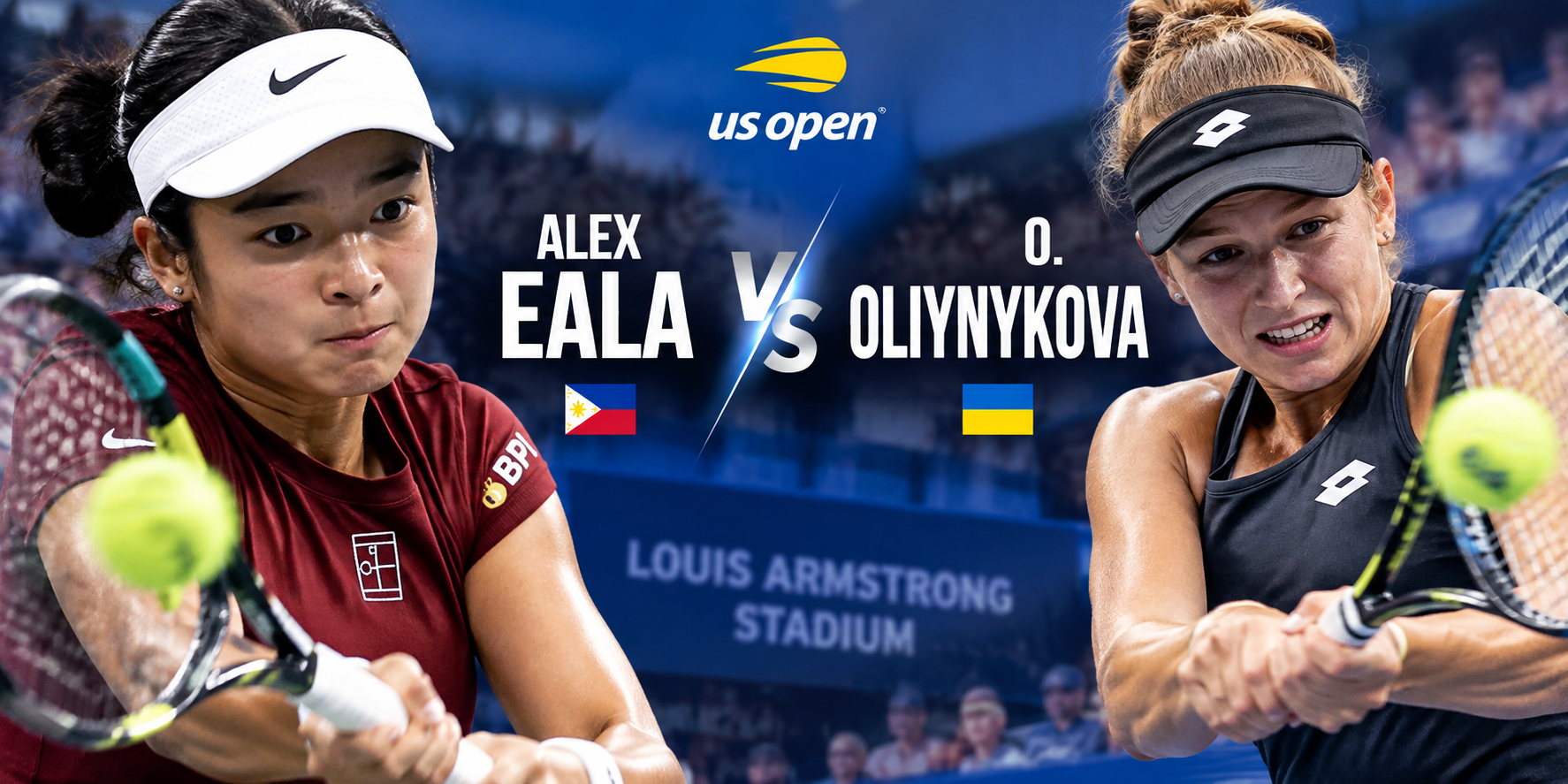
The atmosphere inside Louis Armstrong Stadium was electric as Alex Eala faced Oleksandra Oliynykova in a highly anticipated US Open matchup. Thousands of Filipino fans filled the stands with Philippine flags, chants, and unwavering support, creating an atmosphere that felt more like a home-court advantage than a neutral Grand Slam venue.
But the biggest story was not simply the crowd.
Alex Eala backed up the energy with elite-level tennis.
Her 6-1, 6-4 victory over Oliynykova showed a combination of aggressive baseline tennis, tactical discipline, shot selection, and mental composure. More importantly, it demonstrated the growing tennis IQ that is helping Eala compete successfully on the biggest stages.
Eala vs. Oliynykova: Match Result
Alex Eala defeated Oleksandra Oliynykova 6-1, 6-4.
The scoreline tells only part of the story. Eala controlled the first set almost immediately, while the second set required considerably more patience and tactical awareness.
The ability to win both types of sets—one through overwhelming aggression and another through controlled problem-solving—is an important sign of competitive maturity.
The Louis Armstrong Stadium Crowd Changed the Atmosphere
The Philippine crowd at Louis Armstrong Stadium created one of the most noticeable storylines surrounding the match.
The sea of Philippine flags and constant chants transformed the environment into something resembling a home-court setting for Eala.
The "Home Game" Effect
Large stadiums can create pressure for young players. The noise, cameras, expectations, and importance of every point can become distractions.
Eala appeared to use the atmosphere differently.
Instead of allowing the occasion to overwhelm her, she appeared to convert the crowd's energy into momentum.
Every aggressive forehand, successful defensive sequence, and important point generated another wave of support.
That created a positive feedback loop:
Eala plays aggressively → the crowd responds → momentum increases → Eala continues dictating.
For a player competing on the Grand Slam stage, that emotional connection can be extremely valuable.
However, crowd support alone does not win matches.
The player still has to execute.
And Eala did.
First Set Analysis: Eala Takes Control Immediately
Eala's opening set was the clearest indication of the difference in tactical execution.
She raced to a 4-0 lead, putting Oliynykova under pressure before the Ukrainian player could establish her preferred rhythm.
Eala's forehand was particularly important.
Rather than simply hitting hard, she used the forehand to push Oliynykova away from comfortable court positions and create opportunities to attack the next ball.
According to the match statistics cited in the analysis, Eala produced 11 winners in the first set compared with zero from Oliynykova.
That statistic illustrates the level of control Eala established.
She wasn't simply waiting for mistakes.
She was actively creating them.
Eala's First-Set Formula
Her basic pattern was:
Serve → establish the rally → attack with the forehand → move the opponent → finish the point.
This is classic baseline pressure.
The key is that Eala was not trying to hit a winner from every position. She was using her shots to progressively improve her court position.
That is an important distinction between aggressive tennis and reckless tennis.
Second Set Analysis: Where Eala's Tennis IQ Became More Important
The second set was a different test.
Oliynykova became more competitive, extended rallies, and made Eala work harder for points.
This is where tennis IQ becomes particularly important.
A player with raw power may dominate when everything is working.
A player with high tennis IQ can recognize when the match changes and adjust.
Eala showed that adjustment.
Instead of becoming frustrated when the second set became more difficult, she maintained her baseline patterns and remained patient during longer exchanges.
She didn't need to win every point quickly.
She needed to win the important points.
That difference is crucial at Grand Slam level.
Tennis IQ Comparison: Eala vs. Oliynykova
Alex Eala's Tennis IQ
Eala's strongest characteristic in this match was her ability to combine aggression with patience.
Her tennis IQ was visible in several areas:
1. Court Positioning
Eala consistently looked to control the baseline rather than allowing Oliynykova to dictate from comfortable positions.
When she gained a shorter ball, she could transition from neutral rallying into attack.
2. Shot Selection
Eala didn't rely on one shot.
She used depth, direction, pace, and court positioning to create openings.
Her forehand was the primary weapon, but the important factor was how she constructed points around it.
3. Rally Patience
The second set demonstrated that Eala understood she didn't need to force the match.
When Oliynykova improved her level, Eala stayed disciplined.
This is a major part of tennis IQ: knowing when to attack and when to wait.
4. Momentum Management
Eala handled the emotional energy of the stadium without allowing it to completely dictate her decision-making.
She continued to play her game even when the second set became more competitive.
5. Pressure Awareness
Eala appeared particularly effective when important points arrived.
Instead of becoming passive, she continued looking for opportunities to take control.
That mentality helped her close the match in straight sets.
Oleksandra Oliynykova's Tennis IQ
Oliynykova also demonstrated why she is a difficult opponent.
After the first-set problems, she improved her competitiveness in the second set.
Her ability to make the match more physical and extend rallies showed tactical adjustment.
Rather than continuing to play exactly the same way after falling behind, she made the second set more difficult for Eala.
That adjustment is evidence of competitive intelligence.
However, the problem was that Eala had already established too much control.
Oliynykova needed to consistently disrupt Eala's first-strike patterns and prevent Eala from comfortably setting up her forehand.
Once Eala established control of the baseline, Oliynykova was often forced to defend rather than dictate.
The Key Tactical Battle
The central tactical question was simple:
Who would control the baseline?
Eala won that battle for long stretches.
When Eala controlled the center of the court, she could use her forehand to move Oliynykova around.
When Oliynykova was pushed behind the baseline, her options became more limited.
This is one of the fundamental principles of modern women's tennis:
Court position often matters as much as raw power.
A player who controls the center can dictate direction, pace, and rally length.
Eala repeatedly put herself in that position.
The Importance of the Seventh Game
The second set became much more competitive, making the key moments increasingly important.
Eala's ability to capitalize on crucial break opportunities in the seventh game helped change the balance of the set.
This is where match management becomes critical.
A player can dominate statistically for several games but still allow an opponent back into the match.
Eala avoided that scenario.
She recognized the opportunity, attacked the important points, and then protected her advantage.
That is the type of scoreboard awareness that separates promising players from players capable of making deep Grand Slam runs.
Closing the Match: Mental Strength Under Pressure
Serving out a match at a Grand Slam is never simply routine.
The opponent knows the match is nearly over.
The crowd becomes louder.
Every point suddenly carries greater emotional weight.
Eala remained composed and closed the match in straight sets.
The 6-1, 6-4 victory required only around 64 minutes, showing how efficiently she managed the match.
She didn't spend unnecessary energy fighting for a third set.
She established an early advantage, absorbed the second-set resistance, and finished the job.
What This Match Says About Alex Eala's Development
The most encouraging aspect of this performance wasn't simply the score.
It was the variety of skills Eala demonstrated.
She showed:
-
Aggressive baseline tennis
-
Forehand control
-
Point construction
-
Rally patience
-
Court positioning
-
Pressure management
-
Momentum control
-
Mental resilience
-
Ability to adjust tactically
These qualities suggest a player becoming increasingly comfortable on the biggest stages.
The first set showed her ability to overwhelm.
The second set showed her ability to solve problems.
Together, they provide a much more complete picture of her development.
Eala-Mania Is More Than Crowd Noise
The Philippine support at Louis Armstrong Stadium was spectacular, but the significance goes beyond the atmosphere.
A large and passionate crowd creates attention.
Elite tennis creates credibility.
Eala provided both.
The Philippine flags, chants, and energy made the stadium feel different. But once the match started, Eala's tennis became the reason the crowd kept getting louder.
She didn't simply benefit from the atmosphere.
She gave the crowd something to celebrate.
That distinction matters.
Final Verdict: Eala's Tennis IQ Wins the Day
Alex Eala's 6-1, 6-4 victory over Oleksandra Oliynykova was a statement performance built on much more than power.
Her first-set dominance demonstrated her ability to take control early.
Her second-set performance demonstrated patience, tactical awareness, and emotional control.
Most importantly, she showed that she can change gears depending on what the match demands.
Eala's biggest advantage wasn't simply hitting harder. It was understanding when to attack, when to wait, where to position herself, and how to manage pressure.
That is tennis IQ.
And on a roaring Louis Armstrong Stadium court filled with Filipino supporters, Eala showed that her rise is about more than "Eala-mania."
She is earning the attention with her tennis.