A hamstring strain is one of the most important posterior-thigh injuries in competitive tennis. The hamstring muscle group must repeatedly accelerate the body, control rapid deceleration, stabilize the pelvis, and absorb high forces during lunges, recovery steps and open-court defensive movements.
For professional players, even a moderate hamstring injury can significantly affect sprint speed, court coverage and confidence in explosive movements. A carefully progressed rehabilitation program is therefore essential before returning to tournament competition.
Quick Overview
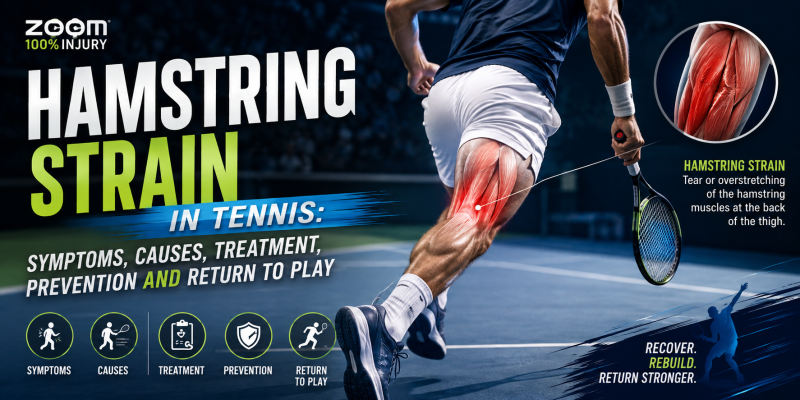
A hamstring strain occurs when one or more of the muscles or tendons at the back of the thigh are overstretched and partially torn.
The three major hamstring muscles are:
- Biceps femoris
- Semitendinosus
- Semimembranosus
Tennis players are particularly vulnerable because the sport combines repeated acceleration and deceleration with sudden changes of direction and extreme lower-limb positions.
Hamstring strains range from minor muscle damage to severe tears involving substantial disruption of the muscle-tendon unit.
Common Classification
Grade 1: Mild overstretching with relatively small amounts of tissue damage.
Grade 2: Partial tearing with measurable pain, weakness and reduced function.
Grade 3: Severe or complete muscle/tendon disruption, sometimes associated with tendon avulsion or retraction.
The exact grading system can vary between clinical classification systems, so MRI findings should be interpreted alongside the athlete's clinical examination and functional performance.
Symptoms of a Hamstring Strain
Symptoms depend on the severity and location of the injury.
Common symptoms include:
- Sudden sharp pain in the back of the thigh
- Pain during sprinting or acceleration
- Pain when changing direction
- Difficulty performing a powerful push-off
- Pain during knee flexion
- Pain when stretching the hamstring
- Localized tenderness
- Muscle weakness
- Reduced stride length
- Tightness or stiffness
- Swelling or bruising in more significant injuries
A player may describe the sensation as a pull, snap, stabbing pain or sudden tightening in the posterior thigh.
Severe injuries may cause substantial difficulty walking and may produce visible bruising or a palpable defect.
What Causes Hamstring Strains in Tennis?
Hamstring injuries are rarely caused by one factor alone. They generally occur when the muscle is exposed to a load that exceeds its current capacity.
1. High-Speed Acceleration
Rapid acceleration toward a short ball places substantial demand on the hamstrings.
2. Sudden Deceleration
A player reaching a wide ball must rapidly reduce horizontal momentum. The hamstrings contribute to controlling this movement eccentrically.
3. Lateral Defensive Movement
Wide defensive movements can combine hip flexion, knee extension and trunk rotation, placing considerable stress on the posterior thigh.
4. Fatigue
Late in a long match, neuromuscular control and force production can deteriorate. Fatigue may alter running and deceleration mechanics.
5. Previous Hamstring Injury
A previous hamstring strain is one of the most important risk factors for another injury.
6. Inadequate Strength or Load Capacity
Insufficient eccentric hamstring strength, poor posterior-chain conditioning or an abrupt increase in training volume can increase injury risk.
7. Poor Pelvic and Trunk Control
The hamstrings interact closely with the gluteal muscles, pelvis and trunk. Poor control can increase mechanical demands on the posterior thigh.
Diagnosis
Diagnosis begins with a detailed history and physical examination.
A sports physician or physiotherapist may assess:
- Location of pain
- Mechanism of injury
- Palpation tenderness
- Active knee flexion
- Passive hamstring length
- Resisted strength
- Running ability
- Acceleration and deceleration tolerance
- Functional movement
- Previous hamstring injuries
MRI
MRI can be useful when clinicians need to determine the location and extent of muscle-tendon injury, particularly in high-level athletes.
It can help identify:
- Muscle fiber disruption
- Musculotendinous involvement
- Edema
- Tendon involvement
- Injury extent
- Possible tendon retraction
However, MRI findings should not be used in isolation to determine when an athlete is ready to return to tennis. Symptoms, strength, running capacity and sport-specific performance remain critical.
Treatment
Treatment should be individualized according to injury severity, location, symptoms and the athlete's competitive requirements.
Phase 1: Acute Protection and Early Loading
During the first several days, the primary objectives are to control symptoms and protect the injured tissue from excessive loading.
Management may include:
- Relative rest
- Compression
- Pain-monitored movement
- Gentle range-of-motion exercises
- Early low-intensity isometric loading
- Cardiovascular cross-training that does not aggravate symptoms
Aggressive stretching and high-speed running should generally be avoided during the early stage when they reproduce pain.
Complete inactivity for prolonged periods is usually not the goal. Progressive loading, introduced at an appropriate stage, is an important part of recovery.
Phase 2: Strength and Neuromuscular Rehabilitation
As pain decreases, rehabilitation progresses toward restoring strength and movement quality.
Exercises may include:
- Hamstring isometrics
- Seated or lying hamstring curls
- Glute bridges
- Single-leg bridges
- Romanian deadlifts
- Hip-extension exercises
- Progressive eccentric hamstring exercises
- Modified Nordic hamstring exercises
- Core and pelvic-control exercises
The athlete should gradually increase both load and range of motion rather than immediately returning to maximal eccentric loading.
Phase 3: High-Speed and Tennis-Specific Conditioning
This is particularly important for professional tennis players.
Being pain-free while walking or performing gym exercises does not automatically mean the hamstring is ready for competition.
The athlete must progressively tolerate:
- Jogging
- Faster running
- Acceleration
- High-speed running
- Deceleration
- Lateral movement
- Direction changes
- Defensive lunges
- Court-specific recovery movements
- High-intensity point play
Tennis practice can progress from controlled hitting to movement-based drills and eventually match simulation.
Prevention
Hamstring injury prevention should be incorporated into the player's normal training program rather than used only after an injury.
Important strategies include:
Eccentric Hamstring Strength
Progressive eccentric exercises, including Nordic variations when appropriate, can improve hamstring capacity.
Progressive Sprint Training
Players need exposure to high-speed running during training so the hamstrings are prepared for tournament demands.
Strengthen the Posterior Chain
The hamstrings should be trained alongside:
- Gluteal muscles
- Calves
- Hip stabilizers
- Core musculature
Manage Training Load
Sudden increases in sprinting, court time, match volume or conditioning can increase injury risk.
Warm-Up
A structured tennis warm-up should progressively increase:
- Body temperature
- Mobility
- Running intensity
- Acceleration
- Direction changes
Previous Injury Monitoring
Players with a previous hamstring strain should receive particular attention to strength, high-speed running exposure and fatigue management.
Return to Tennis
Return to tennis should be criteria-based rather than simply time-based.
A player should demonstrate that the injured hamstring can tolerate the physical demands of professional tennis before returning to tournament competition.
Important benchmarks can include:
- Full or near-full pain-free range of motion
- No significant localized tenderness
- Restored hamstring strength
- Minimal side-to-side strength deficit
- Pain-free acceleration
- High-speed running without symptoms
- Repeated deceleration
- Lateral movement
- Tennis-specific lunging
- Full-intensity hitting
- Competitive point simulation
- No significant symptom flare-up after heavy training
For professional players, the final stage should ideally reproduce the intensity and movement demands of an actual match.
ATP Case Study: Acute Hamstring Strain in a Professional Tennis Player
Note: The following is a representative clinical case study based on the scenario provided, not a publicly identified ATP player's medical record.
Case Overview
A professional ATP-level singles/doubles player in his mid-to-late 20s developed an acute right hamstring injury during a high-intensity baseline exchange on a hard court.
The injury occurred while the player rapidly decelerated and performed a wide defensive lateral movement toward an open-court shot.
Immediate Presentation
The player reported:
- Sudden sharp posterior-thigh pain
- Pain localized primarily around the proximal-to-mid biceps femoris region
- Immediate inability to continue explosive movement
- Difficulty accelerating
- Mild localized tenderness
- No obvious palpable macroscopic defect
The absence of a major palpable defect made a complete Grade 3 disruption less likely, although clinical examination and imaging were required to characterize the injury.
Clinical Examination
The athlete underwent a detailed sports-medicine assessment.
Active knee flexion produced mild discomfort.
A passive straight-leg raise was limited by posterior-thigh tightness and pain at approximately 50 degrees.
Resisted isometric knee flexion also produced pain and demonstrated approximately a 15% strength reduction compared with the opposite side.
These findings supported the presence of a clinically significant hamstring injury.
MRI Findings
MRI performed within approximately 24 hours demonstrated a partial-thickness injury involving the long head of the biceps femoris at the musculotendinous junction.
The representative case was characterized as:
Grade 2a partial-thickness injury
with approximately 20% cross-sectional involvement and moderate perifascial edema.
Importantly, there was no free tendon retraction.
MRI therefore provided useful information about the injury's anatomical location and extent, while clinical function remained central to rehabilitation decisions.
Why Tennis Places the Hamstrings Under Extreme Stress
The mechanism illustrates why tennis is different from straightforward linear sprinting.
A professional tennis player may transition from:
Sprint → sudden braking → lateral movement → deep lunge → rotational recovery → explosive acceleration
within only a few seconds.
During these movements, the hamstrings help control hip and knee motion while absorbing and producing force.
Eccentric Deceleration
When an ATP player rapidly brakes after sprinting, the hamstrings must produce force while lengthening.
This eccentric demand can become particularly challenging when the athlete is fatigued.
Extreme Court Positions
A wide defensive movement may place the hip and knee into challenging positions while the athlete's trunk rotates toward the ball.
This combination can substantially increase posterior-chain loading.
Rehabilitation Timeline in the Case
Days 1–7: Acute Protection
The initial objective was symptom control and protection of the injured tissue.
Management included:
- Relative rest
- Compression
- Pain-monitored movement
- Gentle mobility
- Submaximal hamstring isometrics
- Pool-based conditioning
- Upper-body cardiovascular training
Aggressive hamstring stretching was avoided during the earliest stage.
Weeks 2–4: Strength Development
Once symptoms allowed, rehabilitation progressed toward progressive loading.
The program incorporated:
- Hamstring curls
- Romanian deadlifts
- Double-leg glute bridges
- Single-leg bridges
- Progressive eccentric loading
- Modified Nordic hamstring exercises
- Pelvic-control training
- Anti-rotation core exercises
The objective was not simply to eliminate pain but to rebuild the athlete's ability to generate and absorb force.
Weeks 5–7: High-Speed and Tennis-Specific Training
The final stage emphasized the movements that had originally caused the injury.
Training progressed through:
Jogging → acceleration → faster running → high-speed running → deceleration → lateral movement → tennis-specific movement → point simulation
Court training progressed from more stationary hitting toward increasingly demanding movement-based rallying.
Eventually, the player completed high-intensity multi-directional sessions designed to reproduce professional match demands.
Return-to-Competition Criteria
Before tournament clearance, the athlete demonstrated:
Strength
Isokinetic testing showed less than a 5% peak knee-flexor strength deficit between limbs.
Clinical Examination
There was no significant localized tenderness, and functional stretching assessments were negative.
Functional Performance
The player completed a high-intensity simulated match workload involving:
- Sprinting
- Deceleration
- Direction changes
- Lateral court coverage
- Repeated rallies
- Multi-set workload
without a significant post-training symptom flare.
Return to Competition
In this representative case, the total time away from professional competition was approximately six weeks, followed by a successful return at a 500-level tournament.
However, six weeks should not be interpreted as a universal recovery time for Grade 2 hamstring injuries.
Recovery depends on:
- Exact anatomical location
- Injury severity
- Tendon involvement
- Previous injury history
- Strength deficits
- Rehabilitation response
- High-speed running tolerance
- Competitive demands
A recreational tennis player may require a different progression from an ATP professional whose sport demands repeated maximal acceleration and deceleration.
Key Takeaway for Tennis Players
A hamstring strain is more than a simple "pulled muscle." In tennis, the injury can compromise the player's ability to accelerate, brake, change direction and recover explosively.
The safest return is not determined by the calendar alone.
Pain-free movement → restored strength → high-speed running → deceleration → tennis-specific movement → match simulation → competition
A player should return to competitive tennis only when the hamstring has demonstrated sufficient capacity to tolerate the specific demands of the sport.
For significant pain, weakness, bruising, inability to walk normally, or a suspected severe tear, assessment by a qualified sports-medicine professional is recommended.