
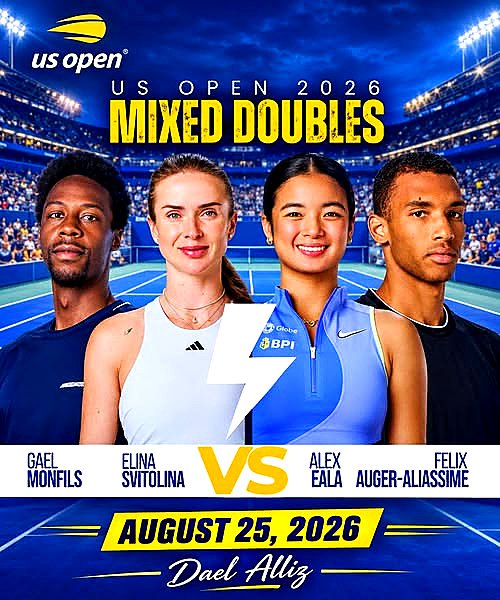
US Open Mixed Doubles — August 25, 2026
The US Open has produced a fascinating first-round matchup between Alex Eala and Felix Auger-Aliassime and the experienced husband-and-wife combination of Elina Svitolina and Gaël Monfils.
This is not simply a battle of four talented singles players. Mixed doubles is a different tactical sport: points are shorter, positioning becomes critical, the return is heavily targeted, and the ability to make the correct decision under pressure can determine the match.
The US Open format makes the mental side even more important. Through the semifinals, matches use sets to four games, no-ad scoring, a tiebreak at 4–4, and a 10-point match tiebreak instead of a traditional third set.
My Expert Prediction: Eala/Auger-Aliassime Slight Favorites
Projected winning probability:
-
Alex Eala / Felix Auger-Aliassime — 68%
-
Elina Svitolina / Gaël Monfils — 32%
That is an analytical estimate, not an official bookmaker probability. Prediction markets have recently priced Eala/Auger-Aliassime considerably higher, illustrating how strongly some market participants favor the younger pairing.
Why do I give Eala and Auger-Aliassime the edge?
Because their potential combination of first-strike tennis, serving power, athletic coverage and aggressive returning fits the compressed scoring format extremely well.
But this is absolutely not a comfortable 68%.
Svitolina and Monfils have the experience and tactical intelligence to make this extremely competitive.
1. The Biggest Advantage: Auger-Aliassime's Serve
The first major tactical weapon belongs to Felix Auger-Aliassime.
In mixed doubles, a powerful first serve can immediately create a short point. If Felix is landing a high percentage of first serves, Eala can become extremely dangerous at the net and on the next ball.
The objective should not simply be:
Serve → wait.
It should be:
Serve → force a weak return → attack immediately.
That creates the type of short, aggressive points that favor Eala and Auger-Aliassime.
Eala's role becomes critical
Alex does not need to hit a winner on every ball.
Her job should be to:
-
attack vulnerable returns;
-
move aggressively at the net;
-
pressure the opponent's second serve;
-
protect the middle;
-
take opportunities early;
-
keep the team emotionally stable after lost points.
That is where Eala's competitive personality can become a major weapon.
2. Eala's Return Could Change Everything
The most important individual matchup may be Eala against Monfils' serve.
Monfils possesses enormous athletic ability and can create unusual angles and defensive shots. But Eala should not allow the French veteran to dictate the rhythm.
Her return strategy should be simple:
Get the ball back deep and attack the next shot.
Because the sets are only four games, there is very little room for a slow start.
A single break can completely change the set.
If Eala and Auger-Aliassime fall behind 0–2, they cannot afford to panic.
If they get ahead 2–0, they cannot become passive.
Every game carries disproportionate value.
3. Svitolina-Monfils: The Experience Factor
This is where the match becomes dangerous for Eala and Auger-Aliassime.
Svitolina and Monfils have years of elite-level experience dealing with pressure, unusual match situations and momentum changes.
Svitolina brings tactical discipline and exceptional competitive awareness.
Monfils brings athleticism, improvisation and the ability to turn defense into offense.
Their biggest advantage is court awareness.
They understand when to slow the point down and when to accelerate.
They also know how to survive when the opponent starts playing spectacular tennis.
4. The Mental Battle
This could ultimately decide the match.
Eala enters with enormous attention surrounding her. She has become one of the Philippines' biggest tennis stars and recently reached No. 18 in the WTA rankings, according to the Philippine Daily Inquirer.
But the question is not whether Eala can handle pressure.
The question is whether she can stay emotionally neutral when a mixed-doubles point goes against her.
There will be:
-
net-cord points;
-
unexpected lobs;
-
fast exchanges;
-
missed volleys;
-
partner errors;
-
no-ad pressure;
-
match-tiebreak pressure.
The winning mentality is:
Next point. No emotional accounting.
If Eala makes a mistake, she cannot spend the next two points trying to compensate for it.
If Auger-Aliassime misses a big serve, Eala must immediately reset.
If they lose a close game, the response should be:
Reset. Rebuild. Attack.
That is championship mixed-doubles mentality.
5. The Match-Tiebreak Factor
This is perhaps the most important reason I would not give Eala/Auger-Aliassime an overwhelming probability.
The match can be decided by a 10-point tiebreak rather than a traditional third set.
That changes everything.
At 8–8, there is no room for passive tennis.
One loose return can become match point.
One great serve can become a huge advantage.
One poor decision can end the tournament.
In that environment, the team that communicates better has a major advantage.
Eala and Auger-Aliassime should establish their patterns before the match:
Who takes the middle?
Who attacks the return?
Who covers the lob?
Where do they serve at 8–8?
Those decisions should not be invented during the pressure moment.
6. The Key Tactical Battle: Eala at the Net
If I were coaching Eala for this match, I would emphasize one instruction:
Be ready to attack.
Eala should not stand passively at the net waiting for the ball.
She should look for:
-
weak crosscourt returns;
-
floating balls;
-
short defensive shots;
-
predictable second serves;
-
opportunities to intercept.
The mixed-doubles court can become extremely fast.
A player who hesitates loses the opportunity.
A player who anticipates can finish the point instantly.
7. What Could Make Eala/Auger-Aliassime Lose?
There are three major danger signs.
1. Too many unforced errors
Short-format doubles rewards efficiency.
If Eala and Felix start trying to hit spectacular winners instead of constructing points, Svitolina and Monfils can punish them.
2. Poor communication
Mixed doubles requires constant communication.
A hesitation between partners is often more damaging than a technical mistake.
3. Emotional momentum swings
If Eala becomes frustrated or Felix starts forcing his serve-and-first-ball combination, the match could quickly turn.
They need to stay calm even when Monfils produces something spectacular.
8. What Makes Eala the X-Factor?
For me, Alex Eala is the X-factor of this matchup.
Felix gives the team enormous firepower.
But Eala can provide the disruption.
Her ability to take the ball early, change direction and attack from unexpected positions can prevent Svitolina and Monfils from establishing their preferred patterns.
This is where the younger player can actually create an advantage over the more experienced team.
Eala should not try to play like Svitolina.
She should play like Eala.
Aggressive.
Fast.
Fearless.
Intelligent.
Final Expert Prediction
Projected Winner: Alex Eala & Felix Auger-Aliassime
Winning probability: 68%
Svitolina/Monfils: 32%
I expect this to be much closer than the percentage suggests.
The experience of Svitolina and Monfils makes them extremely dangerous, particularly if they drag the match into a match tiebreak.
But the combination of Auger-Aliassime's serve + Eala's aggression + younger athletic energy + the short scoring format gives the Filipino-Canadian team the edge.
My predicted scenario:
Eala/Auger-Aliassime win a tight opening set, Svitolina/Monfils respond, and the match is decided by a 10-point tiebreak.
If it reaches that stage, I would still give Eala and Auger-Aliassime a slight advantage because of their ability to generate free points with power and aggressive first-strike tennis.
The Mental Game Prediction
The winner may not be the team with the biggest serve.
It may be the team that makes fewer emotional decisions at 7–7, 8–8 and 9–9.
For Alex Eala, this is another opportunity to demonstrate that her game belongs on the biggest stages.
No fear. No panic. No looking backward.
One point at a time.
That is how Eala can turn the 68% prediction into a victory.
The official US Open draw confirms Eala/Auger-Aliassime and Svitolina/Monfils as the first-round matchup, with the winner advancing into the quarterfinal side of the draw containing top seeds Aryna Sabalenka and Novak Djokovic.