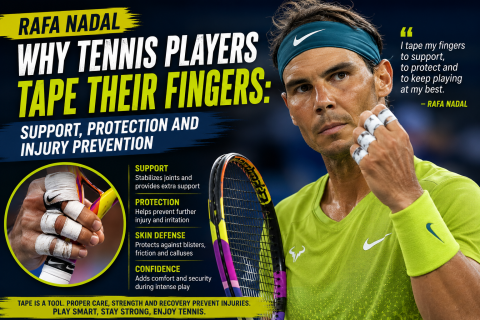

Wrist tendinitis is a common overuse problem for tennis players. Repeated gripping, rapid racket acceleration, wrist rotation, and impact with the ball can place substantial stress on the tendons that control the wrist and thumb.
The term wrist tendinitis is commonly used by athletes and patients, although many chronic tendon conditions are more accurately described as tendinopathy or tenosynovitis. These conditions can involve tendon degeneration, thickening, or irritation of the surrounding tendon sheath rather than inflammation alone.
For tennis players, the exact location of pain is important. Thumb-side wrist pain may indicate de Quervain's tenosynovitis, while pain on the little-finger side can involve structures such as the extensor carpi ulnaris (ECU) tendon. Other wrist injuries can produce similar symptoms, so persistent pain should be evaluated properly.
Quick Overview
Category
What Tennis Players Should Know
Condition
Tendon irritation, tendinopathy, or tenosynovitis around the wrist
Common symptoms
Wrist pain, tenderness, swelling, weakness, and pain with gripping
Common tennis triggers
Serving, forehands, backhands, volleys, gripping, and repetitive wrist rotation
Common locations
Thumb side, little-finger side, back of wrist, or palm-side wrist
Diagnosis
History, physical examination, and selective imaging
First-line treatment
Activity modification, bracing when appropriate, rehabilitation, and progressive strengthening
Injections
May be considered for selected conditions such as de Quervain's tenosynovitis
Surgery
Reserved for persistent or structurally significant cases that do not respond to appropriate conservative treatment
Return to tennis
Gradual progression from daily activity to hitting and then full match play
What Is Wrist Tendinitis?
Tendons connect muscles to bones and transfer muscular force to produce movement.
Several important tendons cross the wrist and control:
- Wrist flexion
- Wrist extension
- Radial deviation
- Ulnar deviation
- Thumb movement
- Finger movement
Tennis repeatedly uses these movements.
A player may experience tendon problems when the cumulative workload exceeds the tissue's ability to adapt.
The condition can involve the tendon itself or the surrounding tendon sheath.
The American Society for Surgery of the Hand describes de Quervain's tenosynovitis as a condition in which the tunnel containing the thumb tendons can become narrowed or the tendons can occupy more space, producing pain particularly with thumb movement, forceful gripping, and twisting.
Why Is Wrist Tendinitis Important for Tennis Players?
The tennis racket creates a long lever between the hand and the ball.
During a stroke, the wrist must help control:
- Racket position
- Racket-face angle
- Acceleration
- Impact stability
- Follow-through
The wrist does not work independently.
It is part of the kinetic chain involving the:
legs → hips → trunk → shoulder → elbow → wrist → hand → racket
If the player generates too much force through the wrist rather than efficiently transferring energy through the entire body, the wrist may experience increased repetitive stress.
This can become especially important during periods of:
- Increased practice volume
- Tournament competition
- Serve-heavy training
- New racket or string setup
- Technique changes
- Returning after a long break
- Playing on consecutive days
Symptoms of Wrist Tendinitis
The symptoms depend on which tendon is affected.
Common symptoms include:
- Localized wrist pain
- Tenderness along a tendon
- Mild swelling
- Pain during gripping
- Pain when turning the wrist
- Pain when lifting objects
- Reduced grip strength
- Pain during tennis strokes
- Stiffness after playing
- Discomfort that increases with repetitive activity
Some players initially notice pain only during tennis.
As the condition progresses, discomfort may begin appearing during everyday activities.
Pain Location Can Provide Important Clues
Thumb-Side Wrist Pain
Pain near the base of the thumb or radial side of the wrist can occur with de Quervain's tenosynovitis.
Symptoms often become worse with:
- Gripping
- Twisting
- Thumb movement
- Lifting
- Repetitive wrist deviation
The American Society for Surgery of the Hand identifies pain and swelling around the thumb-side wrist as characteristic features of de Quervain's tenosynovitis.
Little-Finger-Side Wrist Pain
Pain on the ulnar side of the wrist may involve the ECU tendon or other wrist structures.
For tennis players, this can be particularly relevant because forehands, serves, and two-handed strokes repeatedly load the wrist and forearm.
However, ulnar-sided wrist pain can also result from injuries involving the triangular fibrocartilage complex, joints, or other tendons.
Therefore, the location alone cannot establish a diagnosis.
Back-of-the-Wrist Pain
Pain on the dorsal wrist may involve the extensor tendons.
Repeated wrist extension and racket control can aggravate these structures.
Palm-Side Wrist Pain
Pain on the volar side can involve flexor tendons or other wrist structures.
Again, the exact diagnosis requires a proper examination.
Causes of Wrist Tendinitis in Tennis Players
1. Repetitive Racket Motion
The simplest explanation is repetitive loading.
A tennis player may perform hundreds or thousands of wrist and forearm movements during training and competition.
Even relatively small stresses can accumulate when repeated over many hours.
2. Excessive Grip Pressure
Holding the racket excessively tightly can increase forearm muscle activity.
Some players unconsciously tighten their grip during:
- High-speed serves
- Return of serve
- Hard forehands
- Match pressure
- Defensive situations
Learning to use an appropriate grip pressure can reduce unnecessary muscular tension.
3. Sudden Increase in Training
A sudden increase in tennis volume is one of the most important factors to consider.
For example:
A player who normally plays three times per week suddenly begins playing every day.
The muscles and cardiovascular system may tolerate the increase while the tendons struggle to adapt.
4. Technique Changes
Changes to stroke mechanics can temporarily alter how forces are distributed through the wrist and forearm.
This can happen after:
- Changing coaches
- Changing technique
- Modifying the serve
- Changing from one-handed to two-handed strokes
- Increasing racket-head speed
Technique changes should generally be introduced progressively.
5. Equipment Changes
Equipment can also alter how a player experiences impact.
Potential variables include:
- Racket weight
- Balance
- Grip size
- String type
- String tension
- Racket stiffness
- Overgrip thickness
Equipment is not necessarily the cause of wrist tendinitis, but a sudden equipment change combined with increased playing volume may contribute to symptoms.
6. Inadequate Recovery
Tendons need recovery time.
Playing several long sessions without adequate rest can gradually increase symptoms.
How Is Wrist Tendinitis Diagnosed?
Diagnosis begins with a detailed history.
A clinician may ask:
Where exactly is the pain?
When did it begin?
Was the onset gradual or sudden?
Which tennis strokes cause pain?
Does gripping reproduce symptoms?
Does twisting the wrist hurt?
Did you recently increase your tennis workload?
Did you change your racket or technique?
Did you experience an impact injury?
Is there swelling?
Has grip strength decreased?
The physical examination may assess:
- Tenderness
- Wrist range of motion
- Thumb movement
- Grip strength
- Resisted wrist movements
- Tendon stability
- Sensation
- Joint stability
Finkelstein's Test
Finkelstein's test is commonly associated with evaluation of de Quervain's tenosynovitis.
The test attempts to reproduce pain along the thumb-side wrist.
A positive provocative test can support the diagnosis, but it should be interpreted alongside the patient's history and physical examination.
Players should not repeatedly perform provocative maneuvers on themselves in an attempt to diagnose the injury.
Resisted Wrist Testing
A clinician may ask the player to perform resisted:
- Wrist extension
- Wrist flexion
- Radial deviation
- Ulnar deviation
- Thumb movement
Pain during a particular movement can help identify the involved tendon.
Is Imaging Necessary?
Not every case requires imaging.
Many tendon problems can initially be diagnosed through history and physical examination.
Imaging may become useful when:
- Symptoms are persistent
- The diagnosis is uncertain
- Significant injury is suspected
- A tendon tear is suspected
- There was trauma
- Conservative treatment has failed
X-Ray
X-rays do not directly visualize most tendon problems but can help identify:
- Fractures
- Arthritis
- Bone abnormalities
- Other structural causes of wrist pain
Ultrasound
Musculoskeletal ultrasound can evaluate tendons dynamically and may identify:
- Tendon thickening
- Tendon sheath abnormalities
- Fluid
- Tears
- Abnormal tendon movement
MRI
MRI provides more detailed assessment of the wrist and can be useful when clinicians need to investigate tendon, ligament, cartilage, or other soft-tissue pathology.
Treatment of Wrist Tendinitis
Treatment depends on the exact tendon involved and the severity of the condition.
1. Activity Modification
The first step is usually reducing the activity that repeatedly aggravates the tendon.
For a tennis player, this may mean temporarily reducing:
- Serving
- Hard forehands
- High-volume backhands
- Repetitive volleys
- Heavy topspin drills
- Long practice sessions
You may not need to stop all physical activity.
The objective is to reduce the specific load causing the problem while maintaining appropriate overall fitness.
2. Bracing and Immobilization
A wrist brace can temporarily reduce painful movement.
For de Quervain's tenosynovitis, a brace that restricts both wrist and thumb movement may be recommended.
The American Society for Surgery of the Hand lists splinting, activity modification, medication, corticosteroid injection, and hand therapy among non-operative treatment options for de Quervain's tenosynovitis.
The type and duration of immobilization should be individualized.
3. Physical Therapy and Hand Therapy
Rehabilitation should gradually restore:
- Wrist mobility
- Forearm strength
- Grip strength
- Thumb strength
- Tendon capacity
- Coordination
- Tennis-specific control
Hand therapists may also address technique and activity modification.
For tennis players, rehabilitation should eventually progress from isolated exercises to movements that resemble actual strokes.
4. Progressive Strengthening
Once symptoms have settled sufficiently, progressive loading becomes important.
A rehabilitation program may gradually include:
Isometric exercises
Light resistance
Wrist flexion and extension
Radial and ulnar deviation
Forearm rotation
Grip strengthening
Thumb strengthening
Progressive racket-specific exercises
The goal is to restore the tendon’s ability to tolerate repeated loading.
Strengthening should be supervised when the diagnosis is uncertain or symptoms are significant.
5. Medication
A physician may recommend medications such as NSAIDs when appropriate for pain management.
These medications may reduce symptoms but do not correct the underlying training or mechanical problem.
A player should not use pain medication simply to enable unrestricted tennis while an injury is still developing.
6. Corticosteroid Injections
For selected conditions, particularly de Quervain's tenosynovitis, a corticosteroid injection may be considered when appropriate conservative treatment has not provided sufficient relief.
The American Society for Surgery of the Hand lists corticosteroid injection as one of the established non-operative treatments for de Quervain's tenosynovitis.
Some clinical evidence suggests corticosteroid injection can be effective for de Quervain's tendinopathy, and ultrasound guidance may help accurately target the affected compartment.
However, injections should be performed by an appropriately trained clinician after confirming the diagnosis.
When Is Surgery Necessary?
Most tennis players with wrist tendon problems do not immediately require surgery.
Surgery may be considered when:
- Symptoms persist despite appropriate conservative treatment
- Significant tendon entrapment exists
- A structural tendon problem is present
- A tendon has ruptured
- Severe instability exists
- Conservative treatment repeatedly fails
The exact procedure depends on the tendon and diagnosis.
De Quervain's Tendon Sheath Release
For persistent de Quervain's tenosynovitis, surgery can involve releasing the first dorsal compartment to provide more room for the affected tendons.
The American Society for Surgery of the Hand describes surgical release as an option when less-invasive treatments fail to provide adequate relief.
Although it is generally a relatively small procedure, it still requires appropriate wound care and rehabilitation.
Recovery After Surgery
Return to tennis after wrist surgery depends on:
- Exact procedure
- Tendon involved
- Tissue healing
- Pain
- Range of motion
- Grip strength
- Surgical findings
- Rehabilitation progress
Hand therapy may be used to restore motion and progressively rebuild strength.
There should not be a universal return-to-tennis date applied to every patient.
Prevention for Tennis Players
Warm Up the Wrist and Forearm
Before hitting, gradually prepare the forearm and wrist.
A warm-up can include:
- Light movement
- Forearm rotation
- Gentle wrist mobility
- Progressive grip activity
- Low-intensity groundstrokes
The objective is to gradually increase the workload rather than immediately hitting maximum-power shots.
Manage Your Tennis Volume
Avoid sudden increases in playing time.
If you have been away from tennis for several weeks, do not immediately return to your previous maximum training volume.
Increase workload progressively.
A useful progression is:
Shorter sessions
Lower intensity
More recovery
Gradually increased hitting volume
Progressive serving
Normal practice
Competitive play
Avoid Excessive Grip Tension
Grip pressure should be appropriate for the stroke.
Many players naturally tighten their grip during high-pressure moments.
Learning to relax the hand between high-force moments may reduce unnecessary forearm fatigue.
This is particularly relevant during long matches.
Check Your Equipment
If wrist pain begins after changing equipment, consider discussing the setup with a qualified tennis professional.
Variables worth reviewing include:
Racket weight
Racket balance
Grip size
String type
String tension
Overall racket stiffness
Equipment changes should not be assumed to be the sole cause of an injury, but they can be relevant when symptoms appear after a major change.
Return to Tennis After Wrist Tendinitis
Returning too quickly is one of the most common mistakes athletes make.
The fact that pain has decreased does not necessarily mean the tendon is ready for hundreds of high-speed racket impacts.
A gradual progression is safer.
Stage 1: Daily Activities
You should be able to use the hand and wrist for normal daily activities with minimal symptoms.
Stage 2: Rehabilitation
Restore appropriate:
- Wrist mobility
- Grip strength
- Forearm strength
- Thumb strength when relevant
- Pain-free movement
Stage 3: Shadow Swings
Practice tennis movements without hitting a ball.
This allows you to assess movement tolerance without impact.
Stage 4: Mini Tennis
Begin with short-court hitting at low intensity.
Keep the session short.
Stage 5: Groundstrokes
Progress to normal groundstrokes.
Start with moderate pace and gradually increase intensity.
Stage 6: Serving
Serving should usually be reintroduced gradually because it can generate substantial racket and wrist loading.
Start with controlled serves before returning to maximum-speed serving.
Stage 7: Match Simulation
Progress to longer practice sessions and practice sets.
Monitor symptoms during and after training.
Stage 8: Competition
Return to competitive tennis once the wrist tolerates normal training loads without significant symptoms and strength and function have been adequately restored.
Return-to-Tennis Checklist
Before returning to full competition, consider whether you can:
Perform normal daily activities without significant pain
Move the wrist through an appropriate range
Grip the racket comfortably
Perform shadow swings
Hit light groundstrokes
Hit normal groundstrokes
Serve progressively
Perform volleys without significant symptoms
Maintain grip strength
Complete a full practice session
Recover without a significant symptom flare
A significant injury or persistent pain should be cleared by a medical professional before returning to competitive play.
When Should a Tennis Player See a Doctor?
Seek professional evaluation if:
Wrist pain persists despite reducing tennis.
Pain is becoming progressively worse.
Significant swelling develops.
Grip strength decreases.
You cannot comfortably hold the racket.
Pain occurs during normal daily activities.
The wrist becomes unstable.
You experience a sudden pop.
There is significant bruising.
The injury follows a fall or direct impact.
You suspect a tendon tear or fracture.
Pain continues for several weeks despite appropriate activity modification.
Persistent wrist pain should not automatically be labeled "tendinitis." Several wrist conditions can mimic tendon problems, and the correct diagnosis determines the appropriate treatment.
The Tennis-Specific Lesson
Wrist tendinitis is often a load-management problem as much as a wrist problem.
A player may have excellent technique but still develop symptoms if the training workload suddenly exceeds the wrist's current capacity.
The most useful approach is:
Identify the painful structure.
Reduce the aggravating workload.
Restore mobility.
Rebuild strength.
Correct relevant technique or equipment issues.
Progressively reload the wrist.
Return to tennis step by step.
The objective is not simply to get back on court.
The objective is to make the wrist strong enough to tolerate the demands of tennis again.
Bottom Line
Wrist tendinitis and tendinopathy can interfere significantly with a tennis player's ability to grip, accelerate, control, and stabilize the racket.
The most common symptoms include localized pain, tenderness, swelling, weakness, and pain with gripping or repetitive wrist movement.
Treatment usually begins with activity modification, appropriate bracing when indicated, rehabilitation, and progressive strengthening. Selected cases may benefit from corticosteroid injection, while surgery is generally reserved for persistent or structurally significant problems that do not respond adequately to conservative care.
For tennis players, the final step is not simply waiting for pain to disappear. A successful return requires progressively rebuilding the wrist's ability to tolerate groundstrokes, serves, volleys, and competitive match conditions.
When wrist pain persists, becomes severe, or follows an acute injury, professional evaluation is important because tendon problems can overlap with fractures, ligament injuries, cartilage problems, and other wrist conditions.