
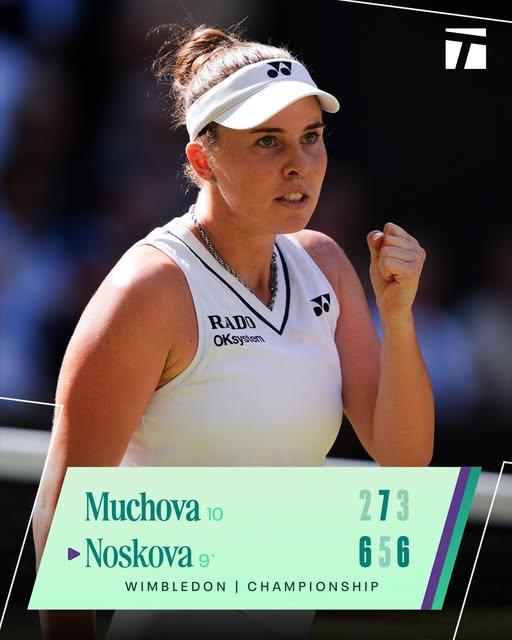
"I would not be standing here without her."
— Linda Nosková, honoring her late mother after reaching the Wimbledon 2026 Final.
Great Champions Don't Always Show Strength by Roaring
Sometimes, the strongest athletes are the quietest.
They don't celebrate every winner.
They don't panic after losing points.
They don't allow emotions to dictate decisions.
Instead, they trust their preparation.
That is exactly what Linda Nosková displayed during her Wimbledon 2026 semifinal victory over Marta Kostyuk.
The scoreboard reads:
Linda Nosková def. Marta Kostyuk 6–4, 6–4
But the score tells only a small part of the story.
Behind every game was a masterclass in emotional control, tactical intelligence, and what sports psychologists often describe as an alpha mindset—the ability to remain calm under extreme pressure while executing a winning strategy.
What Is an Alpha Mindset?
Many people mistake an alpha athlete for someone loud, aggressive, or intimidating.
True champions rarely fit that stereotype.
An alpha mindset is built on:
- Emotional control
- Confidence without arrogance
- Discipline
- Adaptability
- Performing when the pressure is greatest
Nosková demonstrated every one of these qualities.
Match Statistics Don't Lie
Throughout most of the semifinal, Marta Kostyuk fought brilliantly.
She produced explosive winners.
She energized the Centre Court crowd.
She even strung together an impressive eight-point streak during the second set.
Many players would have panicked.
Nosková never did.
She simply stayed committed to the game plan.
Tactical Lesson #1: Win the Short Rallies
The foundation of Nosková's victory was simple.
She refused to allow long defensive exchanges.
Instead she attacked early.
Her flat groundstrokes penetrated through the court.
Rather than giving Kostyuk rhythm, she forced immediate decisions.
Most rallies ended within four shots.
This denied Kostyuk the chance to dictate play.
Elite tennis isn't always about hitting harder.
Sometimes it's about taking time away.
Nosková mastered that perfectly.
Tactical Lesson #2: Attack the Second Serve
One statistic changed the entire match.
Kostyuk landed only 50% of her first serves.
That meant half of every service game began with a vulnerable second serve.
Nosková recognized this immediately.
Instead of playing safely, she stepped forward.
She attacked.
She returned aggressively.
She kept pressure on every service game.
By making approximately 74% of her returns, she forced Kostyuk to begin nearly every rally under pressure.
Great returners don't simply put the ball back.
They immediately place doubt into the server's mind.
That psychological pressure accumulates over an entire match.
Tactical Lesson #3: The Champion's Timing
Many players can play well when leading.
Champions play their best when the match is on the line.
Both sets followed a similar pattern.
At 5–4, Kostyuk served to stay alive.
This is where pressure becomes overwhelming.
Nosková elevated her level.
She broke serve in both sets.
Not earlier.
Not later.
Exactly when it mattered most.
That ability separates good players from Grand Slam finalists.
Mid-Match Adjustment #1: Patience Over Power
Kostyuk thrives on high-risk tennis.
Her explosive style can overwhelm opponents.
Instead of matching aggression with aggression, Nosková made an important adjustment.
She increased her margin.
She added depth.
She waited.
Eventually, Kostyuk's own aggressive style created mistakes.
The first set ended with a double fault.
The second ended with loose backhand errors.
Nosková didn't force those mistakes.
She created the conditions for them.
Mid-Match Adjustment #2: Neutralizing the First Serve
When Kostyuk landed her first serve, she won approximately 77% of those points.
That could have become a major problem.
Nosková responded by subtly adjusting her return position.
She shortened her backswing.
She blocked returns deep.
She focused on neutralizing pace rather than attacking every ball.
Instead of allowing free points, she consistently reset rallies.
This forced Kostyuk to win multiple shots—not just one.
Mid-Match Adjustment #3: Redirecting Power
Kostyuk plays with explosive athleticism.
Many opponents try to out-hit her.
Nosková chose another solution.
She absorbed pace.
She redirected it.
Her flat strokes changed direction effortlessly.
Rather than engaging in power battles, she continuously moved Kostyuk away from her preferred strike zone.
That is tactical maturity.
Emotional Intelligence Wins Grand Slams
Perhaps the greatest strength Nosková showed wasn't technical.
It was emotional.
She never appeared rushed.
She never argued with herself.
She never chased spectacular shots.
She trusted repetition.
Under pressure, athletes often narrow their focus.
Nosková embraced that mindset.
One point.
One rally.
One game.
Nothing more.
Playing for Something Bigger
After the match, emotion finally surfaced.
During her on-court interview, Linda Nosková dedicated the victory to her late mother.
"I would not be standing here without her."
Those words resonated far beyond tennis.
Every athlete carries unseen battles.
Every champion carries memories.
Sometimes the greatest motivation isn't ranking points or trophies.
It's honoring someone who helped shape the journey.
That emotional foundation often produces extraordinary resilience.
Lessons Every Athlete Can Learn
Whether you're a tennis player, coach, or competitor in any sport, Nosková's semifinal offers valuable lessons:
- Stay calm when momentum shifts.
- Attack weaknesses with discipline.
- Adapt instead of forcing your original plan.
- Peak during pressure moments.
- Trust consistency over emotion.
- Let preparation speak louder than celebration.
The Verdict
Linda Nosková didn't reach the Wimbledon 2026 Final through overwhelming power alone.
She won with intelligence.
She won with patience.
She won by recognizing tactical opportunities and executing them with remarkable composure.
Her aggressive return game punished vulnerable second serves.
Her flat baseline game controlled short rallies.
Most importantly, she elevated her performance at the biggest moments, breaking serve at 4–5 in both sets to close each set with authority.
That is championship tennis.
That is the alpha mindset.
And it is why Linda Nosková earned her place in a historic all-Czech Wimbledon final—not merely as a powerful hitter, but as a player who mastered the mental side of the game when it mattered most.