
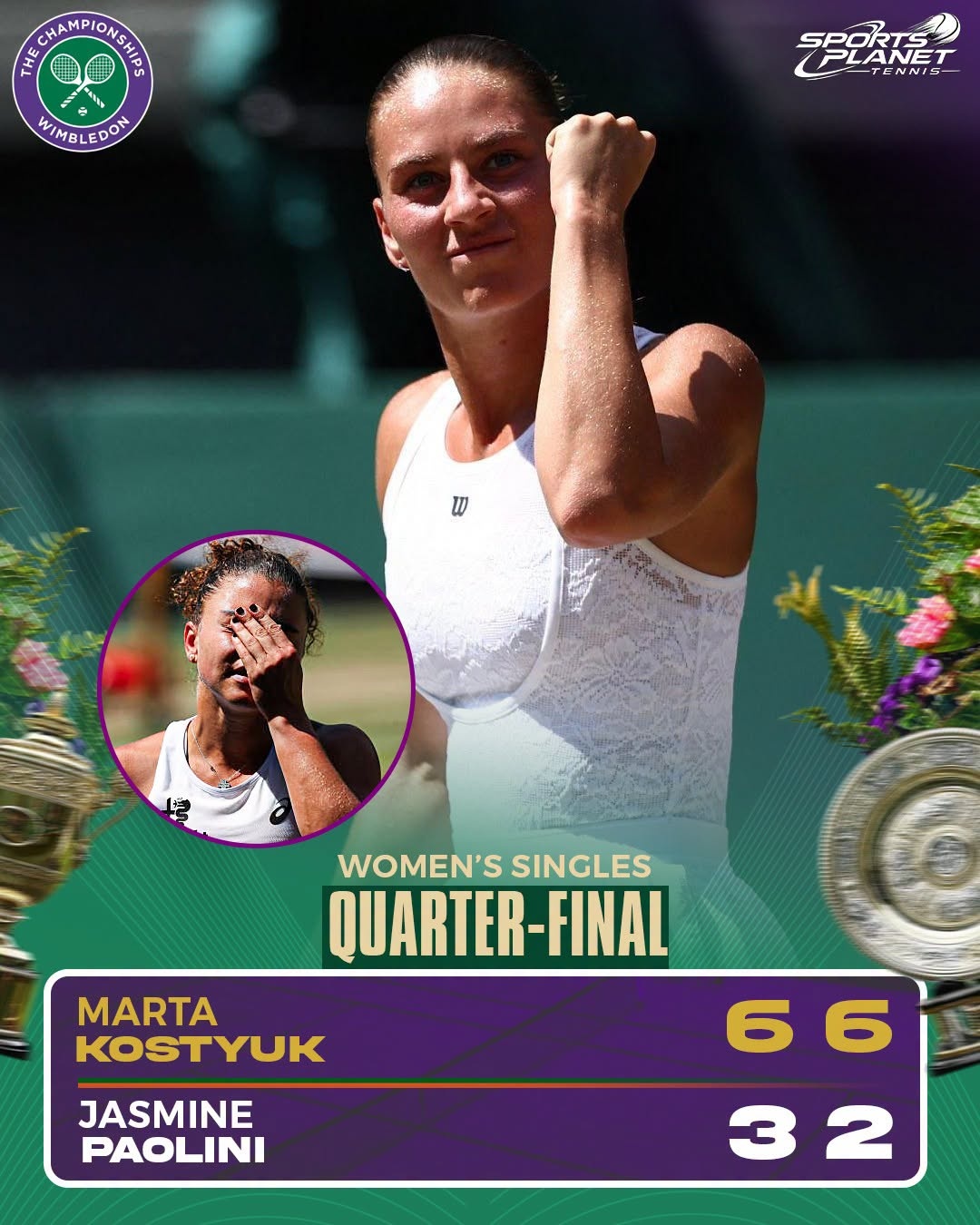
Wimbledon 2026 Quarterfinal
Final Score: Marta Kostyuk def. Jasmine Paolini 6-3, 6-2
Marta Kostyuk has officially arrived among the elite of women's tennis.
After announcing herself as a genuine Grand Slam contender at Roland Garros, the Ukrainian star has now reached her first Wimbledon semifinal, making it back-to-back Grand Slam semifinal appearances in one remarkable season. Even more impressive is her current form: 21 victories in her last 22 matches, a stretch that reflects not only exceptional athletic ability but also a rapidly maturing tennis IQ.
Against Jasmine Paolini, one of the tour's toughest competitors and last year's Wimbledon finalist, Kostyuk produced a performance built on intelligent tactical adjustments, relentless aggression, and near-perfect execution under pressure.
This wasn't simply a victory.
It was a statement that Marta Kostyuk now possesses every weapon necessary to compete for Grand Slam titles.
A Lightning-Fast Opening
From the opening game, Kostyuk refused to allow Paolini to establish rhythm.
Instead of engaging in the extended baseline exchanges that usually favor the Italian, Kostyuk immediately accelerated the tempo.
Her objectives were obvious:
- Strike first.
- Take the ball early.
- Keep Paolini moving laterally.
- Finish rallies before Paolini could dictate.
The strategy immediately paid dividends.
Paolini thrives when she is allowed to construct points patiently with heavy topspin and exceptional footwork. Kostyuk denied her that luxury.
Every short ball became an opportunity to attack.
Technical Ball Adjustments That Changed Everything
The biggest improvement in Kostyuk's game over the past several months has been her shot selection.
Against Paolini she demonstrated remarkable variation.
1. Earlier Ball Contact
Rather than waiting behind the baseline, Kostyuk consistently stepped forward.
Taking the ball early accomplished several objectives:
- reduced Paolini's reaction time
- flattened rally trajectories
- forced defensive positioning
- prevented topspin from pushing her backward
Early ball striking transformed neutral rallies into offensive situations almost instantly.
2. Flattened Forehand
Instead of relying on excessive topspin, Kostyuk drove through the ball.
The flatter trajectory:
- stayed lower
- traveled faster
- penetrated the grass
- limited Paolini's ability to counterattack
Grass rewards players who hit through the court.
Kostyuk fully embraced those conditions.
3. Backhand Down-the-Line Timing
Throughout the match, her two-handed backhand became one of her greatest weapons.
Rather than repeatedly trading crosscourt exchanges, she frequently changed direction down the line.
This adjustment:
- exposed open court
- stretched Paolini's movement
- forced rushed recoveries
- opened forehand winners
Every successful down-the-line backhand increased Paolini's uncertainty.
4. Deep Return Position Adjustment
Against many big servers, players retreat several feet behind the baseline.
Kostyuk did the opposite.
She often stood closer to attack second serves.
This aggressive positioning immediately placed Paolini under scoreboard pressure.
Game Adjustments During the Match
Elite players rarely rely on one game plan.
Kostyuk made continuous tactical adjustments as the match progressed.
Opening Games
She established pace immediately.
The goal was to test whether Paolini could absorb sustained power.
She couldn't.
Middle Portion of Set One
Paolini attempted to extend rallies.
Kostyuk answered by introducing more angles.
Instead of simply hitting harder, she widened the court.
This stretched Paolini beyond her preferred movement patterns.
Closing the First Set
With momentum building, Kostyuk increased first-serve aggression.
She won numerous short service games.
The quick holds prevented Paolini from building confidence.
Beginning of Second Set
Rather than relaxing after winning the opener, Kostyuk became even more aggressive.
Many players become cautious while protecting a lead.
Kostyuk attacked even earlier.
That mindset immediately produced another service break.
Crucial Points That Determined the Match
Several moments completely shifted the contest.
Winning Long Baseline Exchanges
Whenever rallies exceeded ten shots, Kostyuk maintained remarkable patience.
Instead of forcing winners prematurely, she waited for the correct opportunity.
This demonstrated tremendous emotional maturity.
Second Serve Returns
Perhaps the biggest statistical difference came on Paolini's second serve.
Kostyuk repeatedly attacked.
Instead of simply returning safely, she struck aggressively into the corners.
Paolini rarely began points comfortably.
Break Point Conversion
Championship players capitalize on opportunities.
Kostyuk converted break chances efficiently while saving pressure moments with confident serving.
Momentum never fully shifted back toward Paolini.
Net Play
Grass rewards forward movement.
Kostyuk approached behind aggressive groundstrokes with confidence.
Several clean volleys shortened important games.
Court Position Made the Difference
One of the most overlooked elements of this match was court positioning.
Throughout both sets, Kostyuk consistently played inside the baseline.
Benefits included:
- earlier contact
- shorter opponent reaction time
- sharper angles
- greater offensive options
Paolini, meanwhile, often found herself defending several feet behind the baseline.
That positional difference shaped almost every rally.
Mental Strength Under Pressure
Perhaps the most impressive aspect of Kostyuk's rise is her emotional growth.
Earlier in her career she occasionally allowed frustration to affect her shot selection.
Against Paolini, there was none of that.
Instead she displayed:
- calm body language
- positive energy
- tactical discipline
- confidence after errors
- immediate reset between points
Every difficult moment was handled with remarkable composure.
Championship tennis demands emotional consistency.
Kostyuk showed exactly that.
Serve Improvement Continues
Her serve has quietly become one of the biggest improvements in her game.
She mixed:
- wide serves
- body serves
- flat first serves
- kick second serves
This prevented Paolini from anticipating patterns.
More importantly, she protected her own service games with authority.
Movement Perfectly Suited to Grass
Although known primarily for clay-court success, Kostyuk demonstrated that her movement translates beautifully onto grass.
She moved efficiently by:
- taking smaller adjustment steps
- maintaining balance during changes of direction
- recovering quickly after attacking shots
- staying low through impact
Excellent movement allowed her aggressive strategy to remain consistent throughout the match.
Why Her Confidence Is So High
Winning breeds belief.
Twenty-one victories in twenty-two matches have transformed Kostyuk's mindset.
Confidence now appears in every aspect of her game:
- attacking returns
- fearless serving
- willingness to finish at the net
- aggressive shot selection
- calm handling of pressure points
Rather than hoping to win, she now expects to compete with—and defeat—the world's best players.
A Complete Player Has Emerged
Several years ago, Kostyuk relied heavily on raw athleticism and shot-making.
Today her game is far more complete.
She combines:
- elite movement
- explosive power
- intelligent point construction
- tactical flexibility
- emotional maturity
- improved serving
- effective transition play
- outstanding court awareness
Few players on the WTA Tour currently display such balance across every phase of the game.
Looking Ahead to the Semifinals
Reaching consecutive Grand Slam semifinals is no coincidence.
Roland Garros proved Kostyuk could contend on clay.
Wimbledon has now confirmed that her game translates beautifully to grass.
Her aggressive style, improved decision-making, and fearless mentality make her a legitimate title contender.
If she continues serving at this level while maintaining her early ball striking and tactical discipline, she has every opportunity to reach her first Grand Slam final.
Final Analysis
Marta Kostyuk's straight-set victory over Jasmine Paolini was far more than an upset—it was the performance of a player reaching full maturity. Every aspect of her tennis, from early ball contact and flatter groundstrokes to intelligent court positioning and composed decision-making under pressure, reflected a competitor playing with complete confidence.
Her ability to make continuous tactical adjustments, attack second serves, dictate rallies from inside the baseline, and execute on the biggest points demonstrates why she has won 21 of her last 22 matches. Back-to-back Grand Slam semifinals are not the product of momentum alone; they are the result of a complete transformation into one of the most dangerous all-court players on the WTA Tour.
With fearless aggression, refined technical execution, and unwavering belief, Marta Kostyuk has evolved from a promising young talent into a genuine Grand Slam championship contender. Wimbledon has become the latest stage where her remarkable rise continues, and the rest of the field now knows that defeating her will require something truly extraordinary.