
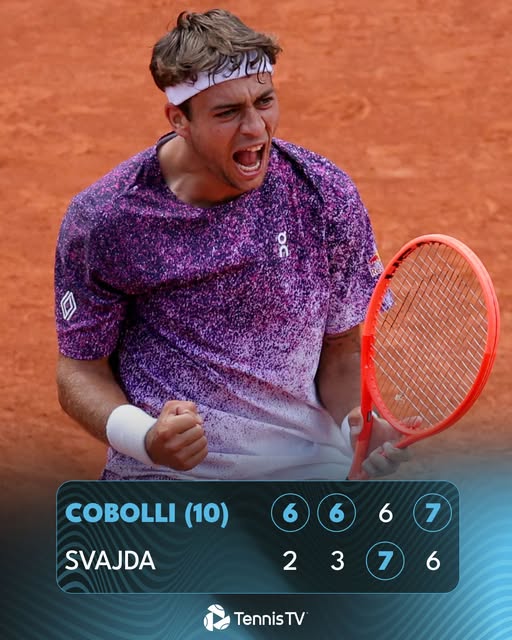
Paris – The day on the Parisian clay began under grey skies, but it was Flavio Cobolli who brought the early morning sunshine to the Italian contingent at Court Philippe-Chatrier. At precisely 11:00 AM local time on the opening day of the second week, the 24-year-old Roman walked onto the sport's most historic terre battue. By the time he walked off, three hours and 19 minutes later, he had carved his name into the tournament's history books. In a match that oscillated between meticulous control and high-stakes chaos, the 10th seed dispatched American Zachary Svajda 6-2, 6-3, 6-7(3), 7-6(5) to secure his place in the quarter-finals of the French Open.
[image: COBOLLI-SVAJDA.jpg]
For Cobolli, this result is a significant landmark. While this marks his second career Grand Slam quarter-final (following a run at Wimbledon in 2025 where he was stopped by Novak Djokovic), it is his first trip to the last eight at Roland-Garros. For Svajda, the world No. 85, the tournament ends in heartbreak, but the 23-year-old American proved to everyone watching in the French capital that his name belongs in the conversation regarding the future of U.S. men's tennis.
The Calm Before the Storm: Cobolli's Flawless Start
The narrative heading into the encounter suggested a mismatch of experience on the red dirt. While Cobolli has evolved into a genuine clay-court specialist, Svajda entered this Grand Slam with just one solitary tour-level victory on the surface to his name. For the first hour and twenty minutes of play on Court Philippe-Chatrier, that statistic seemed painfully prescient.
Cobolli wasted no time establishing his tactical superiority. Playing with the self-assuredness of a man who knows he belongs in the inner sanctum of the top 10, the Italian employed a masterclass in aggressive consistency. Unlike his previous outing against Learner Tien—another promising American—Cobolli did not wait to find his rhythm. He created it instantly.
The first set was decided in a brisk 40 minutes. Cobolli's strategy was clear: target the Svajda backhand with heavy, loopy topspin to push the Californian deep behind the baseline, then step inside the court to unleash the forehand. The approach worked to perfection. Break points were converted with cold efficiency—one at 30 in the third game and another at advantage in the seventh. Moving Svajda like a chess piece across the clay, Cobolli pocketed the first set 6-2 with the look of a man who had merely completed a light practice session.
The second set followed a similar script, though Svajda showed glimmers of the fighting spirit that would later define the match. The American attempted to disrupt Cobolli’s rhythm by shortening the points, taking the ball earlier off the bounce. For a brief moment, it caused the Italian to hesitate. At the start of the second set, Cobolli missed two break points in a row and then had to dig deep to cancel three break points against him in a laborious fourth game.
However, the adversity seemed to sharpen Cobolli's focus. He tightened his shot selection and found another gear. The Italian secured a decisive break at 15 in the seventh game, breaking Svajda’s serve with a stunning inside-out forehand that caught the line. As if to send a message, he broke again in the 10th game to love, closing the second set 6-3 with a clinical display of shot-making. At that moment, with the scoreboard reading two sets to love and the clock showing less than 90 minutes of play, it looked like a very early lunch break for the Roman.
The Svajda Resurrection: A Trap is Sprung
To his credit, Zachary Svajda refused to read the script. Down two sets, playing a top-10 seed on the most intimidating court in clay-court tennis, the American did what the best American competitors do: he fought.
"It is difficult when you are playing that well and a player of his quality suddenly starts painting the lines," an admirer of Svajda's grit would later comment. Cobolli had not dropped a set all tournament. By the third set, Svajda became the first player to break that streak. The momentum shifted dramatically when Cobolli lost his serve at love in the opening game of the third set. It was a rare mental lapse—a momentary dip in intensity that the Italian would later pay a steep price for.
However, Cobolli's mental fortitude has grown significantly over the last 12 months. He broke right back in the very next game. The set settled into a tense rhythm of holds until the tiebreak. In that breaker, the energy changed. The lively Parisian crowd, which had been firmly behind their adopted Italian hero, suddenly found themselves appreciating the artistry of the underdog. Svajda played the tiebreak of his life. Relentless in his aggression, he kept the pressure on Cobolli’s forehand wing, forcing the Italian into rushed errors. The American stormed through the breaker 7-3, roaring with a mixture of relief and adrenaline as he pulled one set back.
The Chatrier crowd rose to applaud, sensing that what was once a procession had now become a legitimate contest.
The Emotional Rollercoaster of the Fourth Set
If the third set was a surprise, the fourth set was a full-blown cardiac event. The collapse of the Italian wall seemed to be materializing in real-time. The momentum swing was so severe that Cobolli appeared tight. After playing free-flowing tennis for two hours, he began to feel the weight of the occasion. This was his chance at a home Slam (metaphorically, given his massive Italian following in Paris), and he was letting it slip.
Yet, what happened next is why Flavio Cobolli is now considered among the elite of the ATP. Rather than folding under the pressure of the American's resurrection, Cobolli responded like a true top-10 competitor. He summoned something deep—perhaps the memory of his Davis Cup heroics or his ATP 500 title in Hamburg—and tore through the start of the fourth set.
Svajda, perhaps exhausted from the effort of the tiebreak or buoyed by overconfidence, hit a wall. The American’s level dropped off a cliff, and Cobolli was merciless. In a stunning blitz, the Italian won four games in a row. He secured breaks in the first and third games of the set, racing to a 4-0 lead. Shortly after, he pushed it to 5-1. The finish line was in view; the quarter-final spot seemed a foregone conclusion.
But tennis has a cruel sense of humor. With Cobolli serving for the match at 5-1, the ghosts of nearly letting a two-set lead vanish earlier appeared to haunt him. Overthinking his shots, he tightened up. Svajda, smelling blood despite the deficit, broke back. Then he held serve. Suddenly, the unthinkable happened: Cobolli was broken again. The scoreboard read 5-5. The American, who had been dead and buried 20 minutes prior, was now just two games away from forcing a fifth set.
"I started thinking too much about the result and stopped playing my game," Cobolli would reflect on the mental hiccup.
Clutch Gene Activated: The Winning Weapon
Down 5-6 and facing a break point that would have given Svajda the chance to serve for the set, Cobolli finally found his reset button. Standing at 30-40 on his own serve, the Italian didn't play safe. He couldn't afford to. He unleashed his greatest weapon—his sliding, cross-court forehand. It was a shot that stretched Svajda so far wide that the American could only get a frame on the ball, sending it high into the Parisian sky for an easy overhead putaway by Cobolli.
That was the turning point. After canceling two match points in that game, Cobolli held his nerve to push the set to 6-6.
The super-tiebreak was an exercise in pure power. While Svajda had relied on grit and scrappy retrieval to get back into the match, Cobolli decided to end it with brute force. He hammered two clean forehand winners down the line that left the American statue-still. Relying on his superior first-serve percentage—a statistic that had dipped during his mid-match crisis but returned in the clutch—Cobolli built a lead he would not relinquish. He closed out the tiebreak 7-5, collapsing onto the clay in a mixture of exhaustion and overwhelming joy.
Weapons Analysis: Why Cobolli is Built for the Clay
Analyzing the victory, it becomes clear that Cobolli possesses a unique toolkit specifically designed for the grinding conditions of Roland-Garros.
-
The "Roman Forehand" (The Crowbar): Cobolli's forehand is not just a shot; it is a mechanism of attrition. He generates massive racquet-head speed that allows him to hit acute angles from defensive positions. Against Svajda, this was his primary weapon. When he was down 5-6 in the fourth set, he didn't push; he ripped the forehand. That ability to turn defense into instant offense is what separates the quarter-finalists from the pretenders.
-
The Sliding Backhand Slice: While Cobolli possesses a solid double-handed backhand, his tactical use of the slice on the clay was the unsung hero of the match. He utilized the slice to reset rallies when Svajda was on the attack, buying himself precious milliseconds to recover his court positioning.
-
Counter-Punching Transition: Cobolli has evolved from a pure baseliner into a player who actively seeks to transition to the net at the right moment. Several times in the critical fourth-set tiebreak, he approached the net off a deep approach shot, forcing Svajda to attempt low-percentage passing shots that ultimately sailed long.
The Ranking Rewards: Into the Top 10 Hunt
The immediate aftermath of this victory is not just emotional; it is mathematical. The 2640 ranking points earned by reaching the quarter-final are a hefty addition to the Italian's bank account. While the official ATP rankings will re-calibrate on Monday, the trajectory is clear: Flavio Cobolli has broken into the top 11 of the world rankings, leapfrogging crucial rivals.
More importantly, the door is now ajar for the Top 10. Should Cobolli win his quarter-final match—against either fourth-seeded Felix Auger-Aliassime or Alejandro Tabilo—he will break into the exclusive Top 10 club for the first time in his career. This is a staggering rise for a player who started the 2025 season with zero wins in his first seven matches.
"You don't play for the ranking," Cobolli said in his on-court interview, dripping with sweat. "You play for the trophies and the history of this sport. But when I was struggling two years ago, I never thought I would be this close to the Top 10 at a Slam. It is a beautiful feeling."
The Voice of ATP USA: American Tennis Still on the Rise
While the headline is Italian glory, the story of Zachary Svajda demands respect from the ATP's U.S. contingent. The United States came into this tournament with high hopes, led by the likes of Taylor Fritz and Frances Tiafoe, but also with a new generation of hungry guns. Svajda was not supposed to be here. He is not a household name in the United States compared to the established stars, but his performance in Paris changes that perception.
"I gave it everything I had," Svajda said in a subdued press conference. "Flavio was the better player today, but I proved I can hang with the best on the biggest stage. I am leaving Paris with my head held high."
Svajda’s run solidifies the depth of the American male contingent. With the emergence of Learner Tien—who pushed Cobolli hard in the previous round—and the continued development of Alex Michelsen, the U.S. is no longer reliant on a single star. The American style of play—powerful serves and flat groundstrokes—is often considered a liability on the slow Parisian clay. Yet Svajda adapted. He learned to construct points, to use the drop shot effectively, and to slide defensively in a way he rarely does on the hard courts of the U.S. Summer Swing.
For a nation that has not seen a men’s champion at Roland-Garros since Andre Agassi in 1999, Svajda’s performance offers a beacon of hope.
A Wide-Open Draw: The Italian Opportunity
The elimination of Jannik Sinner and Novak Djokovic earlier in the week blew the men's draw wide open. While Sinner’s absence is a blow to Italian tennis in terms of star power, it has opened a wide boulevard for Flavio Cobolli.
"You feel it in the locker room. The strongest guys are gone. Everyone is looking at the board and thinking, 'Why not me?'" Cobolli admitted earlier in the week.
He is the highest-ranked Italian left in the draw. The pressure of an entire nation is shifting from the absent Sinner to the robust shoulders of the 24-year-old Roman. He has handled the pressure of the Davis Cup. He has won ATP 500 trophies. But a Grand Slam final? The stats say it is not impossible. In a year where teenagers like Joao Fonseca are taking out legends, the age of the gatekeepers has shifted.
Looking Ahead: The Felix Auger-Aliassime Factor (or Tabilo)
Cobolli will now await the winner of the evening match between Canada’s Felix Auger-Aliassime (the No. 4 seed) and Chile’s Alejandro Tabilo. On paper, Auger-Aliassime represents the biggest physical test left in the bracket. The Canadian possesses a monstrous serve and athleticism that surpasses most of the tour.
However, if there is a kryptonite for Auger-Aliassime, it is prolonged consistency on clay. Cobolli will enter that potential quarter-final as the underdog, but he will do so with a massive advantage: he has spent less time on court than the Canadian, and his game is tailor-made for the surface. Tabilo, the Chilean lefty, is a "lighter" threat but a dangerous one, known for causing upsets against top seeds.
"I don't care who wins," Cobolli shrugged. "My fitness is good. My game is there. I am ready for the Final 8."
A Career Milestone
For those watching the scoreboard tick over on Court Philippe-Chatrier on Monday morning, they witnessed the maturation of a player. Cobolli didn't just beat Svajda; he survived him. That is the difference between a tour-level talent and a Grand Slam contender. Talent wins sets in the sunshine; grit wins tiebreaks in the rain.
Flavio Cobolli is now, unquestionably, the captain of the Italian ship at Roland-Garros 2026. He carries with him the hope of a tennis-mad nation, the coaching wisdom of his father Stefano, and the weaponry to hurt anyone in the draw. With his first Paris quarter-final secured, the road to a maiden Grand Slam title is the shortest it has ever been. The "Final 8" is set, and the Roman is ready to conquer.
*Flavio Cobolli advances to the quarter-finals at Roland-Garros for the first time, beating Zachary Svajda 6-2, 6-3, 6-7(3), 7-6(5). Next up: the winner of Felix Auger-Aliassime vs. Alejandro Tabilo