
An ATP Tour Expert Analysis of Tennis Conditioning, Match Management, Mental Toughness, and Environmental Adaptation
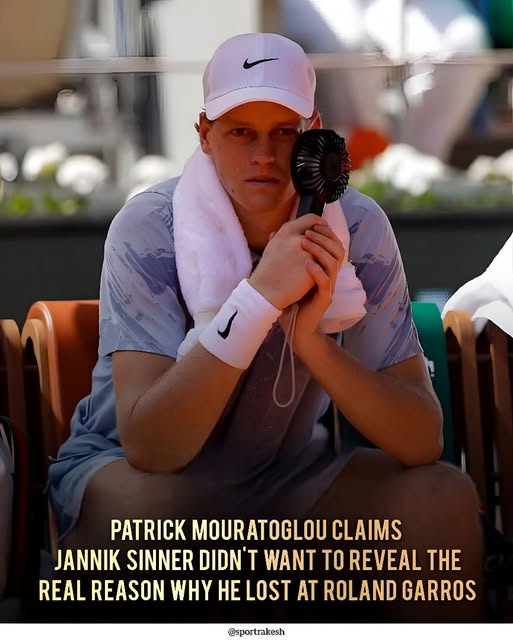
The image circulating online suggests that coach Patrick Mouratoglou believes Jannik Sinner may not have revealed the full reason behind his Roland Garros defeat. Whether or not that specific claim is accurate, it opens an interesting discussion about a topic that receives less attention than forehands, serves, and rankings: climate adaptation.
There is little debate that Jannik Sinner is one of the best players in the world and has earned his place among the elite. His baseline power, movement, tactical intelligence, and competitive spirit have transformed him into a Grand Slam champion and ATP No. 1 contender.
However, even the greatest players have vulnerabilities.
For Rafael Nadal, it was occasionally indoor conditions against peak power hitters.
For Novak Djokovic, it was sometimes handling extremely aggressive first-strike tennis.
For Roger Federer, it could be high-bouncing clay during certain periods of his career.
For Sinner, one area that deserves discussion is how his body responds during long tournaments played in extreme heat and physically draining conditions.
This is not a criticism of his talent.
It is a recognition that modern tennis is increasingly becoming a battle against the environment as much as against opponents.
The Myth of Being Number One
Many fans believe the No. 1 player should dominate every condition.
History says otherwise.
The ATP Tour is played across:
- Dry desert heat
- Humid summer conditions
- Indoor arenas
- High altitude locations
- Windy outdoor venues
- Slow clay courts
- Fast hard courts
Being No. 1 means being the most complete player overall.
It does not mean being unbeatable everywhere.
Even the greatest champions have preferred environments.
The question is not whether Sinner can win.
The question is:
Can he maintain peak physical performance through seven consecutive best-of-five-set matches in brutal conditions?
That is where climate adaptation becomes important.
Roland Garros Is More Demanding Than Fans Realize
Many casual fans think clay courts are simply slower.
That is only part of the story.
Clay creates:
- Longer rallies
- More sliding
- More directional changes
- Higher energy expenditure
- Longer match duration
Every point becomes more expensive physically.
A three-hour match on clay can feel like a four-hour match on hard courts.
When temperatures rise above 30°C (86°F), the challenge increases dramatically.
Players lose:
- Water
- Electrolytes
- Glycogen stores
- Mental sharpness
The body begins fighting for survival while also trying to execute elite-level tennis.
The Hidden Cost of Early-Round Dominance
Many fans focus only on winning.
Elite coaches focus on energy conservation.
This is a major difference.
Imagine two players reaching the third round.
Player A wins:
- 6-3, 6-3, 6-3
- 6-2, 6-4, 6-2
Player B wins:
- 7-6, 6-7, 7-6, 6-4
- 4-6, 7-5, 6-4, 7-5
Both advance.
However, Player B may have spent several extra hours on court.
Over a Grand Slam, those hours accumulate.
The body remembers every sprint.
The muscles remember every slide.
The nervous system remembers every stress response.
By the third or fourth match, accumulated fatigue often becomes visible.
Tennis Conditioning Is More Than Fitness
Many people mistakenly believe conditioning means running.
Professional tennis conditioning is far more complex.
It involves:
Aerobic Capacity
Ability to recover between points.
Anaerobic Capacity
Ability to explode repeatedly.
Muscular Endurance
Maintaining power after hours of competition.
Heat Tolerance
Maintaining performance despite rising body temperature.
Recovery Efficiency
Preparing for the next match.
A player may be incredibly fit yet still struggle when body temperature rises beyond optimal levels.
This distinction matters.
Why Heat Changes Everything
Extreme heat creates a chain reaction.
The body redirects blood toward cooling mechanisms.
As a result:
- Muscles receive less oxygen
- Decision-making slows
- Reaction speed declines
- Footwork becomes heavier
The player feels mentally present but physically delayed.
Even a delay of 0.1 seconds can determine a rally.
At ATP level, that difference is enormous.
The Third-Match Syndrome
Many coaches discuss what can be called the "third-match syndrome."
A player survives two demanding rounds.
The body appears healthy.
Then suddenly in Round 3 or Round 4:
- Energy crashes
- Legs become heavy
- Recovery slows
The issue is rarely that day's opponent.
The issue is cumulative fatigue.
Grand Slams are marathons disguised as tennis tournaments.
Why Sinner's Style Can Become Physically Expensive
Sinner plays aggressive baseline tennis.
His game relies on:
- Early ball striking
- High intensity
- Constant pressure
- Explosive movement
This style wins matches.
But it also consumes energy.
Compare this with players who:
- Slice more
- Shorten points
- Serve-and-volley occasionally
- Change pace frequently
Those styles sometimes conserve energy.
Sinner's approach demands repeated explosive efforts.
Over two weeks, that can become costly.
The Mental Impact of Physical Fatigue
Physical fatigue creates mental fatigue.
This is where matches are truly lost.
When exhaustion rises:
- Shot selection worsens
- Tactical discipline disappears
- Emotional control weakens
The player knows the correct play.
The body simply cannot execute it consistently.
Many fans mistake this for choking.
It is often fatigue.
ATP Expert View: Climate Management Is a Skill
Modern ATP coaches increasingly view climate adaptation as a trainable skill.
Players now prepare using:
- Heat chambers
- Altitude simulation
- Hydration tracking
- Sweat-rate analysis
- Core temperature monitoring
The sport has evolved.
Winning is no longer only about strokes.
Winning is also about physiology.
Comparing Sinner to Historical Greats
Rafael Nadal
Nadal excelled in heat.
His physical preparation became legendary.
He embraced suffering.
His conditioning allowed him to extend rallies until opponents collapsed.
Novak Djokovic
Djokovic developed extraordinary recovery systems.
His flexibility and breathing efficiency helped him maintain energy deep into matches.
Roger Federer
Federer conserved energy better than almost anyone.
His smooth movement reduced physical waste.
He often appeared fresher because he used less energy.
Jannik Sinner
Sinner possesses elite physical tools.
However, continued development in environmental adaptation may determine how many major titles he ultimately wins.
The Importance of Recovery Between Matches
Grand Slam success depends heavily on recovery.
Elite recovery includes:
Sleep Quality
The most powerful recovery tool.
Hydration
Replacing fluid losses.
Nutrition
Restoring glycogen stores.
Cold Therapy
Reducing inflammation.
Mobility Work
Maintaining movement efficiency.
Mental Recovery
Reducing emotional stress.
Champions recover faster than everyone else.
What Happens When Heat Exposure Is Mismanaged
The consequences can include:
- Reduced endurance
- Cramping risk
- Slower movement
- Poor concentration
- Tactical errors
Fans often see only the final score.
The underlying physiological battle remains invisible.
Could Climate Adjustment Become Sinner's Next Evolution?
Absolutely.
Champions evolve.
Djokovic evolved.
Nadal evolved.
Federer evolved.
Sinner is still relatively early in his championship journey.
The next step may not involve a bigger forehand.
It may involve becoming more efficient under extreme environmental stress.
That evolution could include:
- Improved hydration strategies
- More aggressive point shortening
- Better energy conservation
- Enhanced heat adaptation training
The Mental Side of Environmental Stress
Heat affects psychology.
Players become:
- Irritable
- Frustrated
- Impatient
Discipline becomes harder.
The greatest champions maintain clarity despite discomfort.
This mental resilience separates contenders from legends.
The question becomes:
Can you continue making championship decisions when your body wants to stop?
That is the true test.
Lessons from Historic Grand Slam Upsets
Many shocking defeats follow a similar pattern.
The favorite:
- Wins comfortably early.
- Accumulates hidden fatigue.
- Faces a physically demanding opponent.
- Experiences a performance drop.
Fans blame tactics.
Coaches often blame recovery.
The truth is usually somewhere in between.
Why Tennis Is Becoming More Physical Every Year
Modern rackets and strings allow players to hit harder than ever.
As a result:
- Rallies are faster
- Court coverage demands increase
- Recovery becomes more important
Athleticism now influences outcomes more than ever before.
The ATP Tour has become a test of complete athletic performance.
The Difference Between Fitness and Durability
Fitness helps you win today's match.
Durability helps you survive two weeks.
Grand Slam champions require both.
This distinction is critical.
Many players are fit.
Few are durable enough to win seven best-of-five matches.
What Sinner Must Continue Improving
From a coaching perspective, several areas remain important:
Energy Conservation
Winning points with less effort.
Tactical Variety
Reducing physical expenditure.
Environmental Adaptation
Preparing specifically for heat.
Recovery Optimization
Maximizing between-match regeneration.
Mental Endurance
Remaining calm when fatigue appears.
These are small improvements.
At ATP level, small improvements create major results.
Why One Loss Does Not Define a Champion
Every great champion has suffered painful defeats.
Nadal lost.
Federer lost.
Djokovic lost.
Those defeats became lessons.
A single tournament loss should not be viewed as failure.
Instead, it becomes information.
Champions use losses as data.
The best players ask:
- What happened?
- Why happened?
- How do we prevent it next time?
That process creates future titles.
Final ATP Expert Assessment
Jannik Sinner remains one of the most complete players in professional tennis and deserves his status among the sport's elite. However, being the best player in the rankings does not eliminate every weakness. One area worthy of continued development is performance management under extreme heat and physically exhausting tournament conditions.
Whether a defeat stems from tactics, physical fatigue, environmental stress, or a combination of all three, modern tennis increasingly rewards players who can adapt to every climate and every challenge.
The future of Sinner's career may not be determined by how hard he hits the ball.
It may be determined by how efficiently he manages energy, recovers between matches, and adapts to the harshest conditions on the ATP Tour.
If he succeeds in that evolution, he has every opportunity to add multiple Grand Slam titles and further establish himself among the great champions of the modern era.
The history of tennis shows that elite players become legends not because they have no weaknesses, but because they identify those weaknesses and transform them into strengths. Jannik Sinner's next chapter may very well be written through that process of adaptation, resilience, and continual improvement.