
ATP USA Expert Analysis
Grand Slam tennis has a unique way of revealing a player's true character.
During the early stages of a match, talent often dominates.
Power matters.
Technique matters.
Athleticism matters.
But when a match extends deep into a fifth set, when both players have already invested hours of physical and emotional energy, the contest transforms into something entirely different.
It becomes a battle of endurance.
A battle of decision-making.
A battle of courage.
Most importantly, it becomes a battle of who can execute under pressure when every point feels like a championship point.
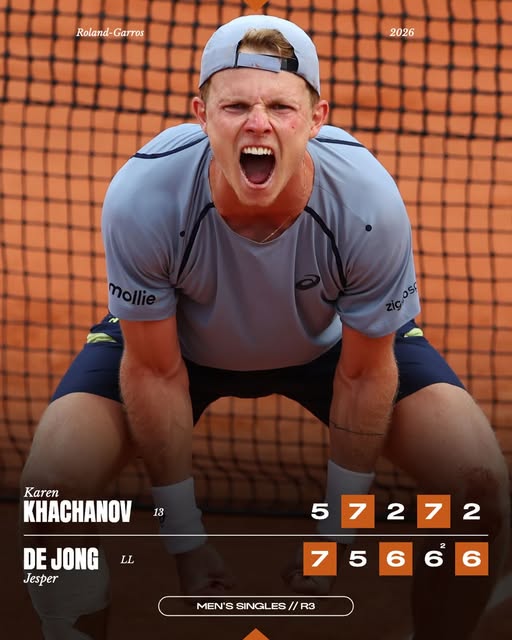
That was the story of Jesper de Jong's remarkable five-set victory over Karen Khachanov at Roland Garros.
The final score reflected an intense struggle that swung repeatedly between two competitors with very different styles, strengths, and tactical approaches.
For ATP analysts in the United States, this match represented one of the most fascinating examples of how mental resilience and endgame execution can overcome experience and power.
The statistics tell part of the story.
The tactical battle tells another.
But the true story lies in how Jesper de Jong handled the most important moments of the match.
Two Completely Different Tennis Philosophies
One reason the contest was so intriguing is because the players approached tennis from different perspectives.
Karen Khachanov
Khachanov's game is built around:
- Power
- Aggression
- First-strike tennis
- Heavy serving
- Physical strength
When Khachanov controls a match, opponents often feel overwhelmed.
The Russian prefers shorter points.
He likes dictating rallies.
He wants opponents reacting rather than attacking.
Jesper de Jong
De Jong's style is different.
His strengths include:
- Movement
- Court coverage
- Patience
- Tactical flexibility
- Endurance
Rather than overpowering opponents, he often outlasts them.
He gradually creates pressure through consistency.
This contrast created a fascinating clash of styles.
The Opening Set: De Jong Sends a Message
Many expected Khachanov's experience to dominate early.
Instead, De Jong immediately established belief.
His movement was sharp.
His footwork was clean.
His energy was exceptional.
Most importantly, he showed no fear.
Young players often struggle against established names because they respect them too much.
De Jong did not appear intimidated.
He played aggressively when opportunities appeared and remained disciplined when rallies extended.
This approach helped him secure the opening set.
From an ATP perspective, the significance was enormous.
The underdog suddenly believed.
ATP USA View: Confidence Changes Match Dynamics
Professional tennis is heavily influenced by confidence.
Confidence impacts:
- Shot selection
- Movement
- Decision-making
- Risk tolerance
Once De Jong captured the first set, the emotional landscape changed.
Suddenly Khachanov became the player facing pressure.
Suddenly expectations shifted.
These psychological changes often influence the remainder of the match.
Khachanov's Response
Elite players rarely surrender.
Khachanov responded exactly as a top professional should.
His aggression increased.
His serve became more effective.
His forehand began producing greater penetration.
He started attacking second serves.
He moved closer to the baseline.
The adjustments worked.
The Russian regained momentum.
This is where experience became visible.
Rather than panicking, Khachanov trusted his strengths.
He understood that over five sets, momentum would naturally fluctuate.
Strength Comparison
To understand why the match unfolded the way it did, it is important to compare the strengths of each competitor.
Serve Advantage
Karen Khachanov
The serve remains one of Khachanov's biggest weapons.
Strengths include:
- Pace
- Height advantage
- Easy service holds
- First-strike opportunities
When serving effectively, he can shorten points dramatically.
Jesper de Jong
De Jong's serve is solid but not overwhelming.
His strengths are:
- Placement
- Variety
- Consistency
However, pure power clearly favors Khachanov.
Edge: Khachanov
Baseline Power
Khachanov
The Russian possesses superior raw power.
His forehand can instantly change rallies.
His backhand remains reliable under pressure.
De Jong
The Dutch player relies more on placement and consistency.
He wins points through construction rather than brute force.
Edge: Khachanov
Movement and Court Coverage
This category strongly favored De Jong.
De Jong
His movement was exceptional.
Key strengths:
- Recovery speed
- Defensive range
- Sliding ability
- Balance
Khachanov
Khachanov moves well for his size but cannot match De Jong's agility.
Edge: De Jong
Stamina Battle
Five-set matches often become physical wars.
This was no exception.
As the contest progressed, stamina became increasingly important.
Khachanov's Physical Challenge
Power tennis consumes energy.
Every explosive forehand requires effort.
Every aggressive movement increases fatigue.
As rallies lengthened, Khachanov's energy expenditure grew.
This is not a criticism.
It is simply the reality of his playing style.
De Jong's Physical Advantage
The Dutchman appeared remarkably comfortable during extended exchanges.
His movement remained efficient.
His recovery between points looked strong.
His energy levels remained stable.
This consistency became a decisive factor.
Why Endgame Tennis Matters
Many matches are not decided at 1-1.
They are not decided at 3-3.
They are decided at:
- 5-5
- 6-5
- Tiebreaks
- Break points
These moments define careers.
ATP coaches frequently discuss the concept of "endgame tennis."
This refers to performance when pressure reaches its highest level.
The player who executes better late often wins.
Endgame Comparison
Karen Khachanov
Strengths:
- Experience
- Big-match exposure
- Aggressive instincts
Weaknesses:
- Occasionally forces shots under pressure
- Can become impatient
Jesper de Jong
Strengths:
- Calmness
- Point construction
- Patience
Weaknesses:
- Less major-match experience
Surprisingly, De Jong handled the endgame moments better.
That became the difference.
Mental Adjustments Throughout the Match
The best players continuously adapt.
Several important adjustments stood out.
De Jong's Adjustments
Extended Rallies
He deliberately lengthened points.
This increased physical pressure on Khachanov.
Better Depth
His groundstrokes landed deeper as the match progressed.
Improved Court Position
He became more aggressive without becoming reckless.
Khachanov's Adjustments
Increased Aggression
The Russian attempted to shorten rallies.
Earlier Ball Striking
He moved forward more frequently.
Serve Variations
He adjusted serve placement effectively.
Both players adapted well.
However, De Jong's adjustments proved slightly more sustainable.
Pressure Points Define Champions
Several critical moments changed the match.
Break Point Opportunities
De Jong consistently remained composed.
His body language never appeared rushed.
This calmness helped him convert important opportunities.
Service Games Under Pressure
Khachanov faced increasing pressure late.
Holding serve became more difficult.
The cumulative effect of long rallies started to appear.
Fifth-Set Decisions
The final set showcased remarkable maturity from De Jong.
Rather than chasing winners, he trusted the process.
This patience ultimately paid off.
ATP USA Expert Analysis of the Mental Game
The mental aspect may have been the most impressive feature of De Jong's performance.
Several characteristics stood out:
Emotional Stability
He rarely showed frustration.
Positive Body Language
Confidence remained visible.
Commitment to Strategy
He stayed disciplined.
Resilience
He responded well after setbacks.
These traits are often associated with future breakthroughs.
Stroke Analysis
De Jong's Forehand
The forehand performed multiple functions:
- Rally construction
- Defensive recovery
- Offensive opportunities
Its versatility became important.
De Jong's Backhand
Reliable and consistent.
The shot allowed him to absorb pressure and redirect rallies effectively.
Khachanov's Forehand
Arguably the most explosive shot on the court.
When timed correctly, it produced immediate damage.
However, maintaining that level over five sets is difficult.
Khachanov's Backhand
Solid and dependable.
It helped him remain competitive throughout the match.
The Importance of Patience
One lesson from this match is simple:
Patience wins on clay.
Roland Garros rewards players who accept long rallies.
De Jong embraced this reality.
Khachanov often attempted to accelerate points.
Neither strategy is wrong.
On this day, patience proved slightly more effective.
What This Victory Means for De Jong
The significance extends beyond one match.
Victories like this create:
- Confidence
- Experience
- Ranking opportunities
- Belief
Perhaps most importantly, they demonstrate that a player belongs at this level.
That realization can transform careers.
ATP USA Assessment
From an American ATP analyst perspective, several conclusions emerge:
Khachanov's Strengths
- Greater power
- Better serve
- More experience
- Strong baseline weapons
Khachanov's Weaknesses
- Higher energy expenditure
- Occasional impatience
- Difficulty sustaining aggression over very long matches
De Jong's Strengths
- Superior movement
- Better stamina
- Excellent composure
- Tactical discipline
De Jong's Weaknesses
- Less raw power
- Fewer free points on serve
- Less major-match experience
On this occasion, the strengths that matter most in five-set clay-court tennis prevailed.
Final Thoughts
Jesper de Jong's victory over Karen Khachanov was a masterclass in endurance, mental resilience, and endgame execution. While Khachanov brought superior power, serving strength, and experience, De Jong countered with movement, patience, tactical intelligence, and remarkable composure under pressure.
The match demonstrated an important truth about Grand Slam tennis: talent alone is rarely enough. Success often belongs to the player who manages pressure more effectively, adapts more intelligently, and remains physically strong when fatigue begins influencing decision-making.
From an ATP USA expert perspective, the most impressive aspect of De Jong's performance was not a single winner or spectacular rally. It was his ability to stay committed to the right strategy during the most important moments of the match.
When the pressure peaked, when the fifth set arrived, and when every point carried enormous weight, Jesper de Jong trusted his preparation, trusted his stamina, and trusted his game.
That trust ultimately earned him one of the biggest victories of his career and provided another reminder that in Grand Slam tennis, the endgame often determines everything.