Tennis Rankings Analysis | Player Performance | Tactical Adjustments | Mental Game | Future Predictions
In professional tennis, reaching World No. 1 is an extraordinary achievement. But staying there is an entirely different challenge.
Every season brings new champions, unexpected defeats, rising talents and established players fighting to protect their positions. One successful tournament can push a player several places higher, while one disappointing stretch can put months of hard work at risk.
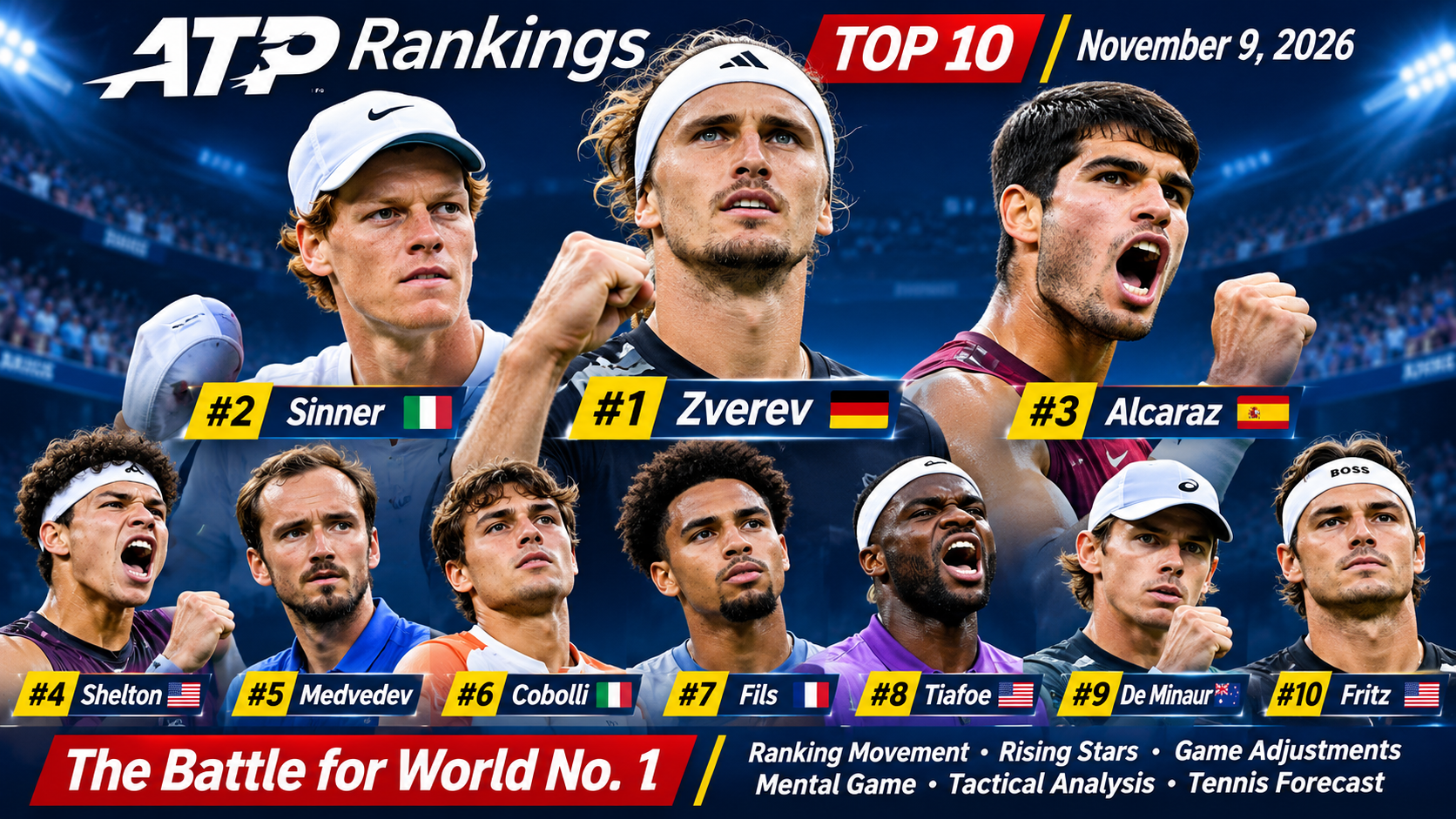
The November 9, 2026 ATP rankings present an interesting picture: Alexander Zverev occupies the No. 1 position, Jannik Sinner is close behind at No. 2, and Carlos Alcaraz remains in third place.
Meanwhile, players such as Ben Shelton, Flavio Cobolli and Arthur Fils represent an increasingly competitive generation challenging the established hierarchy.
The biggest question is not simply who is ranked first today.
Who has the consistency, adaptability, tactical intelligence and mental strength to remain among the world's best players?
1. The November 2026 ATP Top 10: Who Controls the Rankings?
Ranking snapshot: November 9, 2026
Rank
Player
Country
Ranking points
1
Alexander Zverev
Germany
9,550
2
Jannik Sinner
Italy
9,450
3
Carlos Alcaraz
Spain
7,100
4
Ben Shelton
USA
5,170
5
Daniil Medvedev
—
3,820
6
Flavio Cobolli
Italy
3,680
7
Arthur Fils
France
3,625
8
Frances Tiafoe
USA
3,390
9
Alex de Minaur
Australia
3,370
10
Taylor Fritz
USA
3,285
Source: November 9 ranking snapshot.
Tennis Tension Lab+1
The No. 1 battle: Zverev versus Sinner
The difference between Zverev and Sinner is only 100 ranking points.
This is an extremely interesting situation because the top position is not protected by a comfortable advantage.
Alexander Zverev – The consistency challenger
Zverev's strengths include:
- Powerful first serve.
- Excellent two-handed backhand.
- Strong baseline positioning.
- Ability to construct points patiently.
- Experience competing in major finals.
His challenge is maintaining composure during the biggest moments and converting opportunities against the very best players.
Jannik Sinner – The pressure machine
Sinner's game is built around:
- Exceptional ball striking.
- Consistent depth from the baseline.
- Aggressive returns.
- Fast transitions between defense and offense.
- Relentless rally pressure.
His biggest advantage is his ability to maintain high-quality tennis throughout long matches.
Tennis forecast: The Zverev-Sinner rivalry could become one of the defining ranking battles. With only 100 points separating them, one important tournament result could change the leadership.
Carlos Alcaraz – The unpredictable threat
Alcaraz remains one of the most dangerous players on tour.
His greatest weapon is adaptability. He can change the speed of rallies, attack the net, use drop shots, defend difficult positions and create unexpected angles.
His challenge is not a lack of weapons. It is maintaining consistency and concentration throughout the season.
If Alcaraz combines his creativity with disciplined shot selection, he has the weapons to challenge both Zverev and Sinner.
2. Which Players Are Rising Fastest?
A ranking position tells us where a player stands. Ranking movement tells us what is changing.
However, there is an important distinction: a weekly ranking increase does not automatically prove a sustained upward trend.
Based on the November 9 snapshot and reported movements, here is the analysis.
Taylor Fritz – The visible top-10 climber
Fritz moved up two positions to No. 10 after his run to the Paris quarterfinals. This is the clearest confirmed upward movement among the ten players in the supplied ranking.
Tennis365
His strengths:
- Powerful first serve.
- Aggressive forehand.
- Ability to dictate baseline rallies.
- Experience against elite opponents.
His next challenge is converting strong tournament performances into consistent results across different surfaces.
Arthur Fils – The long-term player to watch
Fils at No. 7 is an exciting name in the rankings.
His aggressive approach and physical game give him considerable potential. His next development stage should focus on consistency, shot selection and tactical patience.
He must learn when to attack and when to construct the point.
Flavio Cobolli – The consistency opportunity
Cobolli's position at No. 6 demonstrates his ability to compete among the elite.
His challenge is to maintain this level against established top players. Improving serve reliability, return positioning and decision-making under pressure can help him protect his ranking.
Ben Shelton – The potential ranking disruptor
Shelton's powerful serve and left-handed attacking game make him difficult to face.
His next step is developing greater control during extended rallies and improving his ability to defend against opponents who neutralize his first strike.
Important distinction: Fritz's +2 is a documented weekly rise. The positions of Fils, Cobolli and Shelton indicate their current standing, not proof that they are all rising week after week.
3. Player-by-Player Tactical and Mental Analysis
No. 1 – Alexander Zverev
Game identity: Controlled aggression and baseline power.
- Tactical priority: Maintain depth and control the center of the court.
- Mental priority: Remain composed during critical points.
- Development opportunity: Improve attacking confidence when opportunities appear.
Forecast: A serious contender to defend the No. 1 position.
No. 2 – Jannik Sinner
Game identity: Relentless baseline pressure.
- Tactical priority: Dominate return games.
- Mental priority: Maintain concentration throughout long rallies.
- Development opportunity: Continue developing tactical variation.
Forecast: One of the strongest candidates to reclaim No. 1.
No. 3 – Carlos Alcaraz
Game identity: Creativity, speed and all-court tennis.
- Tactical priority: Use changes of pace and court positioning.
- Mental priority: Avoid unnecessary risks.
- Development opportunity: Combine creativity with consistency.
Forecast: A major threat to the top two.
No. 4 – Ben Shelton
Game identity: Explosive serving and aggressive left-handed tennis.
- Tactical priority: Use the serve to control the first shot.
- Mental priority: Remain patient when opponents return aggressively.
- Development opportunity: Strengthen defensive transitions.
Forecast: Capable of challenging higher-ranked players.
No. 5 – Daniil Medvedev
Game identity: Defensive intelligence and unusual court positioning.
- Tactical priority: Absorb power and redirect the ball.
- Mental priority: Stay disciplined when opponents attack.
- Development opportunity: Improve offensive transitions.
Forecast: Experience and tactical intelligence remain important advantages.
No. 6 – Flavio Cobolli
Game identity: Aggressive modern baseline tennis.
- Tactical priority: Build points with controlled aggression.
- Mental priority: Believe in his game against established champions.
- Development opportunity: Improve consistency under pressure.
Forecast: A player worth watching for further top-five challenges.
No. 7 – Arthur Fils
Game identity: Athleticism and attacking groundstrokes.
- Tactical priority: Improve shot selection and court positioning.
- Mental priority: Avoid rushing points.
- Development opportunity: Build greater consistency.
Forecast: One of the interesting younger contenders in this group.
No. 8 – Frances Tiafoe
Game identity: Athleticism, creativity and explosive shot-making.
- Tactical priority: Use variety to disrupt opponents.
- Mental priority: Maintain emotional stability.
- Development opportunity: Reduce unforced errors and improve match-to-match consistency.
Forecast: His highest potential comes when his physical energy and tactical discipline work together.
No. 9 – Alex de Minaur
Game identity: Speed, defensive coverage and counterattacking.
- Tactical priority: Turn defense into offense.
- Mental priority: Remain patient against powerful hitters.
- Development opportunity: Find more opportunities to finish points.
Forecast: A difficult opponent for anyone who depends on easy winners.
No. 10 – Taylor Fritz
Game identity: Powerful serving and aggressive baseline play.
- Tactical priority: Control the first two shots of each rally.
- Mental priority: Maintain confidence during return games.
- Development opportunity: Improve movement and defensive transitions.
Forecast: His recent two-place rise gives him momentum, but defending his top-10 position will be another challenge.
4. The Biggest Ranking Battle: Consistency Versus Momentum
There are three different types of players in the ATP Top 10.
The established elite
1–3
Zverev, Sinner and Alcaraz
These players have the ability to compete for major titles and the No. 1 position.
The dangerous challengers
4–7
Shelton, Medvedev, Cobolli and Fils
This group can disrupt the established hierarchy through strong tournament performances.
The ranking defenders
8–10
Tiafoe, De Minaur and Fritz
Their challenge is to protect their positions while continuing to collect important ranking points.
The ranking system rewards results over a rolling 52-week period. This means players must continually replace points earned at previous tournaments with new performances.
A player can win a major tournament and still face ranking pressure if they cannot reproduce previous results.
This is why consistency is such a powerful weapon.
5. The Mental Game: What Separates No. 1 From No. 10?
The difference between the world's best players is not simply technical ability.
At this level, almost everyone has an excellent serve, powerful groundstrokes and professional movement.
The difference often comes down to decision-making.
Mental strategy 1: Accept difficult moments.
A top player understands that losing a game does not mean losing the match.
Mental strategy 2: Recognize the opponent's weaknesses.
Study the opponent's second serve, backhand patterns, movement and preferred rally direction.
Mental strategy 3: Adjust during the match.
If crosscourt rallies are not working, change direction. If the opponent is dominating the baseline, consider approaching the net.
Mental strategy 4: Protect your strengths.
Do not abandon your strongest weapons simply because the opponent wins a few points.
Mental strategy 5: Maintain emotional control.
The ability to remain calm at 4-4, 30-30 can be more valuable than producing a spectacular winner at 40-0.
6. Tennis Forecast: Who Could Rise and Who Could Fall?
Editorial forecast
These are tactical assessments, not guaranteed predictions of future ranking positions.
Player
Forecast
Main reason
Sinner
No. 1 challenger
Baseline consistency
Alcaraz
No. 1 challenger
Tactical versatility
Zverev
Strong contender
Serve and experience
Shelton
Potential rise
Serving advantage
Fils
Potential rise
Athletic attacking game
Cobolli
Potential rise
Opportunity to develop consistency
Fritz
Defend top 10
Recent ranking momentum
De Minaur
Defend top 10
Exceptional movement
Medvedev
Potential recovery
Tactical experience
Tiafoe
Volatile contender
High ceiling, consistency challenge
My strongest watchlist:
- Jannik Sinner – The strongest candidate to challenge the top position.
- Carlos Alcaraz – The most versatile tactical threat.
- Ben Shelton – A dangerous opponent when his serve is working.
- Arthur Fils – An interesting player to monitor for further progress.
- Taylor Fritz – His recent ranking movement deserves attention.
For a more reliable long-term ranking forecast, monitor at least 8–12 weeks of ranking movement, tournament results, points defended and performance against top-20 opponents.
7. What Should Tennis Players Learn From the ATP Top 10?
You don't need to play like a professional to learn from professional tennis.
Whether you are a recreational player, club competitor or aspiring tournament player, these principles can improve your performance.
- Develop a reliable first serve.
- Learn to attack the opponent's second serve.
- Build consistency before increasing power.
- Understand your opponent's preferred patterns.
- Develop a reliable defensive game.
- Recognize when to change tactics.
- Train your mental discipline as seriously as your physical game.
The biggest mistake recreational players make is trying to hit winners from every position.
Professional tennis teaches us something different: construct the point, recognize the opportunity and execute at the right moment.
Final Verdict: Rankings Change, but Champions Adapt
The November 2026 ATP rankings show how competitive men's tennis has become.
Zverev is currently at the top, but Sinner is only 100 points behind. Alcaraz remains close enough to challenge the leadership, while Shelton, Cobolli and Fils represent an interesting group of players with opportunities to climb higher.
Fritz's rise to No. 10 also demonstrates how quickly a strong tournament result can influence the rankings.
But the real championship question remains:
Who can consistently perform when the pressure is highest?
A ranking measures achievement. A player's mental strength, tactical intelligence and ability to adapt determine how difficult it will be to stay there.
In tennis, reaching the top is a challenge. Staying there requires a completely different level of discipline.
The champion is not always the player who hits the hardest. It is the player who understands the game, adapts to the opponent and performs when everything is on the line.