
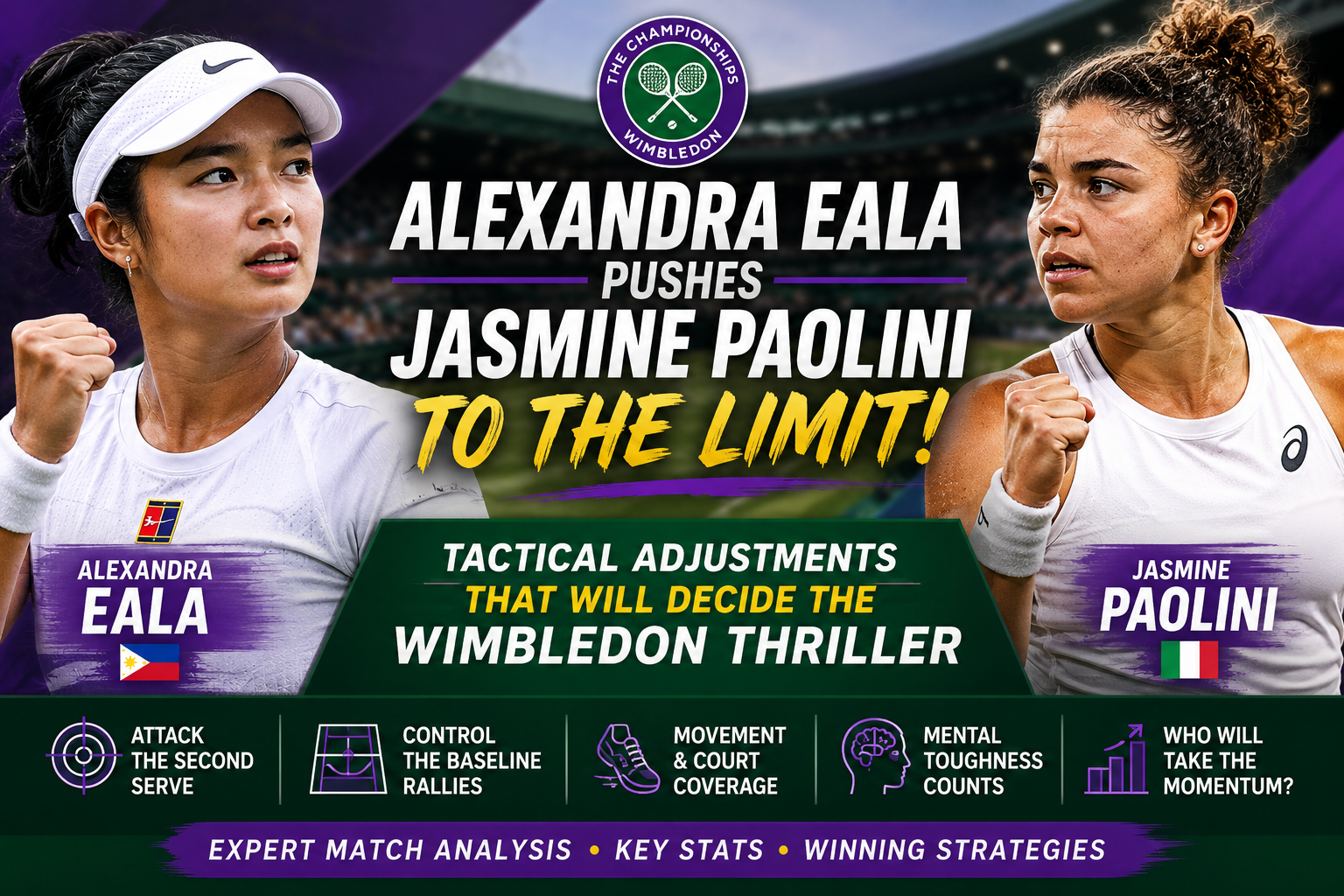
Based on your screenshot, the live score appears to be:
- Set 1: Jasmine Paolini won 6–4
- Set 2: Alexandra Eala won 6–4
- Set 3: 3–3, with Paolini leading 15–0 in the current game.
This means the match is completely open. Whoever wins the next few games will likely take control.
Tactical Analysis
Paolini's path to victory (about 60%)
Strengths
- Excellent movement on grass.
- Very consistent from the baseline.
- Rarely gives away free points.
- Strong return game on second serves.
- Comfortable absorbing pace before counterattacking.
What she needs to do
- Continue making Eala play one extra shot.
- Attack Eala's second serve.
- Extend rallies beyond 6–8 shots, where her consistency becomes a major advantage.
- Keep a high first-serve percentage to avoid pressure.
Eala's path to victory (about 40%)
Eala should not try to out-rally Paolini.
Instead she needs to:
- Attack early with her forehand.
- Use her left-handed serve wide in the ad court.
- Step inside the baseline on second-serve returns.
- Finish points within the first 4–5 shots.
- Stay aggressive even after losing a point.
When Eala dictates the rally, she can hit through Paolini. When she becomes defensive, Paolini usually gains the upper hand.
The Decisive Factor
The player who breaks serve first in this final set will gain a significant advantage.
Key moments to watch:
- 4–3: Puts pressure on the opponent.
- 5–4: Opportunity to serve for the match or force the opponent to stay alive.
- 6–5: Creates maximum scoreboard pressure.
If Eala can earn the first break, her chances of winning rise considerably because she can swing freely with the lead.
ATP Coach's Perspective
If I were coaching Eala, I would tell her:
- Attack every second serve.
- Trust your forehand and left-handed angles.
- Move forward whenever you get a short ball.
- Don't let Paolini settle into long, defensive exchanges.
- Play to win the point rather than waiting for errors.
Current Live Prediction
At 3–3 in the deciding set, I would estimate:
- Paolini: 55%
- Eala: 45%
The match is now close to a coin flip. If Eala can produce one outstanding return game or capitalize on a few second serves, she has a genuine chance to pull off the upset. The next one or two service games are likely to determine the outcome.
Based on the analytical principles of tennis match statistics, determining who has the upper hand—or who is on track to win—comes down to a few critical, high-impact metrics.
Here is a breakdown of how to analyze the game statistics shown in your match sheet to project the winner:
1. The Serving Dominance Factors
The serve dictates the rhythm of the entire match. Look at these two stats first:
-
1st Serve Points Won (%): Anything above 70% indicates dominant serving. If a player is winning a high percentage of their first serves, they are holding service games easily, placing massive mental pressure on the opponent.
-
2nd Serve Points Won (%): This is often the ultimate indicator of a player's vulnerability. If a player's second-serve win rate drops below 50%, the opponent is actively punishing their weaker serves, leading to frequent break point opportunities.
2. Break Point Efficiency (The Clutch Factor)
Matches are won and lost on a handful of critical points.
-
Break Points Converted: Look at how many opportunities a player creates and actually executes (e.g., 4/5 vs. 2/11). A player with high efficiency under pressure is mentally sharper.
-
Break Points Saved: If a player is constantly digging themselves out of a $0-40$ hole, their luck will eventually run out. The player facing fewer break points is controlling the baseline rallies.
3. The Aggression Ratio (Winners vs. Unforced Errors)
-
The Golden Rule: A positive ratio (more Winners than Unforced Errors) almost always guarantees a win.
-
If Player A has 25 Winners and 15 Unforced Errors (+10), they are dictating play cleanly.
-
If Player B has 10 Winners and 30 Unforced Errors (-20), they are beating themselves by giving away free points.
4. Total Points Won
-
In close matches, a player can actually lose more games but win more total points (or vice versa due to the tennis scoring system). However, the player who consistently wins over 52% of the total points played in a match is statistically highly favored to close out the victory.