
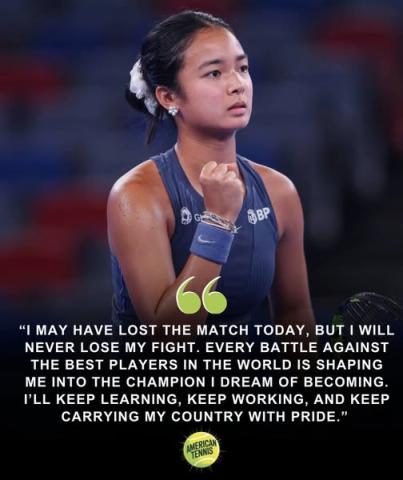
“I may have lost the match today, but I will never lose my fight spirit and soul.”
Those words from Alexandra Eala reveal the mindset of a player who understands something many young athletes never fully learn:
Elite tennis growth is not built only through victories but losse .
It is built through difficult matches against the very best players in the world.
Eala’s recent battle against the World No. 2 was more than just another result on the scoreboard. It was another educational step in her transformation from rising talent into potential elite-level contender.
From a USA expert tennis perspective, these types of matches are incredibly valuable for long-term development.
Why?
Because elite opponents expose everything:
- Technical weaknesses
- Movement inefficiencies
- tactical hesitation
- emotional reactions
- physical limitations
- decision-making under pressure
And for ambitious players like Alexandra Eala, those lessons can become fuel for rapid improvement.
The scoreboard may show a loss.
But inside the match are clues for future breakthroughs.
That is how elite players think.
Losing to the Best Can Accelerate Developmente
Young players often improve faster after difficult losses than comfortable wins.
When facing top-ranked players, every point reveals the real demands of elite tennis.
Against the World No. 2, Eala experienced:
- Faster rally speed
- Greater shot tolerance
- Better directional control
- Higher physical intensity
- More tactical discipline
- Increased mental pressure
Those experiences cannot be fully replicated in practice.
This is why top coaches in the United States often say:
“Exposure creates evolution.”
Playing elite opponents forces players to raise standards immediately.
Eala’s Mentality Is Her Biggest Weapon
The most impressive part of Eala’s response was not the defeat itself.
It was her mindset afterward.
Instead of frustration or excuses, she focused on:
- learning
- improving
- continuing the process
- carrying her country with pride
That mentality is extremely important.
Many talented players struggle emotionally after losses against top opponents.
Eala appears different.
She understands that development toward elite rankings is a long journey.
That emotional maturity is one reason many coaches believe she has legitimate Top 20 potential in the future.
The Difference Between Top 100 and Top 20
Reaching the WTA Top 20 requires a major leap in several areas.
The difference is not only power.
It includes:
- consistency under pressure
- physical endurance
- tactical adaptability
- emotional control
- point construction
- recovery speed
- mental resilience
Against elite players, small weaknesses become visible quickly.
The encouraging sign for Eala is that many of her weaknesses are highly improvable.
Game Analysis: What the Match Revealed
From a USA expert coaching perspective, the loss revealed several important areas for Eala’s future development.
1. Rally Tolerance Under Pressure
Top-ranked players sustain aggressive quality for longer periods.
Eala competed well early in exchanges, but elite opponents maintain depth and pressure deeper into rallies.
Improvement area:
- maintaining shot quality after 6–8 shots
- reducing short defensive balls
- improving physical endurance during extended exchanges
2. Defensive Recovery Speed
Against the World No. 2, court recovery becomes critical.
Elite players attack open space immediately.
Eala showed excellent effort, but recovery positioning can still improve.
This includes:
- first explosive recovery step
- balance after wide shots
- transition from defense to neutral
3. Second Serve Protection
Top players punish weaker second serves aggressively.
At elite level, second serves must:
- create discomfort
- maintain spin variation
- avoid predictable placement
Improving second-serve confidence could dramatically help Eala’s future rankings.
4. Forehand Stability Under Pressure
During difficult moments, Eala’s forehand occasionally lost depth consistency.
Top opponents recognize this immediately and increase pressure.
This is normal for developing players.
The key is repetition and confidence-building under match intensity.
The Importance of Weakside Development
Every elite player has a “weaker side.”
Champions become dangerous when that weakness improves enough to prevent opponents from targeting it repeatedly.
For Eala, continued weakside development will be crucial.
Depending on match situations, this includes:
- forehand stability under pace
- defensive backhand depth
- return consistency
- movement recovery patterns
USA high-performance coaches often focus heavily on strengthening weaker patterns because elite opponents always attack predictability.
The goal is not perfection.
The goal is reducing vulnerability.
Visualization Training: A Critical Next Step
One of the most important tools for future elite growth is visualization.
Top athletes mentally rehearse:
- pressure situations
- point construction
- recovery after mistakes
- successful patterns
- emotional control
- championship moments
Visualization helps players prepare mentally before real matches happen.
For Eala, visualization training could strengthen:
- confidence under pressure
- aggressive mindset
- tactical execution
- emotional recovery after lost points
Elite tennis increasingly depends on mental rehearsal as much as physical repetition.
Why Eala’s Fighting Spirit Matters So Much
Many players possess talent.
Far fewer possess resilience.
Resilience determines long-term success.
What separates future elite athletes is often the ability to:
- lose without losing confidence
- stay disciplined during setbacks
- continue improving patiently
- remain emotionally strong under criticism
Eala’s statement reflects exactly that type of mentality.
She is not measuring herself only by one result.
She is measuring herself by long-term growth.
That perspective is powerful.
Studying the Match: The Smart Champion Approach
After difficult losses, elite teams analyze everything carefully.
This includes:
- rally patterns
- serve locations
- return positioning
- movement efficiency
- emotional reactions
- point-ending errors
- successful patterns
The smartest players treat losses like information.
From a USA coaching perspective, Eala’s development now depends heavily on how effectively her team studies these matches.
The questions become:
- Where did the pressure begin?
- Which patterns succeeded?
- Which situations caused breakdowns?
- What physical demands became overwhelming?
- Which tactical adjustments could improve future performance?
This analytical process accelerates improvement.
Why Facing Elite Players Builds Confidence Too
Interestingly, difficult matches against top players also build confidence.
Why?
Because young players begin realizing:
- the pace is manageable
- the level is reachable
- elite players are human
- opportunities exist during rallies
Even during losses, players gain belief when they compete well in moments against world-class opponents.
That experience matters enormously.
Physical Development Toward the Top 20
The physical demands of elite women’s tennis are extreme.
To reach the Top 20, Eala’s body must continue evolving in:
- explosive movement
- endurance
- core stability
- lower-body strength
- recovery capacity
This is especially important because modern tennis is increasingly physical.
Long rallies, aggressive movement, and repeated directional changes require elite conditioning.
The good news is that Eala still has room for physical growth.
That is exciting for her long-term potential.
Tactical Maturity Will Elevate Her Ranking
Young players often rely too heavily on instinct or emotion.
Elite players build points strategically.
Eala is learning this process.
Future improvements may include:
- smarter rally construction
- changing spin height
- selective aggression
- using angles more effectively
- varying pace
- improving transition offense
Top 20 players understand momentum management extremely well.
Eala is still developing that elite tactical maturity.
The Emotional Side of Elite Tennis
Mental endurance separates good players from great ones.
At the highest levell:
- pressure is constant
- momentum swings are brutal
- mistakes are magnified
- media expectations increase
- crowd emotions become louder
Eala’s emotional composure during difficult moments remains encouraging.
She competes with pride and visible determination.
That emotional foundation matters enormously for long-term success.
Why Representing the Philippines Adds Pressure
Carrying national expectations can become emotionally heavy for rising athletes.
Eala is not only competing for herself.
She represents:
- Philippine tennis
- young Filipino athletes
- growing international attention
- future hopes for women’s tennis in Asia
That pressure can either overwhelm players or strengthen them.
So far, Eala appears motivated by it.
Her pride in representing her country is becoming part of her identity.
USA Expert Perspective: Why Coaches Remain Optimistic
From a USA high-performance coaching viewpoint, Eala possesses several qualities coaches cannot easily teach.
1. Competitive Fight
She refuses to mentally surrender.
2. Coachability
She appears willing to learn and adapt.
3. Athletic Intelligence
She reads patterns relatively well for her age.
4. Emotional Maturity
Her responses after losses show long-term thinking.
5. Professional Mindset
She speaks like an athlete focused on growth rather than excuses.
Those qualities create long-term potential.
The Importance of Recovery After Losses
One underrated skill in professional tennis is emotional recovery after defeat.
Elite players learn how to:
- reset quickly
- study losses objectively
- avoid emotional spirals
- maintain confidence
- return to training productively
This process matters tremendously.
Eala’s public mindset suggests she is developing healthy competitive resilience.
Building a Top 20 Identity
To become a Top 20 player, Eala must eventually build a strong competitive identity.
Top players usually become known for:
- relentless defense
- elite consistency
- aggressive attack
- movement excellence
- mental toughness
Eala’s future identity may revolve around:
- fighting spirit
- tactical intelligence
- left-handed variation
- emotional resilience
- disciplined improvement
Identity helps players trust themselves during difficult moments.
Visualization of Future Success
One powerful mental tool for Eala moving forward is visualizing elite success consistently.
This includes imagining:
- defeating Top 10 opponents
- handling stadium pressure
- serving under pressure
- closing difficult matches
- surviving momentum swings
- lifting trophies
Visualization trains the brain to become familiar with high-pressure success.
Many elite athletes use this technique daily.
Great Highlights Despite the Loss
Even in defeat, several encouraging moments stood out.
Highlight 1: Competitive Courage
Eala continued fighting aggressively against one of the world’s best players.
Highlight 2: Emotional Strength
She handled adversity with maturity and composure.
Highlight 3: Movement Effort
Her court coverage and defensive hustle remained impressive.
Highlight 4: Learning Mindset
Her post-match mentality reflected growth-focused thinking.
Highlight 5: National Pride
She carried herself proudly while representing the Philippines.
The Reality of Elite Development
The road toward the Top 20 is never linear.
Every elite player experiences:
- difficult losses
- painful learning moments
- confidence struggles
- tactical setbacks
- physical challenges
What matters most is response.
Champions grow through adversity.
What Eala Must Improve Next
To continue rising toward elite rankings, several development areas remain crucial.
Technical Goals
- stronger second serve
- more forehand depth consistency
- improved recovery footwork
Tactical Goals
- smarter rally construction
- better shot selection under pressure
- more variety in point patterns
Physical Goals
- greater endurance
- stronger lower-body explosiveness
- improved recovery capacity
Mental Goals
- visualization routines
- emotional reset habits
- confidence under pressure
These improvements are realistic with continued high-level training.
Why This Loss Could Become Important Later
Sometimes the most important matches are not victories.
They are learning experiences that expose the next level required for greatness.
Years later, players often remember difficult losses as turning points.
This match may become one of those moments for Eala.
Not because she lost.
But because she learned exactly what elite tennis demands.
Final Thoughts
Alexandra Eala’s defeat against the World No. 2 was not the end of momentum.
It was another step in the evolution of a future elite playere.
Her mindset afterward revealed maturity, resilience, and long-term vision — qualities that matter enormously in professional tennis.
From a USA expert tennis perspective, Eala possesses many ingredients necessary for eventual Top 20 success:
- fighting spirit
- emotional discipline
- athletic intelligence
- national pride
- willingness to improve
- strong competitive mentality
Now the next phase begins:
- studying the match carefully
- strengthening weaker areas
- improving tactical adaptability
- building physical endurance
- sharpening visualization habits
- continuing elite-level preparation
The gap between rising star and elite contender is built through difficult experiences exactly like this one.
And while the scoreboard may show a loss today, the deeper story may be something far more important:
Alexandra Eala is continuing to build the mentality, intelligence, and resilience required to eventually compete among the very best players in the world.
The journey toward the WTA Top 20 is difficultte.
But champions are shaped through battles against greatness.
And Eala is learning those lessons one match at a time.