
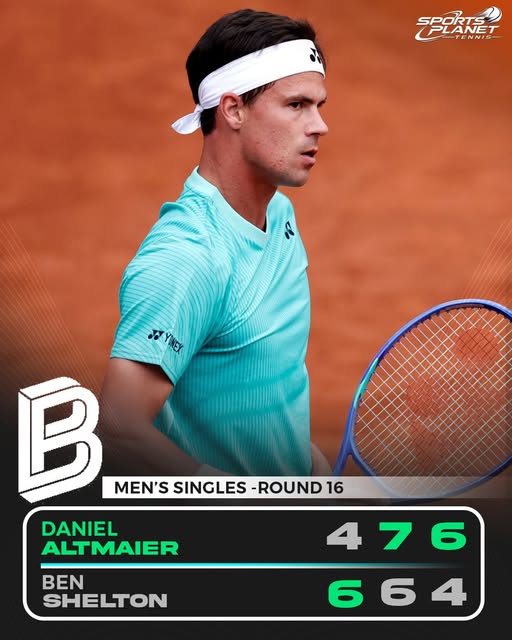
It was on the brink of becoming a routine victory. At 5-4 up in the second set, World No. 6 Ben Shelton was just two points away from closing out his Round of 16 match at the Hamburg European Open. The American’s 230 km/h serve had fired down 12 aces, and the Centre Court at Rothenbaum was starting to fall quiet. Then, the 65th-ranked German on the other side of the net decided it wasn't over yet. In a stunning display of resilience, Daniel Altmaier clawed his way back to claim a famous 4-6, 7-6(4), 6-4 victory.
The final roar from the Rothenbaum faithful echoed through the Hamburg night. For Altmaier, it was more than just a win; it was his first Top 10 victory of the 2026 season, a testament to a grueling three-hour battle of attrition, and a massive psychological victory over one of the fastest-rising stars in men’s tennis. This was the sound of confidence tennis at its most sublime.
The Rothenbaum Roar: A 12th Man Advantage
Tennis is often described as a solitary gladiatorial contest, but on Tuesday evening in Hamburg, Daniel Altmaier was never truly alone. The German clay-court specialist, who had entered the tournament with a modest 4-13 record for the season, drew palpable energy from the partisan support of the home crowd. This was the opening night of the Round of 16, the "Match of the Day," and the German fans were ready for an upset.
The noise grew with every grueling rally, reaching a fever pitch during a marathon third game of the final set. After Shelton saw four break point opportunities slip away in a game that saw six deuces, the American’s frustration boiled over. The quiet, almost stoic Altmaier, meanwhile, fed off the energy. Later, the 27-year-old would reveal that the secret to his success was a silent mind—a "Ruhe im Kopf" (calm in the head)——but on the court, he let the stadium do the shouting for him.
This wasn’t just a tennis match; it was a tennis festival. As Altmaier stepped up to serve for the match at 5-4 in the third, the drums were already beating. Somewhere in the stands, a small group had broken into a spontaneous Sirtaki dance, the Greek circle dance that has become a staple of the Rothenbaum party atmosphere. When Altmaier eventually held serve to love, the standing ovation lifted the roof off the historic Hamburg venue. The home crowd didn’t just watch history—they willed it into existence.
The Anatomy of a Comeback: Turning Point Analysis
To understand the magnitude of Altmaier’s statement, one must revisit the precise moment the match pivoted. For the first hour, Shelton was exactly as advertised. The 23-year-old American, fresh off a title win in Munich, looked to be in cruise control. He broke early in the first set, weathered a brief storm when Altmaier broke back, and immediately re-broke to secure the opener 6-4. By the middle of the second set, the narrative seemed set: Shelton, the big server, was marching toward the quarter-finals.
"4-5, Shelton Serving."
The turning point came at 4-5 in the second set. Shelton was two points from the match. The clock showed just before 8:00 PM local time. The American was on his serve. The fans were checking their watches. Then, the "unthinkable" happened. Altmaier refused to fade.
"I felt it was a little unfair being a set and 4-5 down," Altmaier said after the match, "because I felt I was playing quite well". That belief translated into action. While Shelton tried to force the issue with aggressive serve-and-volley tactics, Altmaier stayed deep and extended the rallies. The statistics are damning: Shelton approached the net 32 times during the match but won a disastrous 18% of those points, the lowest net conversion rate of his career on clay.
As Altmaier broke back to force a tiebreak, the momentum shifted violently. In the breaker, Altmaier raced to a 3-0 lead, but Shelton fought back to 4-4. However, the German’s decision-making tightened. He didn't go for reckless winners; he played the percentages, forcing a tense forehand error from Shelton to take the tiebreak 7-4 and level the match.
Turning the Screws: The Art of Tactical Adjustment
Analysis shows that Daniel Altmaier won this match not with flashy trick shots (though his Vorhand-Passierball was spectacular), but with devastating tactical discipline. In the first set, he had looked for the quick finish. After dropping his racquet in frustration following a lost break point, Altmaier recalibrated completely.
1. Neutralizing the Heat:
Shelton consistently fired serves at 230 km/h, often finishing points at the net. Altmaier’s adjustment was simple yet brutally effective: deep, high-bouncing topspin to the American’s backhand. This forced Shelton to hit up rather than through the court, nullifying his power. By the third set, Altmaier had doubled Shelton’s output of backhand winners, turning what should have been Shelton’s weapon into a liability.
2. Patience over Power:
Altmaier, a clay-court specialist who trains extensively in Argentina, knew that the heavy conditions (temperatures were just over 10 degrees Celsius) favored the grinder. He refused to be drawn into a slugfest. Instead, he absorbed Shelton’s pace and returned it with interest, waiting for the US-American to blink.
3. The Shelton Meltdown:
The tactical pressure eventually broke Shelton mentally. In the third set, as the tension mounted, a frustrated Shelton slipped on the baseline. Instead of shrugging it off, he sat on the court, threw his racquet, and kicked the wall in anger. Altmaier, contrasting with his opponent, remained "icy-cool". He capitalized immediately, breaking serve to go up 3-2 in the final set—a lead he would never relinquish.
Stamina and the Grind: Winning the War of Attrition
The final statistics box reads: 2 hours, 51 minutes. For Altmaier, a player ranked 59 spots below his opponent at the time of the match, it was a war of attrition. In the deciding set, Shelton had four break point opportunities on Altmaier’s serve. Altmaier saved every single one of them. This wasn't just about fitness; it was about endurance under fire.
By the third set, Shelton’s explosive first-step speed had diminished. Altmaier, on the other hand, looked as fresh at the 2:50 mark as he had at the start. He moved Shelton from corner to corner, punishing the American’s defensive backhand and refusing to give him a short ball to attack. When Altmaier finally served for the match at 5-4, there was no hiccup. He pounded three unreturnable serves to earn triple match point and sealed the deal when Shelton sprayed a final error into the net. The German had run a marathon to the American’s sprint, and in the end, the distance specialist held the trophy for the greatest win of his domestic season.
Post-Match Reaction: "A Crazy Comeback"
In the mixed zone, Altmaier was characteristically understated but deeply satisfied. "I'm proud. I stuck to my game," he told the media. Having not beaten a Top 10 player for an extended period, he noted, "Wenn man arbeitet und an sich selbst glaubt, dann kommen die Chancen und man gewinnt irgendwann" (If you work and believe in yourself, the chances will come and you will win eventually).
The victory also snapped Shelton’s impressive run at ATP 500 tournaments. Before Tuesday, the American had held a perfect 11-0 record at the 500-level in 2026. "If you see this match, it's a crazy comeback," Altmaier reflected.
For Shelton, the loss continues a worrying trend of inconsistency on clay. Despite his Munich title, he has now lost early exits in Madrid, Rome, and Hamburg heading into Roland-Garros. His record for the season falls to an underwhelming 18-8, with just four wins on the dirt.
A Huge Statement: What It Means for the ATP Rankings
For Daniel Altmaier, this is a career-defining moment. It marks his seventh career Top 10 victory and his first of 2026. More importantly, it signals that the German, currently sitting at No. 65, is ready to break the glass ceiling. While the ATP projects major point boosts for deep runs in Hamburg, the intangible value of this win is higher. It validates the years of grinding on the Challenger circuit and proves that his tactical mind can outmaneuver the sheer firepower of the sport’s new generation.
This wasn't just a game about hitting a tennis ball. It was a study in conflict resolution: when the big servers falter, the tacticians thrive. When the speed fades, the stamina endures. And when the home crowd roars, a "World No. 65" can become a giant killer. Altmaier now advances to the quarter-finals, the sole German standing tall in the draw, with a stern test waiting—likely against the resurgent Tommy Paul or Argentina's Tomas Martin Etcheverry.
But for one night in Hamburg, tennis belonged to Daniel Altmaier. And his 4-6, 7-6, 6-4 victory will be remembered as the night a determined German silenced the guns of an American star.
Sources: Interviews, On-Site Match Reports, ATP Tour Statistics, and Rothenbaum Broadcast Coverage.