
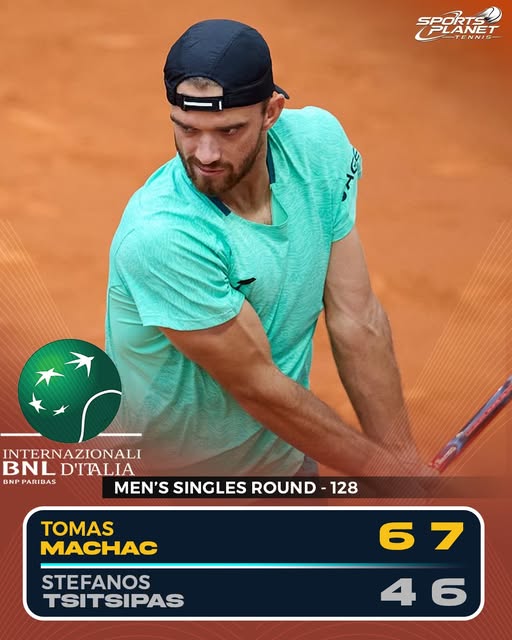
The ATP Tour is changing fast. Power alone is no longer enough. Players now win matches through constant tactical adjustment, controlled aggression, and smarter court positioning. Tomas Machac’s straight-set victory over Stefanos Tsitsipas in Rome showed exactly how modern tennis is evolving.
The scoreboard looked simple:
- Tomas Machac def. Stefanos Tsitsipas 7-6, 6-4
But underneath the numbers was a deep tactical battle that revealed why some rising ATP players are beginning to challenge established stars consistently.
From a coaching perspective in the USA high-performance system, this match was one of the clearest examples of modern ATP mutation tennis — adapting point patterns in real time to neutralize a bigger name.
Machac did not overpower Tsitsipas physically.
He dismantled him strategically.
The Biggest Difference in the Match Was Court Positioning
Most casual fans focus only on winners and errors.
Professional coaches look somewhere else first:
- return position body angle and alighnemt
- court depth
- rally tolerance
- directional control
- transition timing
- forehand pressure zones
Machac controlled these areas beautifully.
Tsitsipas likes to dictate with his forehand from inside the baseline. When he gets comfortable, he uses heavy spin and angle combinations to open the court slowly before attacking.
Machac completely disrupted that rhythm.
Instead of trading predictable crosscourt rallies, he constantly redirected the ball early and flat through the middle of the court, removing Tsitsipas’ favorite patterns.
That adjustment matters enormously on clay.
Why Machac’s Backhand Hurt Tsitsipas All Match
One of the oldest tactical attacks against Tsitsipas is pressure to the one-handed backhand.
Many ATP players try this strategy.
The problem is they often overhit.
Machac did something smarter.
He changed:
- height
- speed
- depth
- spin variation
instead of just hitting harder.
This forced Tsitsipas into uncomfortable contact points repeatedly.
The Hidden Adjustment Most Fans Missed
Machac avoided giving Tsitsipas rhythm.
That is extremely important.
Elite clay players become dangerous when rallies feel repetitive and predictable. Tsitsipas loves finding timing through repeated heavy forehand exchanges.
Machac prevented that entirely.
He mixed angle stokes:
- flatter backhands
- shorter angle balls
- low skidding shots
- sudden pace acceleration
This made Tsitsipas hesitate during neutral rallies.
Once hesitation appears at ATP level, confidence drops quickly.
Return Position Was a Huge Tactical Win
Tsitsipas usually earns many free points behind his serve plus forehand combination.
Machac neutralized this by adjusting his return depth during the match.
Sometimes he stood:
- far behind the baseline
- sometimes closer
- sometimes slightly shifted to the backhand side
Those micro-adjustments forced Tsitsipas to think before serving.
That psychological effect matters.
When a server loses automatic rhythm, first-serve percentages often dip under pressure.
The ATP Tour Is Becoming More About Disruption
Ten years ago, many players relied mostly on weapons.
Today’s ATP game is about disrupting timing.
Players like:
- Carlos Alcaraz
- Jannik Sinner
- Alex de Minaur
- Tomas Machac
all use disruption patterns constantly.
This includes:
- changing rally speed
- redirecting early
- taking balls earlier
- mixing height
- shortening opponent preparation time
Machac executed this modern formula perfectly against Tsitsipas.
Tsitsipas Struggled to Create Forehand Domination
Stefanos Tsitsipas is dangerous when:
- he controls the middle
- steps inside baselinee
- attacks with forehand to open court
- finishes forward
Machac prevented step #2 repeatedly.
That changed the entire match dynamic.
Whenever Tsitsipas attempted aggressive court positioning, Machac redirected quickly into uncomfortable zones.
This forced Tsitsipas into defensive recovery movement instead of offensive transition.
That is a major tactical victory.
Machac’s Physical Efficiency Was Elite
A lot of fans mistake movement for speed alone.
Professional movement is about efficiency.
Machac moved economically throughout the match.
He rarely overran balls.
He stayed balanced during:
- directional changes
- recovery steps
- open-stance hitting
- defensive transitions
This preserved energy during longer rallies.
Meanwhile Tsitsipas often looked slightly rushed when changing direction after wide forehand exchanges.
On clay, balance matters more than raw sprinting speed.
Sliding Mechanics Made a Difference
Modern clay tennis requires advanced sliding control.
Machac’s sliding was extremely clean.
Notice how often he:
- slid into balance
- recovered immediately
- stayed low through contact
- kept upper body stable
That allowed him to absorb Tsitsipas’ heavy forehand spin effectively.
Poor sliding creates late contact points.
Late contact creates short balls.
Short balls against Tsitsipas usually mean immediate punishment.
Machac avoided that trap.
The Serve Patterns Were Smarter Than People Realized
The serve statistics alone do not explain the match.
Placement mattered more.
Machac consistently served to:
- jam the body
- pull Tsitsipas off balance
- prevent forehand setup
That tactical serving prevented Tsitsipas from attacking second shots comfortably.
At ATP level, the serve is not just about aces anymore.
It is about controlling the next ball.
Machac understood that all match long.
Second Serve Courage Changed Momentum
One major reason players lose against top opponents is fear on second serve.
Machac did not become passive.
Instead:
- he trusted kick placement
- attacked immediately after serve
- stayed aggressive behind second serves
That mindset prevented Tsitsipas from dominating return games psychologically.
Why Tsitsipas Looked Frustrated
Frustration in tennis usually comes from uncertainty.
Tsitsipas never fully settled into comfortable patterns.
He could not predict:
- rally tempo
- direction changes
- incoming ball height
- timing pressure
That creates mental fatigue.
Modern ATP tennis is now heavily psychological through tactical pressure.
Players are constantly solving problems in real time.
Machac created too many tactical questions.
Tsitsipas could not stabilize the match flow consistently.
The Evolution of Tomas Machac’s Game
This version of Machac is far more dangerous than previous seasons.
Earlier in his career he sometimes relied too heavily on:
- counterpunching
- reactive tennis
- defensive scrambling
Now he is taking initiative earlier.
That evolution is critical.
The modern ATP Tour rewards players who can:
- absorb pace
- redirect pace
- accelerate suddenly
- attack transition moments
Machac now does all four.
That is why his ceiling is rising fast.
The Influence of Modern ATP Training
Across USA and European academies, training has changed dramatically.
Players now focus heavily on:
- reaction speed
- anticipation
- pattern recognition
- transition aggression
- compact swings under pressure
Machac’s game reflects this new generation approach.
His preparation looked extremely compact against Tsitsipas.
Compact swings are essential against heavy RPM modern tennis because they allow earlier contact timing.
Earlier timing steals opponent recovery time.
That is one of the biggest weapons in today’s ATP game.
High RPM Tennis Is Changing Everything
Modern players generate incredible spin RPM.
Heavy spin pushes opponents farther behind the baseline and creates uncomfortable shoulder-height contact.
Machac handled this beautifully by:
- taking balls earlier
- flattening trajectory selectively
- redirecting down the line
This neutralized Tsitsipas’ heavy forehand patterns.
The future ATP game belongs to players who can absorb spin without losing offensive positioning.
Match Momentum Shifted During Important Rally Windows
Big matches are rarely decided by total points alone.
Momentum windows matter.
Machac played his cleanest tennis during:
- break-point moments
- extended deuce games
- second-serve pressure situations
That shows emotional maturity.
Many rising players hit brilliantly early in matches but lose discipline during pressure moments.
Machac stayed tactically committed.
That is a sign of higher-level development.
The Mental Side Was Extremely Strong
Body language matters in elite tennis.
Machac looked calm throughout key moments.
No panic.
No emotional overreaction.
No rushing between points.
That stability affects shot quality.
Tsitsipas meanwhile appeared increasingly frustrated after longer tactical rallies failed to produce control.
Emotional frustration often causes:
- rushed forehands
- poor shot selection
- overhitting
- lower first-serve percentage
You could see some of those patterns emerge late in the match.
What Young Tennis Players Should Learn From This Match
This match is an excellent teaching tool for junior players.
The biggest lesson:
You do not always need bigger power to beat elite opponents.
You need:
- smarter patterns
- cleaner movement
- tactical flexibility
- emotional control
- timing disruption
Machac demonstrated all of these.
Young players often focus only on hitting harder.
But modern ATP tennis rewards adaptability more than reckless aggression.
The Most Important Coaching Lesson
The smartest adjustment Machac made was refusing to play predictable rally tennis.
Predictability helps elite players.
Variation hurts them.
That includes:
- ball height variation
- tempo variation
- directional variation
- court position variation
Machac constantly changed visual information for Tsitsipas.
That forced continuous recalculation mentally.
Over two sets, that pressure becomes exhausting.
Why This Win Matters for the ATP Tour
This was not just one upset victory.
It represents the direction of modern tennis.
The new ATP generation is:
- faster
- tactically smarter
- more flexible
- more aggressive in transition
- better at taking time away
Machac fits that evolution perfectly.
Players can no longer rely purely on one weapon for years without adjustment.
The tour adapts too quickly now.
Final ATP Coach Analysis
From an ATP coaching perspective, Tomas Machac won this match because he controlled:
- timing
- rhythm
- positioning
- emotional stability
- tactical variation
He never allowed Stefanos Tsitsipas to establish comfortable offensive patterns.
That is elite modern tennis.
The ATP Tour today belongs to players who solve problems fastest under pressure.
Machac looked like one of those players in Rome.
And if this tactical growth continues, his rise in the rankings may only be beginning.