
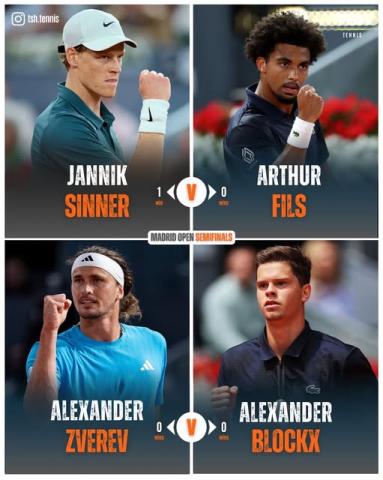
The last four men standing in Madrid will fight tomorrow for a place in the final. After a week of thrilling tennis at the Caja Mágica, the Mutua Madrid Open semifinals are set, and the lineup is a fascinating blend of established champions and emerging challengers. World No. 1 Jannik Sinner faces Frenchman Arthur Fils in their second career meeting and first in nearly five years. Meanwhile, third seed Alexander Zverev takes on Belgian qualifier Alexander Blockx in a first‑time showdown that has captured the imagination of the tennis world.
As the dust settles on the quarterfinals, one question dominates every conversation in the Spanish capital: Who makes it to the final? The smart money remains on Sinner. Among all players in the draw, the Italian has demonstrated an unmatched ability to adjust his game at the fastest scale, reading opponents, conditions, and momentum shifts with a clarity that has become his trademark. But in a tournament that has already produced upsets and epics, nothing is guaranteed.
Part One: Jannik Sinner – The Favorite for a Reason
When Jannik Sinner walks onto the Manolo Santana Stadium for his semi‑final against Arthur Fils, he will do so carrying the weight of expectation. And unlike so many past world No. 1s who have buckled under such pressure, Sinner seems to thrive on it. His 2026 season has been a masterclass in sustained excellence: a title at the Australian Open, runner‑up finishes at Indian Wells and Monte Carlo, and now a run to the Madrid semis that has been as efficient as it has been authoritative.
What makes Sinner the clear favorite is not merely his ranking or his trophy cabinet. It is his ability to adjust his game at a speed that leaves opponents grasping for answers. In his quarterfinal victory over Sebastian Korda – a player who had beaten him twice before – Sinner lost the first set 6‑7 in a tiebreak. Most players would have tightened up, retreated into safer patterns. Sinner did the opposite. He raised his first‑serve percentage from 54% in the opener to 71% in the second and third sets. He started standing closer to the baseline to take Korda’s serve earlier. He began slicing his backhand into the forehand corner, a tactical adjustment that forced Korda to generate his own pace from an uncomfortable position. The result was a 6‑2, 6‑4 comeback that looked, in hindsight, inevitable.
This is the Sinner effect. He processes information faster than anyone on tour. He identifies a weakness – a tendency to drift wide on the ad side, a vulnerability to the high ball to the backhand – and he exploits it relentlessly. In an era of power tennis, Sinner has reintroduced the art of the tactical adjustment. He does not simply out‑hit you; he out‑thinks you, and he does it in real time.
His record on clay this season is further evidence of his adaptability. After a slow start in Monte Carlo, where he lost in the final to Stefanos Tsitsipas, Sinner has looked increasingly comfortable on the red dirt. He has learned to slide into his backhand, to use the court’s angles, to trust his movement. In Madrid, where the high altitude makes the ball fly faster than at Roland Garros, Sinner has found a perfect balance between aggression and patience. He is hitting through the court without over‑pressing. He is using his slice to disrupt rhythm. He is serving with variety – kickers out wide, body serves, occasional flat heaters up the T.
The numbers bear this out. Through four matches in Madrid, Sinner has lost just one set. He has saved 10 of 13 break points faced. He has won 54% of his second‑serve return points, a staggering statistic that puts relentless pressure on opponents. And perhaps most tellingly, he has converted 44% of his break‑point opportunities – a conversion rate that ranks him among the tournament leaders.
For Sinner, the semi‑final against Fils is not a trap. It is an opportunity to reinforce his status as the man to beat. He enters the match with a 1‑0 head‑to‑head record against the Frenchman, having won their only previous meeting at the 2021 Next Gen ATP Finals in Milan. That was nearly five years ago – a lifetime in tennis terms. Both players have evolved dramatically since then, but Sinner has evolved more. He has gone from promising teenager to undisputed world No. 1. Fils, meanwhile, has gone from junior standout to top‑20 fixture, but he has yet to crack the upper echelon of the sport.
Part Two: Arthur Fils – The Young Challenger with Nothing to Lose
If Sinner is the favorite, Arthur Fils is the wildcard – a player with the firepower to trouble anyone on his day, but whose consistency has been his greatest enemy. The 21‑year‑old Frenchman entered Madrid ranked 18th in the world, having won two titles already in 2026 (Montpellier and Barcelona). But he had also suffered puzzling early exits in Doha, Dubai and Miami, losses that suggested he was still searching for the elusive ingredient of week‑to‑week reliability.
In Madrid, however, Fils has found something close to his best tennis. He has dropped only one set en route to the semi‑finals, dispatching Tommy Paul in straight sets in the fourth round and then edging a rejuvenated Stan Wawrinka in the quarterfinals 7‑6, 7‑5. The win over Wawrinka was particularly instructive: Fils was pushed to the limit by the 41‑year‑old Swiss veteran, but he held his nerve in the crucial moments, saving three set points in the first‑set tiebreak and breaking Wawrinka’s serve at 5‑5 in the second.
What makes Fils dangerous against Sinner is his raw athleticism and his ability to generate pace from seemingly impossible positions. He possesses a forehand that can be compared to a young Juan Martin del Potro – heavy, flat and capable of painting lines from anywhere on the court. His backhand is less reliable but still a weapon when he has time to set up. His first serve regularly clocks above 220 km/h, and his second serve, while occasionally vulnerable, has improved significantly under the guidance of his coaching team.
But the gap between Fils and Sinner remains substantial, and it centers on one word: adjustments. Fils tends to play one way – aggressive, front‑foot, all‑or‑nothing. When that approach works, he looks unbeatable. When it doesn’t, he can spiral into error‑fest territory. Against a tactician like Sinner, who will probe for weaknesses from the very first point, Fils will need to show a level of restraint and adaptability that has not always been present in his game.
The dynamic of this match will be fascinating. Fils knows he cannot out‑Sinner Sinner in a baseline attrition war. He will need to take risks, to come to the net, to try to shorten points. But Sinner’s passing shots are among the best in the game, and his ability to redirect the ball cross‑court from both wings makes him a nightmare for anyone attempting serve‑and‑volley or aggressive net approaches.
The Frenchman’s best hope lies in his serve. If he can land a high percentage of first serves – 65% or better – and hold cheaply, he can keep the pressure on Sinner to hold his own service games. From there, the match becomes a contest of a few crucial points. But Sinner has proven time and again that he is the best big‑point player on tour. In tiebreaks this season, his record is 8‑2. In deciding sets, he is 6‑1. Those are the numbers of a champion.
Part Three: Alexander Zverev vs. Alexander Blockx – The Known vs. The Unknown
On the other side of the draw, the semi‑final between Alexander Zverev and Alexander Blockx presents a different kind of narrative: the established superstar against the breakout qualifier. Zverev, the two‑time Madrid champion (2018, 2021), has been in devastating form all week. He has not dropped a set, crushing Flavio Cobolli 6‑1, 6‑4 in the quarterfinals with a performance that was described by Jimmy Connors as "too strong, too sharp, too consistent." The German is playing with a locked‑in focus that suggests he is on a mission to reclaim the Madrid title and send a message ahead of the French Open.
Blockx, meanwhile, is the story of the tournament. The 21‑year‑old Belgian qualifier, ranked 69th in the world, has already taken down three seeded players: 16th seed Felix Auger‑Aliassime in the second round, 31st seed Matteo Berrettini in the third round, and – most sensationally – defending champion Casper Ruud in the quarterfinals, beating the Norwegian 6‑4, 6‑4 in a performance that left the Caja Mágica stunned.
Blockx’s game is built on left‑handed aggression. He possesses a big serve that he can place with precision, a forehand that he unleashes with devastating effect, and a willingness to come to the net that feels almost old‑fashioned. He moves well for his size – 1.93 meters – and has shown remarkable composure for a player in his first Masters semifinal. Against Ruud, he did not give away a single break point in the entire match, a defensive statistic that would be impressive for any player, let alone a qualifier facing a top‑5 opponent.
But Zverev is a different beast entirely. Where Ruud struggled to penetrate Blockx’s defence, Zverev will attack from the first ball. The German’s backhand is arguably the best in the world – a shot he can hit down the line, cross‑court, with topspin or slice, from any position on the court. His serve, when it is firing, is nearly unbreakable. And at 6’6", he covers the court with a fluency that defies his height.
The key for Blockx will be to disrupt Zverev’s rhythm. The German loves a predictable pattern – backhand cross‑court exchanges, forehands to the opponent’s backhand. If Blockx can vary his shot selection, use his left‑handed angle to pull Zverev wide on the ad side, and attack the net effectively, he can make the match uncomfortable. But discomfort is not the same as victory. To beat Zverev on clay, over three sets, you need to sustain a level of intensity that Blockx has never been asked to maintain against a player of this calibre.
The head‑to‑head is 0‑0. They have never played. That can work in Blockx’s favour – Zverev will have to figure him out on the fly. But it can also work against the Belgian, because he has no prior experience of the weight of Zverev’s groundstrokes, the depth of his shots, the subtle variations in spin and pace that make the German so difficult to read.
Part Four: Experience and Dynamic Adjustment – Why Sinner Stands Above
When analysts and former players assess the Madrid semifinals, they almost universally land on the same conclusion: Jannik Sinner is the man to beat. Not because he has the prettiest game – though it is certainly elegant – but because he possesses an ability to adjust his tactics at a faster scale than any of his peers.
This is not an exaggeration. In his match against Korda, Sinner changed his return position three times in the first set alone. He started behind the baseline, then moved up, then dropped back again. He was testing Korda’s reactions, looking for a pattern. By the second set, he had found it: Korda’s second serve to the deuce court was consistently landing short. Sinner began stepping inside the baseline and attacking it with his forehand, winning nine of eleven such points.
Against Fils, the adjustment will be different. Fils is a player who thrives on rhythm – he wants to hit the same ball repeatedly, to build momentum through repetition. Sinner’s task will be to break that rhythm. He will use his slice to keep the ball low, his lob to push Fils back, his drop shot to test Fils’s movement forward. He will vary the pace of his groundstrokes, sometimes hitting with heavy topspin, sometimes flattening out the ball. He will not allow Fils to settle.
This is the hallmark of a great champion. Bobby Jones, the legendary golfer, once said that golf is played on a five‑inch course – the space between your ears. The same is true of tennis, and no player currently on tour has a stronger mental game than Sinner. He does not panic. He does not deviate from his plan. He processes information, makes a decision, and executes. It sounds simple, but it is extraordinarily difficult, especially under the lights on a big stage.
Zverev, for all his talent, has not always shown that same level of clarity. There have been matches – the 2020 US Open final against Dominic Thiem, the 2024 French Open final against Carlos Alcaraz – where Zverev’s game has unravelled under pressure. His second serve can desert him. His forehand can tighten. He can become passive, waiting for errors rather than creating his own opportunities. At 29 years old, Zverev is still searching for the mental consistency that separates the very good from the immortal.
That is not to say Zverev cannot win Madrid. He absolutely can. He has the game, the experience, and the hunger. But if he and Sinner meet in the final – and that is the most likely outcome – the edge will go to the Italian. Sinner has beaten Zverev in four of their last six meetings, including a straight‑sets victory in the semifinals of the Australian Open earlier this year. He knows how to exploit Zverev’s backhand, how to move him side‑to‑side, how to force the German into defensive positions where his height becomes a disadvantage rather than an asset.
Part Five: Who Makes the Final? Predictions and Analysis
As the tennis world debates the two semifinals, one thing is clear: the Madrid Open has delivered a compelling narrative. The unexpected run of Alexander Blockx has captured hearts. The resurgence of Arthur Fils has hinted at a bright future. The dominance of Alexander Zverev has reminded everyone of his clay‑court pedigree. But the steady, relentless excellence of Jannik Sinner remains the story of the tournament.
Prediction 1: Sinner def. Fils in straight sets
Fils will have his moments. He will hit some spectacular winners, he will win a few games with sheer power, and he might even take a set if Sinner has a momentary lapse in concentration. But over three sets, Sinner’s ability to adjust will prove decisive. Expect a 6‑4, 6‑3 or 6‑4, 7‑5 scoreline. Sinner moves into his second Madrid final.
Prediction 2: Zverev def. Blockx, but not easily
Blockx has earned the respect of the entire locker room. He will not be intimidated by Zverev’s reputation. He will serve well, attack the net, and make the German work for every point. But Zverev’s experience in big matches – this will be his 28th Masters 1000 semifinal – will carry him through. Expect a 7‑6, 6‑4 victory, with Zverev winning the crucial tiebreak on big points.
Final Prediction: Sinner def. Zverev in three sets
If the final materialises as Sinner vs. Zverev, it will be a clash of two of the game’s elite. Zverev has the power to push Sinner, the clay‑court credentials to win, and the motivation to prove that he can still beat the world’s best. But Sinner has something Zverev lacks: the ability to raise his level precisely when it matters most. In a tight third set, with the title on the line, Sinner will find an extra gear. He will break Zverev’s serve at 4‑4 or 5‑5 and serve out the championship. Score: 6‑3, 3‑6, 6‑4.
Part Six: The Bigger Picture – What These Semis Mean for Roland Garros
Beyond the immediate excitement of the Madrid semifinals, there are larger implications for the clay‑court season and the French Open, which begins in just three weeks.
For Sinner, a deep run – and especially a title – would cement his status as the pre‑tournament favorite in Paris. He has never won Roland Garros; his best result is a semifinal appearance in 2024. But he has never entered the tournament playing better on clay than he is right now. His movement has improved, his patience has grown, and his belief that he can win on any surface is absolute.
For Zverev, a strong performance in Madrid would be a crucial confidence boost. He has come close at the French Open before – losing the 2024 final to Alcaraz in five sets – but he has never quite crossed the finish line. At 29, the window is narrowing. A title in Madrid, followed by a strong showing in Rome, would position him as a genuine contender in Paris.
For Fils and Blockx, the semifinals represent a breakthrough regardless of the result. Both players will leave Madrid with higher rankings, greater belief, and the knowledge that they belong at this level. Fils, in particular, has the potential to be a top‑10 mainstay for years to come. Blockx, meanwhile, has announced himself as a dangerous floater in any draw – the kind of player that seeds will want to avoid in the early rounds of Grand Slams.
Conclusion: The Stage Is Set
Tomorrow, under the lights at the Caja Mágica, two semifinals will determine who fights for the Madrid Masters crown. Jannik Sinner, the world No. 1 and the man to beat. Arthur Fils, the young Frenchman with nothing to lose. Alexander Zverev, the two‑time champion seeking to reclaim his throne. Alexander Blockx, the qualifier from Belgium dreaming the impossible dream.
Who makes it to the final? The smart answer is Sinner and Zverev. The romantic answer is Fils and Blockx. The unpredictable nature of tennis means we may get neither.
But one thing is certain: the dynamic of the game will be tested at its fastest scale, and the player who can adjust quickest – who can read the moment, trust their instincts, and execute under pressure – will emerge victorious. In that regard, Jannik Sinner remains the favorite among all players. His experience, his tactical intelligence, and his ability to adapt in real time set him apart.
Follow us for everything happening in the tennis world. The Madrid Open semifinals are just the beginning. The road to Roland Garros runs through the Spanish capital, and the final four are ready to run.
—
Madrid Open Semifinals – Order of Play (May 1, 2026)
Centre Court – Manolo Santana Stadium
-
(1) Jannik Sinner vs. (18) Arthur Fils – Not before 2:00 PM
-
(3) Alexander Zverev vs. (Q) Alexander Blockx – Not before 4:30 PM
Both matches will be broadcast live on Tennis Channel (USA), Sky Sports (UK), and Eurosport (Europe).