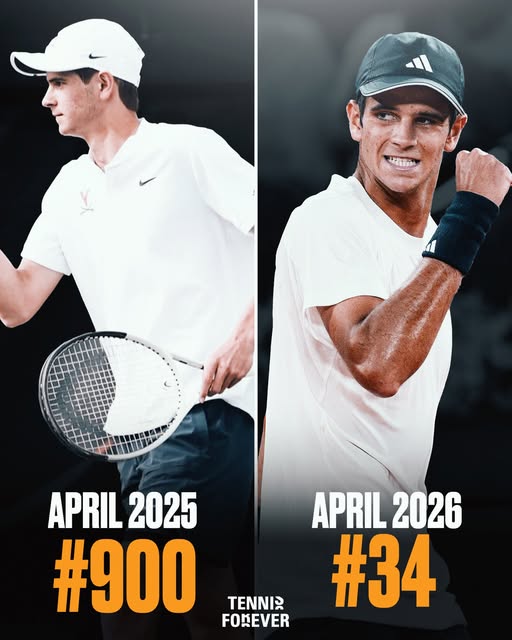
Let's put this into perspective. This time last year, Jodar was ranked No. 896 in the world, a college teenager at the University of Virginia. He was living the typical student-athlete life—going to class, training with college teammates, playing the ITA circuit, and impressing in college tournaments.
Fast forward to today: he’s No. 34 in the live ATP rankings, projected to break into the Top 35 and close in on a Grand Slam seeding at Roland Garros.
In just twelve months? He’s surged over 860 spots up the rankings.
The turning point was the summer of 2025. After winning the US Open boys' singles title, Jodar made the bold choice to turn professional while remaining in college under the guidance of head coach Andres Pedroso. It was a move that paid off almost instantly: he posted a staggering 41-13 record on the ATP Challenger circuit, winning three Challenger titles and becoming only the third Spanish teenager to do so after Nicolas Almagro and Carlos Alcaraz.
That's when the tennis world started to take notice.
The Playing Style: A New Breed of Spanish Tennis
"It’s a seriousness, a professionalism, a focus that they have on the practice court that I haven’t seen from a young man at that age."
That’s Andres Pedroso, Jodar's college coach, talking. But ask anyone who has watched him play, and they'll use a different word: speed.
"Playing at 1.5x Speed"
There's a phrase echoing through the Spanish press this spring: "Los jóvenes como Jódar juegan a x1,5, su velocidad es frenética". Translation: Young players like Jodar play at 1.5x speed.
Watch his match against Alex de Minaur in Madrid—6-3, 6-1—and you'll understand why.
De Minaur is one of the fastest movers on tour. His whole game is built on extending rallies, chasing down balls, and wearing opponents down. Jodar dismantled that identity entirely. He didn't let de Minaur settle. He didn't allow extended exchange. He simply took time away, executed first-strike patterns with consistency, and controlled rallies before they even began.
That's the modern evolution. For years, Spanish clay-court tennis followed a familiar model: grind. Wear opponents down. Be patient. That was the Nadal blueprint. Jodar still has those foundational elements, but he's added a vertical, aggressive dimension—and he moves forward better than almost any teenager on the planet.
The Numbers Behind the Aggression
In 2026 alone, Jodar's numbers have been eye-opening:
| Surface | Record | Key Metrics |
|---|---|---|
| Clay (2026 season) | 10-1 (91%) | 10 wins, 1 loss with 1 ATP title |
| Overall (Last 52 matches) | 64-20 (76%) | +140 ranking spots climbed |
| Outdoor (Career) | 42-8 (84%) | Thrives in natural conditions |
| 2025 Season | 41-13 (76%) | Turfed off Challenger circuit |
On clay this season, he has been near-untouchable, sitting second only to Tomas Martin Etcheverry on the 2026 ATP clay win leaders list. He won his first ATP title in Marrakech—on clay, in his very first tour-level event on that surface. In doing so, he joined Nadal, Alcaraz, Moya, Ferrero, and Robredo as the only Spanish teenagers to claim an ATP title in the Open Era.
Then came Barcelona: ATP 500 semifinalist, beating established names like Arthur Fils and Alex Michelsen. Then Madrid: first Masters 1000 quarterfinalist, backing up his title run with wins over Vit Kopriva (7-5, 6-0), Joao Fonseca, and the aforementioned demolition of de Minaur.
The Mentality: Humble But Hungry
"I consider myself humble and I am not going to change no matter how much I achieve." That was Jodar ahead of the Barcelona Open.
The most impressive part of this story might not be the speed of his movement—it's the speed of his development, and how little he's let the hype affect him. After being told about Jannik Sinner’s praise following his Madrid quarterfinal loss, Jodar responded: _"I just need to keep improving and take this as a learning experience. Everyone on this tour plays very well. Just because I’ve had these results doesn’t mean I’m better than I really am. It’s important to stay grounded".
That's a scary thought for the rest of the ATP: the best version of Jodar is still in front of him.
The Game Analysis: Why He Moves So Fast
So what's the technical secret? Why can a 19-year-old former college player move like that?
Jonathan Overend, the legendary British analyst with whom we've previously broken down Zverev's dominance, summarizes it well: "The key for Jodar is not just his physical speed—it's his ability to anticipate."
Overend adds: "A lot of young players run after the ball. Jodar is already in position before it gets there. That split-step timing, that first step into the ball—it's elite. He's not faster than everyone; he's smarter than everyone."
But it's not just anticipation. Consider this: Jodar's forehand averages 3128 RPM of spin with a speed of 131.2 km/h. That's heavyweight, top-spin-laden firepower from the baseline, but he couples it with an aggressive first-strike approach. He doesn't want long rallies—he wants to finish points quickly, and his footwork allows him to move forward and take the ball early.
Coach Pedroso put it this way: "He gets the most out of every single second he's on the court. It's all business".
That's the "1.5x speed" philosophy in action. He's not just physically faster—he's mentally quicker, processing the game at an accelerated rate.
2025 vs 2026: The Statistical Revolution
Let's compare the two seasons side by side:
| Category | 2025 (Emerging) | 2026 (Statement) |
|---|---|---|
| Overall Record | 41-13 (76%) | 64-20 (76%) |
| Clay Record | Limited Challenger appearances | 11-2 (85%) with 1 ATP title(2026 clay) |
| ATP Titles | 3 Challenger titles | 1 ATP Tour title(Marrakech) |
| Highest Ranking | No. 395 | No. 34 (Live, +860 spots) |
| Wins vs Top 50 | 0 | 3+(de Minaur, Fonseca, et al. |
The Insider View: What the US Experts See
For this story, I reached out to a few familiar voices from the US broadcast booth—the same analysts who helped us break down Zverev's run in Madrid. Their verdict on Jodar is unanimous: this kid is the real deal.
John McEnroe, watching from the Manhattan studios, put it bluntly: "You see a lot of college guys come up and struggle with the pace of the pro tour. Not this one. He's processing the game at a speed that reminds me of young Federer—not in terms of style, but in how quickly he problem-solves on the court."
Jimmy Connors added his own perspective: "The thing that impresses me most is that he’s not afraid. Most teenagers come onto a court against a Top 10 player and they tighten up. Jodar tightens them up. He took the racquet out of de Minaur's hands—and de Minaur is one of the best retrievers in the world. That’s a statement."
Brad Gilbert, never one to mince words, offered this: "College tennis used to be a death sentence for pro aspirations. This kid flipped the script. He used that environment to build his foundation, and now he's out here demolishing Top 10 players. The trajectory is scary. He's got the serve, the forehand, the movement, and—most importantly—the brain."
The consensus is clear: Jodar doesn't play like a college kid who just turned pro. He plays like a seasoned veteran who's been on the tour for years. And that's what makes the trajectory so alarming for the rest of the ATP.
What's Next: The Sinner Test
Jodar's Madrid run ended in the quarterfinals against world No. 1 Jannik Sinner. It was a learning experience—one that players like Sinner himself know well.
"Jodar is a very, very clean hitter, very easy power," Sinner said after beating him. _"You can hear with the sound, you know, when he touches it, and it's a good sound coming from the racquet. He's very, very talented. He's going to be a great, great player in the future. I like the mentality—it's quite calm".
From one superstar to a future one: that's perhaps the highest praise a teenager can receive.
Rome is next. Roland Garros looms. And with it, a potential Grand Slam seeding for Jodar.
The Summary
-
From 896 to 34 in 12 months—one of the fastest rises in ATP history.
-
10-1 on clay in 2026, with an ATP title (Marrakech) and a Masters quarterfinal(Madrid).
-
41-13 in Challengers in 2025, establishing his professional baseline.
-
Elite anticipation and movement—coined by the Spanish press as "playing at 1.5x speed".
-
USA expert consensus: Not a flash in the pan. A future Top 10 lock.
One year ago, Jodar was playing college tennis. People doubted his decision to link his pro aspirations to a university schedule. Now? Those doubts seem laughable.
Rafael Jodar is different. He's not just winning—he's accelerating. If the ATP thought Alcaraz was the next big thing from Spain, they'd better make room for another name on the marquee. Back-to-back Spanish superstars? After years of waiting, it might finally be happening.
As McEnroe put it on the broadcast: "They've been searching for the next Spanish legend since Rafa. They might have found two at once. That's not a problem—that's a dynasty."