Toronto Round-of-16 Game Analysis: How Alexandrova, Shnaider, Swiatek and Svitolina Adjusted to Win
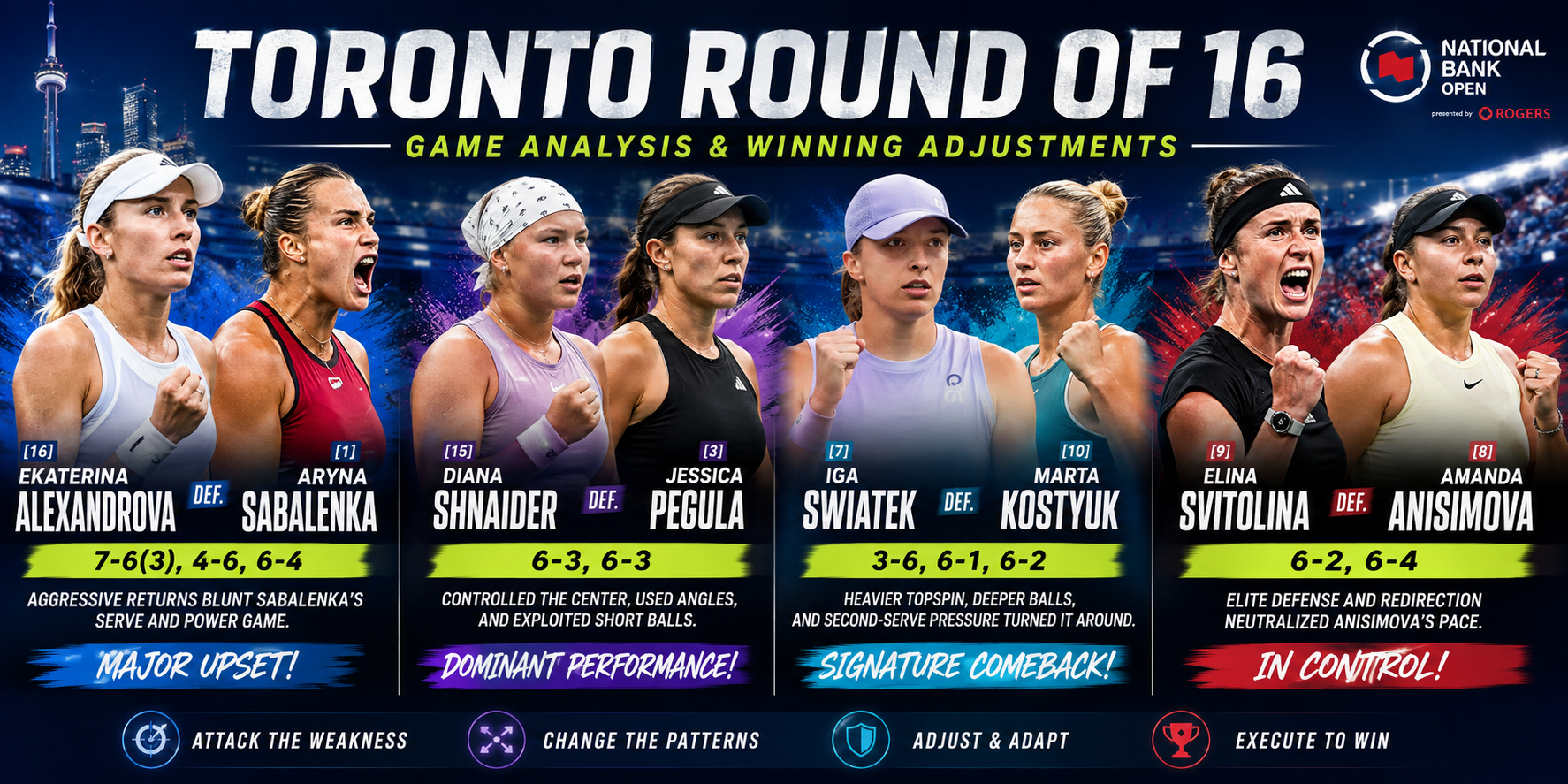
TORONTO, Canada — The latest round of the National Bank Open produced four very different lessons in modern women's tennis: attack the opponent's biggest weapon, change the geometry of the court, adjust after losing a set, and turn defense into offense.
The victories of Ekaterina Alexandrova, Diana Shnaider, Iga Swiatek and Elina Svitolina were not simply about hitting better shots. Each player identified a tactical problem, made adjustments, and then executed that adjustment under pressure.
From an American tennis-coaching perspective, that is the biggest takeaway from these matches:
At the highest level, winning is often less about having the better game plan at the start and more about recognizing when the original plan is no longer working.
1. Ekaterina Alexandrova Def. Aryna Sabalenka
7-6(3), 4-6, 6-4
The biggest upset of the round was also one of the clearest examples of tactical courage.
World No. 1 Aryna Sabalenka brought the expected combination of explosive serving, first-strike tennis and overwhelming baseline power. But Alexandrova refused to allow Sabalenka to establish her preferred serve-plus-one pattern.
Alexandrova won 7-6(3), 4-6, 6-4 in 2 hours and 29 minutes, reaching the quarterfinals after another major battle against Sabalenka.
The key adjustment: attack the serve
Against Sabalenka, many players instinctively move several feet behind the baseline on the return.
That gives Sabalenka exactly what she wants.
She gets time.
Alexandrova chose the opposite approach.
She attacked the return, particularly against second serves, attempting to prevent Sabalenka from immediately taking control of the next ball.
This is extremely important tactically.
Against a player such as Sabalenka, the return does not necessarily need to be a winner. Its primary purpose is to destroy the opponent's first attacking opportunity.
Alexandrova's return pressure forced Sabalenka to hit more difficult first shots after the serve rather than simply stepping into a comfortable forehand.
Why it worked
Sabalenka's greatest weapon is not simply her serve or forehand individually.
It is the combination:
Serve → first forehand → court position → pressure.
Alexandrova attacked the first link.
That disrupted the entire sequence.
Her aggressive returning also prevented Sabalenka from settling into a predictable rhythm. The match became less about Sabalenka imposing her power and more about both players competing for the first strike.
That was a major tactical victory for Alexandrova.
The third-set adjustment
After losing the second set 6-4, Alexandrova had a major psychological challenge.
She had already demonstrated that her aggressive strategy could work. The danger was becoming too aggressive and giving Sabalenka free points.
Instead, Alexandrova maintained the same basic philosophy while managing the risk better.
She continued to look forward on the return but used greater point construction once the rally developed.
That distinction is crucial:
Aggressive does not mean reckless.
Alexandrova did not need to hit every ball harder.
She needed to make Sabalenka uncomfortable early and then force her to create the extra shot.
The result was a decisive third set, with Alexandrova recovering from an early deficit and eventually converting her third match point when Sabalenka double-faulted.
Coaching lesson
If you are playing a much bigger hitter:
Do not automatically defend deeper.
Sometimes the best defense is taking time away from the opponent before they can attack.
2. Diana Shnaider Def. Jessica Pegula
6-3, 6-3
Diana Shnaider produced one of the most efficient performances of the round, defeating third seed Jessica Pegula 6-3, 6-3.
The tactical theme here was completely different from Alexandrova-Sabalenka.
Shnaider did not try to overpower Pegula with constant pace.
Instead, she changed the geometry of the court.
The key adjustment: use the left-handed forehand to move Pegula
Shnaider's left-handed forehand created difficult angles that repeatedly moved Pegula away from the center of the court.
This mattered because Pegula is extremely comfortable when she can establish her compact, early-contact baseline game.
She likes taking the ball early.
She likes relatively predictable patterns.
She likes controlling the center.
Shnaider disrupted all three.
The short-ball punishment
Once Shnaider moved Pegula away from the center, the next objective was simple:
Attack the shorter ball.
This is classic high-level pattern recognition.
Instead of trying to hit a winner immediately, Shnaider used the heavy forehand to create space.
Then, when Pegula's defensive ball landed shorter, Shnaider stepped forward.
That made the court progressively smaller for Pegula.
Why Shnaider's adjustment worked
Pegula's game is built around efficiency.
Shnaider made efficiency difficult.
She forced Pegula to hit from different court positions, particularly when Pegula was pulled outside her preferred strike zone.
That meant Pegula was frequently trying to generate pace while moving rather than while balanced.
The difference is enormous.
Coaching lesson
Against a player who takes the ball early:
Don't simply try to hit harder. Change the angles.
Move the opponent horizontally first.
Then attack vertically by moving forward.
3. Iga Swiatek Def. Marta Kostyuk
3-6, 6-1, 6-2
Iga Swiatek's comeback against Marta Kostyuk may have been the clearest example of mid-match tactical correction.
Kostyuk took the opening set 6-3 by playing aggressively and taking time away from Swiatek.
She stepped inside the baseline, attacked early and prevented Swiatek from establishing her normal heavy-spin rhythm.
But Swiatek made the adjustment.
And it was dramatic.
She won 12 of the final 15 games to turn the match around and reach the quarterfinals.
The key adjustment: push Kostyuk backward
Swiatek increased the weight and shape of her topspin.
That sounds like a small technical adjustment.
It wasn't.
The objective was to change Kostyuk's court position.
Instead of allowing Kostyuk to attack from inside the baseline, Swiatek pushed her several feet behind it.
Now Kostyuk had less time to attack.
The aggressive player suddenly became the defensive player.
Second-serve pressure
Swiatek also applied greater pressure to Kostyuk's second serve.
This created a second tactical problem.
If Kostyuk served conservatively, Swiatek could attack.
If Kostyuk tried to increase the serve speed, she risked errors.
That is what a good tactical adjustment does.
It forces the opponent into uncomfortable choices.
The biggest change: point tolerance
Swiatek also reduced unnecessary risk.
Instead of trying to finish points too quickly, she used heavier, deeper balls to create the opening.
This is one of the most important lessons for developing players.
When you are losing, the natural reaction is often:
"I need to hit bigger."
Swiatek essentially did the opposite.
She improved the quality of her heavy shots and made Kostyuk hit more balls.
Eventually, Kostyuk's aggressive game became increasingly difficult to sustain.
Coaching lesson
When an aggressive opponent is taking your time away:
Don't panic and try to hit harder.
First ask:
"How can I move her backward?"
If you regain court position, you regain time.
4. Elina Svitolina Def. Amanda Anisimova
6-2, 6-4
Elina Svitolina produced another excellent example of how defense can become an offensive weapon.
She defeated Amanda Anisimova 6-2, 6-4, controlling much of the match with defense, anticipation and redirection.
The key adjustment: absorb pace and redirect
Anisimova possesses tremendous baseline pace.
Trying to beat that pace directly can be dangerous.
Svitolina instead used her ability to absorb power.
She allowed Anisimova's pace to become part of the solution.
Rather than constantly trying to generate maximum power herself, Svitolina redirected the ball into deep areas of the court.
This forced Anisimova to hit another aggressive shot.
And another.
And another.
Why this works against power players
Power tennis becomes increasingly difficult when the opponent refuses to miss first.
A big hitter can dominate a two- or three-ball exchange.
But if the rally reaches six, eight or ten shots, the tactical equation changes.
The attacking player must repeatedly create enough quality to maintain control.
Svitolina's defense effectively asked Anisimova:
"Can you keep hitting this hard without giving me a shorter ball?"
Eventually, the answer was no.
The late second-set pressure
Anisimova attempted to fight back in the second set, but Svitolina maintained her defensive discipline and did not allow the comeback to completely change the match.
This is another important quality of experienced players:
They don't confuse a momentum shift with a tactical collapse.
A player can lose several points without abandoning the strategy that created the lead.
Coaching lesson
Against a hard hitter:
Use their pace before trying to create your own.
Deep redirection can be more effective than trading maximum power.
The Four Winning Adjustments
The four matches provide four different tactical solutions.
Match
Winning Adjustment
Main Objective
Alexandrova vs. Sabalenka
Attack the return
Prevent serve-plus-one dominance
Shnaider vs. Pegula
Change angles
Move Pegula outside her strike zone
Swiatek vs. Kostyuk
Add heavier topspin
Push Kostyuk behind the baseline
Svitolina vs. Anisimova
Absorb and redirect pace
Force Anisimova to create repeatedly
The fascinating part is that none of these players simply decided to "play harder."
They played smarter.
What These Matches Teach Club Players
For recreational and competitive players, there is a major lesson here.
When your opponent is winning, don't immediately ask:
"How do I hit a better shot?"
Ask:
1. Where is my opponent most comfortable?
If they love the center, move them.
If they love short balls, keep the ball deep.
If they love slow second serves, attack them.
If they love pace, change the speed or use their pace.
2. What is my opponent's first attacking pattern?
Every good player has one.
Sabalenka wants serve plus first strike.
Pegula wants early baseline control.
Kostyuk wants to take time away.
Anisimova wants to impose pace.
The winning player must disrupt that first pattern.
3. Can I change court position?
Court position is often more important than raw power.
Moving an opponent two meters backward can completely change their shot quality.
4. Am I being aggressive—or simply reckless?
This is one of the biggest differences between advanced tennis and recreational tennis.
Aggression should have a purpose.
Attack the right ball.
Attack the right space.
Attack at the right time.
The Bigger Lesson: Tennis Is a Game of Adjustments
The Toronto round of 16 demonstrated why elite tennis is not simply a contest of who possesses the biggest serve or hardest forehand.
It is a chess match played at high speed.
Alexandrova attacked Sabalenka's serve before Sabalenka could establish her power game.
Shnaider used angles and court geometry to disrupt Pegula's rhythm.
Swiatek changed the shape and depth of her groundstrokes to take time away from Kostyuk.
Svitolina absorbed Anisimova's pace and turned defense into court control.
That is the real definition of high-level match adjustment.
The best players don't necessarily start every match with the perfect strategy.
They recognize problems faster.
They make corrections sooner.
And, most importantly, they trust those corrections when the pressure becomes highest.
Final Tennis Expert Verdict
The biggest tactical winner of the round may be Alexandrova, because defeating the World No. 1 required her to challenge Sabalenka's greatest strength rather than retreat from it.
But Swiatek's comeback may be the most instructive from a coaching perspective.
She demonstrated that losing the first set does not mean the game plan is broken.
Sometimes the answer is simply to change the court position, change the ball's trajectory and make the opponent play a different match.
That is the essence of championship tennis:
Recognize. Adjust. Execute. Repeat.