
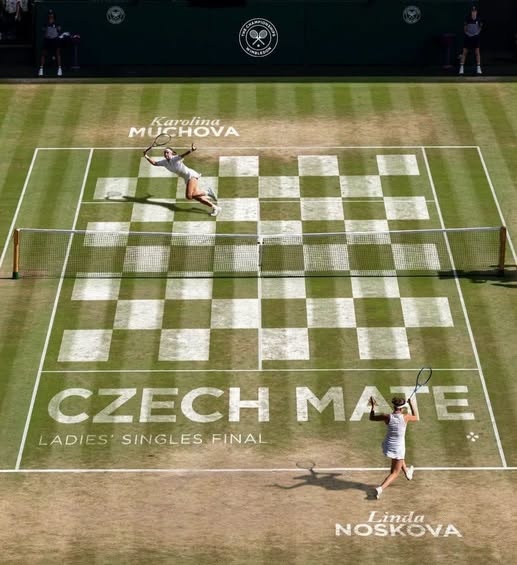
The Wimbledon Final: A Chess Match on Grass
Linda Nosková vs. Karolína Muchová – Where Every Shot Is a Strategic Decision
The 2026 Wimbledon Ladies' Singles Final is more than a battle of power and athleticism—it is a sophisticated chess match played at world-class speed. Every serve, return, slice, drop shot, and approach to the net represents a calculated move designed to expose an opponent's weakness.
Unlike recreational tennis, professional tennis at Wimbledon is a contest where players constantly solve problems under immense pressure. Every point is a new puzzle.
The all-Czech final between Linda Nosková and Karolína Muchová perfectly represents this concept.
Tennis Is Physical Chess
In chess, players think several moves ahead.
Elite tennis players do exactly the same.
Before serving they consider:
- Opponent's court positioning
- Previous return pattern
- Fatigue level
- Wind direction
- Grass court bounce
- Score pressure
- Psychological momentum
One serve can be planned three or four shots in advance.
A wide serve may simply be used to open the court for the next forehand winner.
Every rally is strategic rather than random.
Karolína Muchová: The Artist
Muchová plays one of the smartest tactical games on the WTA Tour.
Her strengths include:
- Exceptional variety
- Slice backhand
- Drop shots
- Net approaches
- Court intelligence
- Tactical serving
- Ability to change rally rhythm
She constantly forces opponents to think instead of simply hitting harder.
Her goal is to disrupt rhythm.
Linda Nosková: Controlled Aggression
Nosková represents modern power tennis.
Her strengths include:
- Big first serve
- Heavy forehand
- Flat backhand
- Aggressive baseline positioning
- Early ball striking
- High pace during rallies
Instead of confusing opponents with variety, she attempts to dominate them through relentless pressure.
Why This Match Resembles Chess
The player who successfully controls these areas usually wins:
Opening
Like chess openings.
The first four shots establish control.
- Serve placement
- Return depth
- Court positioning
Winning the opening often wins the rally.
Middle Game
Now adjustments begin.
Questions include:
- Attack crosscourt?
- Change direction?
- Use slice?
- Move opponent forward?
- Attack second serve?
This stage separates elite players from good players.
End Game
Pressure becomes enormous.
Break points.
Set points.
Championship points.
Mental strength often determines who executes the final move.
Physical Battle
Elite tennis demands extraordinary physical qualities.
Both finalists must maintain:
- Explosive acceleration
- Sprint speed
- Lateral movement
- Balance on grass
- Core stability
- Shoulder endurance
- Leg strength
- Recovery between points
A three-hour Wimbledon final may involve hundreds of explosive movements.
The Mind Game
The psychological battle is equally important.
Players continually ask themselves:
- Should I attack?
- Should I defend?
- Is she expecting a wide serve?
- Should I surprise with a body serve?
- Will she anticipate my backhand?
These split-second decisions determine championships.
Why Linda Nosková May Have a Slight Statistical Edge
Although Muchová defeated Nosková in their only previous meeting (US Open 2025), 7–6, 4–6, 6–2, their overall head-to-head remains limited at 1–0, making it difficult to draw strong conclusions. Their Wimbledon final is their first meeting on grass.
From a tactical perspective, Nosková may hold a slight advantage if she can consistently execute the following:
1. Bigger First Serve
A high first-serve percentage creates more free points and short rallies.
Projected target:
- 65–70% first serves in
2. More Winners
Nosková's aggressive style can produce:
- 30–40 winners
provided she keeps unforced errors under control.
3. Shorter Points
Grass rewards first-strike tennis.
If rallies remain under five shots, Nosková benefits.
4. Physical Freshness
Aggressive tennis conserves energy by shortening rallies, which can be crucial deep into a Grand Slam final.
5. Mental Confidence
If Nosková establishes an early lead, her confidence may allow her to play more freely and dictate play.
Where Muchová Can Turn the Match
Muchová's path to victory relies on disrupting Nosková's rhythm through:
- Slice backhands
- Drop shots
- Frequent changes of pace
- Net approaches
- Wide serving patterns
- Longer, tactical rallies
Rather than trying to overpower Nosková, Muchová will likely seek to make her uncomfortable and force lower-percentage shots.
Projected Match Statistics
| Category | Linda Nosková | Karolína Muchová |
|---|---|---|
| First Serve % | 68% | 64% |
| Aces | 8–12 | 4–7 |
| Winners | 34–40 | 24–30 |
| Unforced Errors | 20–28 | 16–22 |
| Net Points Won | 65% | 72% |
| Break Points Converted | 42% | 45% |
| Average Rally Length | 4–5 shots | 6–8 shots |
These are analytical projections, not official match statistics.
Expert Tactical Assessment
This Wimbledon final is likely to be decided not by raw power alone but by who controls the balance between aggression and patience.
- If Linda Nosková serves well, keeps points short, and strikes cleanly off both wings, she has a realistic chance to overpower her opponent.
- If Karolína Muchová succeeds in varying pace, extending rallies, and drawing Nosková into uncomfortable positions, her tactical versatility could prove decisive.
In the end, this all-Czech championship is a contest of both mind and body—a chess match played at full speed on grass, where every point is a calculated move and every adjustment can shift the momentum toward the Wimbledon title.