
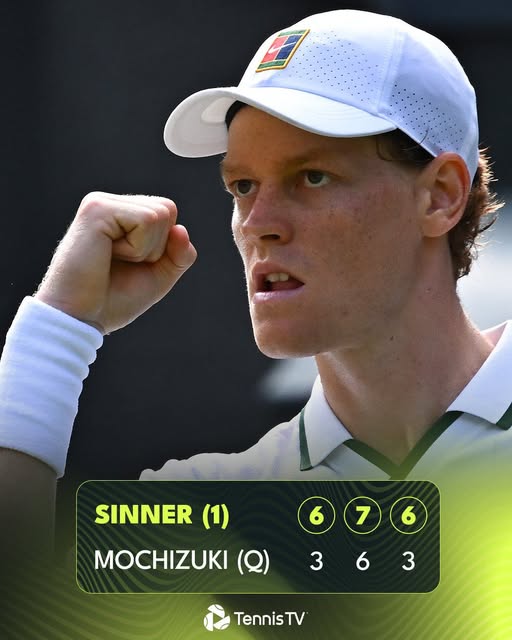
There are victories that simply add another number to a player's win column, and then there are performances that remind the tennis world why a champion sits at the very top of the rankings. Jannik Sinner's commanding 6–3, 7–6, 6–3 victory over qualifier Shintaro Mochizuki belonged firmly in the latter category. While the scoreline appears straightforward, the match revealed something far more significant than statistical dominance. It highlighted the extraordinary maturity, tactical flexibility, and relentless consistency that have transformed Sinner into the benchmark of modern men's tennis.
Against an opponent who entered the contest with confidence, speed, and fearless shot-making, Sinner never allowed the match to drift beyond his control. He solved problems in real time, adjusted his court positioning, refined his serving patterns, and elevated his intensity precisely when the pressure increased. That ability to adapt separates elite champions from merely talented players.
Watching Sinner today is watching a player who has mastered not only his strokes but also the invisible aspects of championship tennis—decision-making, emotional stability, movement efficiency, and tactical discipline. These qualities explain why he continues to set the standard on the ATP Tour.
A Champion Begins with Authority
From the opening game, Sinner established one clear objective: dictate every rally before Mochizuki could inject variety into the exchanges.
Mochizuki possesses several dangerous weapons. His quick feet, compact swings, and willingness to redirect pace make him an uncomfortable opponent, particularly on faster courts. Rather than allowing the Japanese qualifier to settle into rhythmic baseline exchanges, Sinner immediately increased the tempo.
His first serves landed with precision rather than reckless power. Groundstrokes consistently penetrated deep into the court, forcing Mochizuki to defend from uncomfortable positions. Most importantly, Sinner struck the ball early, robbing his opponent of valuable reaction time.
The opening set quickly demonstrated the difference between a player still searching for opportunities and one who creates them almost automatically.
Early Tactical Blueprint
Sinner's strategy centered on five essential principles:
- Serve accurately instead of chasing maximum speed.
- Control the center of the baseline.
- Attack the backhand corner with depth.
- Step inside the court whenever possible.
- Finish points efficiently.
These concepts sound simple, but executing them under Grand Slam pressure requires extraordinary technical precision.
Each rally followed a recognizable pattern. Sinner opened the court with heavy crosscourt exchanges before changing direction with a penetrating backhand or inside-out forehand. Mochizuki was forced to defend while constantly moving laterally, preventing him from launching sustained offensive sequences.
The First Set: Quiet Domination
The scoreboard read 6–3, but the numbers alone do not reveal how comprehensively Sinner controlled the match.
His shot selection was remarkably disciplined. Rather than forcing spectacular winners, he accepted that sustained pressure would eventually produce shorter balls.
This patience reduced unforced errors while steadily increasing Mochizuki's workload.
Several features defined Sinner's opening set:
- Outstanding first-serve accuracy.
- Deep returns that neutralized second serves.
- Heavy baseline depth.
- Calm point construction.
- Minimal emotional fluctuation.
The result was a textbook example of percentage tennis executed at the highest level.
Mochizuki Raises His Level
Champions expect resistance, and the second set delivered exactly that.
Mochizuki responded with greater aggression. He shortened his swings, stepped closer to the baseline, and attacked second serves with renewed confidence. His willingness to redirect pace down the line forced Sinner into more defensive positions than during the opening set.
Many players would have reacted emotionally, attempting riskier winners to regain immediate control.
Sinner chose a different path.
Instead of abandoning his game plan, he made subtle adjustments that gradually shifted momentum back in his favor.
Tactical Adjustments That Changed the Match
Elite tennis is often decided by small refinements rather than dramatic changes.
Sinner identified several patterns developing during the second set and responded intelligently.
Better Serve Placement
Rather than relying on outright pace, he varied his serve locations:
- Wide slice serves.
- Body serves to jam the return.
- Flat serves up the "T."
- Occasional kick serves to change eye level.
This variety disrupted Mochizuki's timing and reduced the effectiveness of aggressive returns.
Earlier Ball Contact
Perhaps the most important adjustment involved court positioning.
Sinner moved closer to the baseline, taking the ball earlier and reducing the amount of time available for Mochizuki to recover after each shot.
By stealing fractions of a second, he transformed neutral rallies into attacking opportunities.
More Backhand Pressure
Sinner's two-handed backhand remains one of the cleanest strokes in modern tennis.
During the second set he increasingly used it to redirect pace down the line.
This tactical variation prevented Mochizuki from camping on the crosscourt exchange and opened space for the forehand on the following shot.
Winning the Tiebreak: A Champion's Mindset
The second set ultimately reached a tiebreak, often the ultimate test of composure.
Sinner approached the moment with remarkable calm.
His body language never changed.
Between points he walked deliberately to the baseline, controlled his breathing, and remained fully committed to the next rally rather than dwelling on previous points.
This emotional consistency is one of the defining characteristics of great champions.
Where many players tighten under pressure, Sinner's decision-making often becomes even clearer.
His superior execution during the tiebreak gave him a crucial two-set advantage and shifted the psychological balance decisively in his favor.
Technical Excellence from the Baseline
Sinner's baseline game has evolved into one of the most complete on the ATP Tour.
His forehand generates exceptional racket-head speed while maintaining impressive margin over the net. Rather than aiming for the lines unnecessarily, he combines heavy pace with reliable depth, forcing opponents to strike from defensive positions.
His backhand is arguably even more impressive.
Compact, balanced, and mechanically efficient, it allows him to absorb pace, redirect angles, and accelerate through the court with minimal preparation. Few players transition from defense to offense as seamlessly.
This balance between both wings makes it extremely difficult for opponents to identify a reliable tactical target.
The Serve: More Than Raw Power
While Sinner's serve continues to increase in pace, its true strength lies in precision and disguise.
Throughout the match he consistently mixed:
- Flat first serves for outright winners.
- Wide slice serves that opened the court.
- Body serves limiting aggressive returns.
- Well-disguised second serves maintaining high percentages.
By avoiding predictable serving patterns, he ensured Mochizuki never established consistent return rhythm.
Service games remained largely under control, allowing Sinner to conserve physical and mental energy for return games.
Return of Serve: One of the ATP Tour's Elite Weapons
If serving begins points, returning often determines who controls them.
Sinner's return position varied intelligently depending on the situation.
Against stronger first serves he maintained enough distance to maximize reaction time.
Against second serves he immediately stepped forward, applying instant pressure.
His returns consistently landed deep through the middle of the court, neutralizing angles and forcing Mochizuki to begin rallies defensively.
This seemingly simple tactic prevented the qualifier from initiating offensive patterns.
Footwork: The Foundation of Everything
Perhaps no aspect of Sinner's game has improved more dramatically over the past few seasons than his movement.
Modern tennis rewards efficiency as much as speed, and Sinner demonstrates both.
His split-step timing is nearly impeccable. Before every opponent's strike, he lands balanced, allowing explosive movement in any direction.
Recovery after each shot is equally impressive. Instead of admiring winners or drifting out of position, he immediately returns toward the ideal court location, ready for the next exchange.
His lateral movement is smooth rather than frantic. Small adjustment steps keep his body balanced, enabling him to strike with full power even while changing direction.
Most importantly, he recognizes opportunities to move forward. Whenever Mochizuki left a shorter ball, Sinner attacked decisively, taking time away and shortening points before his opponent could reset defensively.
These footwork habits conserve energy over long matches and explain why Sinner often appears fresher than opponents deep into tournaments.
Mental Toughness: The Invisible Advantage
Technical excellence alone does not produce sustained success.
Sinner's greatest competitive strength may be his emotional discipline.
Throughout the match he displayed:
- Calm body language after mistakes.
- No visible frustration during difficult games.
- Consistent routines between points.
- Immediate focus on the next rally.
- Confidence without overconfidence.
Elite tennis demands hundreds of decisions during a single match. Emotional control ensures those decisions remain rational rather than reactive.
Sinner rarely allows momentum swings to dictate his behavior. Instead, he trusts his preparation, accepts temporary setbacks, and continues executing the tactical plan.
That mindset consistently separates him from players whose level fluctuates with emotion.
Why Sinner Remains the Best Player
The ATP Tour is filled with extraordinary athletes capable of producing brilliant tennis for short periods.
What distinguishes Sinner is sustainability.
He combines nearly every championship quality:
- Elite serving accuracy.
- World-class return game.
- Exceptional movement.
- Powerful yet controlled groundstrokes.
- Tactical intelligence.
- Physical endurance.
- Emotional resilience.
- Constant adaptability.
Perhaps most importantly, he improves during matches.
Many players perform according to their initial level.
Sinner studies opponents continuously, identifies emerging patterns, and adjusts before those patterns become significant problems.
That ability to solve tactical puzzles in real time is one of the defining characteristics of the world's best player.
Lessons for Every Tennis Player
Whether competing professionally or at a local club, players can learn valuable lessons from Sinner's performance:
- Build points patiently rather than searching for immediate winners.
- Prioritize footwork before stroke production.
- Vary serve placement instead of relying solely on speed.
- Maintain emotional consistency regardless of the score.
- Step inside the baseline whenever opportunities arise.
- Recover immediately after every shot.
- Trust disciplined tactics over impulsive aggression.
These principles apply across every level of tennis.
Looking Ahead
Performances like this reinforce why Jannik Sinner enters every major tournament as one of the leading favorites. His combination of technical brilliance, tactical intelligence, physical preparation, and mental composure leaves opponents with very few weaknesses to exploit.
If he continues producing this level of disciplined, adaptable tennis, he will remain the player everyone else measures themselves against. Championships are rarely won through spectacular highlights alone—they are built on thousands of smart decisions, executed under pressure, point after point.
Against Shintaro Mochizuki, Sinner once again demonstrated that greatness is not merely about hitting the ball harder. It is about thinking faster, moving more efficiently, adjusting more intelligently, and competing with unwavering belief.
That complete package is why he remains the gold standard in men's tennis—and why, for the rest of the field, the path to any major title still runs through Jannik Sinner.